
A three-touch review sequence is three short messages, sent after a finished job, that ask the customer for a Google review. Touch one is a quick ask while the work is fresh. Touch two is a gentle reminder for people who meant to do it and forgot. Touch three is a last, low-pressure nudge. Then you stop. Done by hand, it falls apart the first busy week. That is why we built the three-touch review request engine into Quotewren: it texts your customer after the job so the follow-up happens whether or not you remember.
TL;DR
- Three touches is enough: a same-day text, a reminder a few days later, and one final nudge about a week after that. After the third, stop.
- Send the first ask when the customer is happiest, usually the day the work is done.
- Every customer gets the same message. No filtering out unhappy customers, no gifts, no discounts in exchange for a review.
- Keep each message to two or three sentences with one direct Google link.
- Check results by counting new reviews per ten finished jobs, not by gut feel.
Table of Contents
- Why three touches and not one
- The three-touch timeline at a glance
- Touch 1: Ask while the work is fresh
- Touch 2: The friendly reminder
- Touch 3: One last nudge, then stop
- Keep it legal: no gating, no gifts, no quotas
- Making each message quick to act on
- Examples by trade
- How to tell whether it is working
- When to stop the sequence
- Where this fits in your quote-to-review routine
- Our view: automate the follow-up, keep the personal touch
- Put the sequence on autopilot
- FAQ
- Sources
Why three touches and not one
Most happy customers do not say no to a review. They just get busy. The homeowner whose water heater you swapped at 4 p.m. has kids, dinner and a phone full of other messages. One ask is easy to lose. Ten asks feel like nagging, and a customer who feels nagged may leave you a worse review than the one you were hoping for.
Three touches sit in the middle. The first catches the people who are ready right now. The second catches the people who were busy. The third gives a last chance and then lets the customer be. That is the whole idea, and it does not need a marketing degree.

Why bother? Reviews are a big part of how local customers pick a plumber, an electrician or a lawn crew. When someone searches "HVAC repair near me," the business with fresh, steady Google reviews looks safer than the one with a few reviews from years ago. A sequence turns reviews from something you hope for into something that happens after every job. For more on the local search side, see our post on reviews and local SEO for solo tradespeople.
The three-touch timeline at a glance
Use this as a starting point. Adjust it to your trade, then keep it the same for every customer.
| Touch | When | Channel | Goal | Sent to |
|---|---|---|---|---|
| 1. The ask | Same day, a few hours after the job, or the next morning for emergency calls | Text | Catch the customer while the work is fresh | Every completed customer |
| 2. The reminder | About 3 to 4 days later | Text | Remind people who meant to do it | Only customers who have not reviewed yet |
| 3. The last nudge | About a week after touch 2 | Text (or email if you have no number) | One final, easy chance | Only customers who have not reviewed yet |
These gaps are our suggested starting rhythm, not a rule from Google or any agency. If you want more on timing by job type, we cover it in the best time to ask for reviews after a job.
Touch 1: Ask while the work is fresh
The best moment is when the customer is happiest. For a plumber who stops a leak, that is when the water stops dripping. For a cleaner, it is when the customer walks into a spotless kitchen. Asking too early, before they have seen the finished work, gets a lukewarm answer. Asking a week later, the moment is gone.
Here are timing ideas by job type:
- Same-day repairs (a faucet, an outlet, a garbage disposal): a few hours after you leave.
- Emergency calls (a burst pipe, no heat in January): the next morning. Nobody wants a review request while the basement is still wet.
- Bigger installs (a furnace, a panel upgrade, a new deck): that evening, once they have lived with it for a few hours.
- Multi-day projects: at the final walkthrough, then the evening text.
- Recurring work (lawn care, house cleaning): after the first visit or two, not after every single visit.
What touch 1 should say
Keep it short, personal and easy. Use the customer's first name, say what you did, and give one link.
Hi Maria, this is Dan from Dan's Plumbing. Thanks for having us fix your kitchen sink today. If you have 30 seconds, an honest Google review really helps a small business like ours: [link]
Three things make this work:
- A first name and the job. It reads like a person wrote it, because a person did.
- "Honest." You are asking for the truth, not for five stars.
- One direct link. If the customer has to search for your business on Google, many will quit. The link should open straight to your review box. Our write-up on cutting friction to get more Google reviews goes deeper on this.
Note the word "text." Text messages get read fast, which is why we default to SMS. Texting customers for business purposes has its own rules in the US, so read our guide to whether SMS review requests are legal before you start.
Touch 2: The friendly reminder
A few days later, check who has not left a review. Only those people get touch 2. Someone who already reviewed should never get a reminder. That is the quickest way to annoy a happy customer.
The angle should change. Touch 1 was "how did we do?" Touch 2 is "this takes almost no time."
Hi Maria, Dan again. If you haven't had a chance yet, a quick Google review takes about a minute and helps neighbors find a plumber they can trust: [link]. Thanks either way.
"Thanks either way" matters. It tells the customer there is no pressure and no hard feelings. It also keeps you on the right side of the rules, which we get to below.
If you have the customer's email but the text did not seem to land, an email is a fine channel for this touch. Email gives you room to remind them of the job, such as "the water heater we installed on Tuesday," which jogs memory.
Touch 3: One last nudge, then stop
About a week after touch 2, send one more. Make it the shortest of the three.
Hi Maria, last note from me. If you're happy with the sink repair, a Google review would mean a lot: [link]. If something wasn't right, reply here and I'll make it right. Thanks for choosing us.
That last line is worth a closer look. It gives a customer who was not fully happy an easy way to talk to you directly. That is good customer service. But it must be offered to everyone, in every message, at the same time. It must never be a gate that decides who sees the Google link.
After touch 3, the sequence ends. No touch 4. No "just checking in again" a month later. A customer who ignored three polite asks has given you their answer. The sequence stops, and you move on to the next job.
Keep it legal: no gating, no gifts, no quotas
This part is not optional, and it is where well-meaning contractors get in trouble.
Do not filter who gets the link
Review gating means asking customers "how was your experience?" first, then sending only the happy ones to Google. Do not do it. The FTC's rule on consumer reviews and testimonials, 16 CFR Part 465, took effect in October 2024. It covers fake reviews, buying reviews, and certain practices that suppress or hide honest reviews. Our own post on review gating rules for solo tradespeople explains how this plays out for a small shop.
The simple way to stay clean: send the same message with the same link to every finished customer.
Do not offer anything in exchange
No "$10 off your next visit if you leave a review." No free drain cleaning. No raffle entry. Google's Maps user-generated content policy is the rulebook for what can appear on your listing, and it does not allow trading perks for reviews. The safe plan is to ask, say thanks, and move on. For a plain-English look at Google's current rules, including review kiosks, read our Google review policy post.
Do not pressure staff or customers
If you have a helper or a small crew, do not set review quotas, and do not tell customers to name your techs in their reviews. Do not ask for reviews while standing in someone's kitchen with a phone in your hand. Send the text after you leave. A contractor-focused walkthrough on getting Google reviews as a contractor without begging covers similar ground on keeping the ask honest.
None of this is legal advice. If you are unsure about a specific wording or offer, ask a business attorney in your state.
Making each message quick to act on
The goal is a review in under a minute. Here is a checklist for every message:
- Under 40 words if you can. Longer texts get skimmed.
- One link, one request. Do not also ask for a referral, a Facebook like and a survey.
- Your name and business name. Customers should know who is texting.
- A real person's tone. "Thanks for having us out" beats "Your feedback is valuable to us."
- A direct Google review link. Test it on your own phone once. If it opens a blank page, fix it.
- A way to opt out. Follow the texting rules in our SMS guide.
And a few don'ts:
- Don't write "please leave us 5 stars." Ask for an honest review.
- Don't send at 10 p.m. A reasonable daytime or early evening hour is better.
- Don't send to a customer who is in a dispute with you. Sort out the dispute first.
Examples by trade
Plumber, same-day repair. Touch 1 goes out around dinner time on the day you replaced the toilet fill valve. Touch 2 goes out four days later. Touch 3 goes out the next week.
HVAC tech, furnace install. Touch 1 goes that evening, after the house has warmed up. Touch 2 goes out after a few days. Touch 3 goes out a week later, and it can mention the new system by name: "your new furnace."
Electrician, panel upgrade. Customers rarely feel anything dramatic about a panel, so the first ask works best the next day after power has been steady. Mention the work specifically: "the panel upgrade last Thursday."
Landscaper, spring cleanup. Ask after the first visit once the yard looks good, with a photo of the finished yard if you have one. Do not send a sequence after every weekly mow.
House cleaner, deep clean. Touch 1 goes out two or three hours after the visit, when the customer is home enjoying the result.
Handyman, small punch list. Touch 1 goes out when the last item on the list is checked. A handyman can use a free handyman quote template to spell out that list ahead of time, so the "done" moment is clear to everyone.

How to tell whether it is working
Don't guess. Track two numbers for a month.
- Reviews per ten completed jobs. If you finish 20 jobs and get 3 new reviews, that is 1.5 per ten. Write it down.
- Where the reviews come from. Notice whether most arrive after touch 1, touch 2 or touch 3. If touch 3 never produces anything, you might shorten the gap or drop it.
Then change one thing at a time. Try a different wording in touch 2. Try sending touch 1 a few hours later. Wait another ten jobs and compare. Changing everything at once teaches you nothing.
Also, read your reviews and respond to them, good and bad. A short, polite reply to every review shows future customers that a real owner is paying attention.
If you are just starting out, aim for your first handful of reviews before worrying about fine-tuning. Our 3-step plan for your first Google reviews shows how.
When to stop the sequence
Stop the sequence for any of these reasons:
- The customer leaves a review. Cancel the remaining touches right away.
- The customer replies with a complaint. Switch to a phone call and fix the problem.
- The customer says stop. Honor it immediately and do not text them again.
- You have sent three touches. The sequence is over.
At a small shop, the hard part is not writing the messages. It is remembering to send them when you are under a sink at 6 p.m. and then doing the paperwork at 9 p.m. The sequence only works if it runs the same way every time.
Where this fits in your quote-to-review routine
Reviews are the last step of a simple chain: quote, approval, job, invoice, review. If you skip a link, the chain gets weak. A clear quote avoids arguments over price. A prompt invoice gets you paid. And a customer who just paid easily is usually in a good mood, which is a good time to ask for a review. For the early part of that chain, our free HVAC quote template is a clean place to start.
It also helps to remember the difference between the documents. A quote is a fixed price you offer for defined work. An estimate is a rough guess that can change. A deposit is money paid up front to hold the job or cover materials. An invoice is the bill after the work is done. A review request is not a billing document at all, so keep it separate in your head and in your messages.
Our view: automate the follow-up, keep the personal touch
We built Quotewren for one kind of person: the owner-operator who does the work, writes the quote, sends the invoice and still has to chase reviews. Most contractors we talk about already know they should ask for reviews. The problem is not knowing, it is doing it every single time, on the days when the truck is loaded and the phone will not stop.
That is why the review sequence is built into the paid plans instead of sold as an add-on, and why it sits next to quoting and invoicing. The same finished job that becomes a quote and then an invoice can also trigger the three-touch request by SMS. You do not need a separate tool, a crew-sized system or a pile of features meant for companies with fleets.
Our advice is simple. Keep the messages short, keep them honest, send the same ask to everyone, and let the sequence handle the reminders. Late payments and thin reviews are two of the most common things that hold small trades businesses back, and both are about follow-up. Doing it automatically, at a flat monthly price, means the follow-up gets done.
jaras
Put the sequence on autopilot
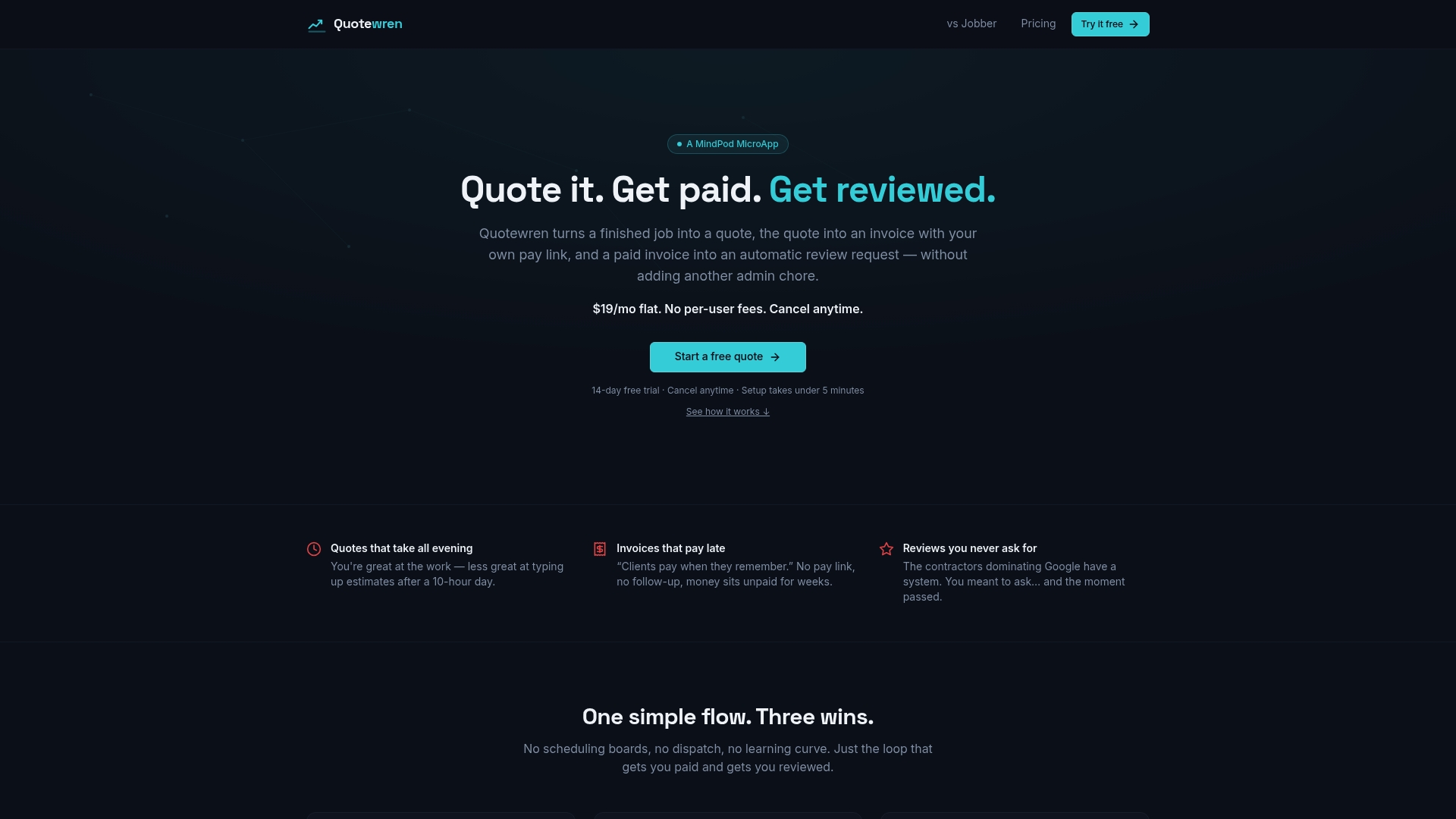
If you would like to stop thinking about review texts, Quotewren handles the three-touch SMS request after a job is complete. It also creates branded quotes and invoices with pay links, all built for solo tradespeople. You can start on the Free plan at $0, move to Quotewren at $19 per month, or choose Quotewren Crew at $39 per month. See the plans at Quotewren.
FAQ
How many review requests is too many?
Three is a good ceiling for one job. After the third request with no response, stop. More than that tends to feel like pressure, and it can turn a happy customer into an annoyed one.
Should I send review requests by text or email?
Text is usually the best first choice because people read texts quickly. Email works well for a reminder when you want to mention the specific job. Use whichever channel you have permission to use, and follow the US texting rules before you start.
Can I give a discount to customers who leave a review?
No. Google's policy does not allow offering something in exchange for a review, and the FTC rule bans incentives tied to positive sentiment. The safe approach is to ask, thank the customer and move on.
Can I only send the review link to customers who say they are happy?
No. That is review gating, and it is a bad idea for both legal and trust reasons. Send the same message to every finished customer, and invite anyone with a problem to contact you directly in the same message.
Do I need to send the sequence to every customer?
Send it to every customer whose job is complete, as long as they have not asked you to stop and are not in a dispute. For repeat work like weekly lawn care, ask once after the first visit or two instead of every time.
Sources
- FTC Trade Regulation Rule on the Use of Consumer Reviews and Testimonials (16 CFR Part 465)
- Google Maps user-generated content policy
- Get More Google Reviews as a Contractor (Without Begging)