
Yes, you can text a customer to ask for a review. In the US, it is legal when the customer gave you their number and agreed to get texts from you, you make it easy to stop them, and you ask everyone the same way without offering a reward. Skip any of those and you can run into trouble under federal law, state law, Google's rules, or all three.
This guide is for solo plumbers, electricians, HVAC techs, handymen, landscapers, cleaners and other owner-operators. It is plain-English guidance, not legal advice. If you have a specific problem, such as a demand letter or a lawsuit, talk to a lawyer who handles consumer protection or TCPA cases.
TL;DR
- Get a clear yes to texts before you send one. Ask on the quote, the work order or at the door, and save proof.
- Every text needs an easy way out. If a customer replies STOP, stop right away and keep them off your list.
- Ask every customer, not just the happy ones, and never pay or discount in exchange for a review.
- Keep records of when and how each customer agreed. Keep them for years, not weeks.
- Statutory damages for a bad text can run $500 to $1,500 per message, so a small habit now saves a big problem later.
Table of Contents
- The short answer: what makes a review text legal
- Is a review request a "marketing" text?
- Examples from real trade jobs
- Opt-outs: the part that trips up small shops
- Reminders, follow-ups and "blasting"
- Federal, state and carrier rules all apply
- Review rules: who you ask and what you offer
- What happens if you get it wrong
- Keep records you can pull up in two minutes
- Your step-by-step setup
- Our view: keep it simple and keep it honest
- Put it on autopilot
- FAQ
- Sources
The short answer: what makes a review text legal
Three federal laws and rules matter most to a small trade business: the Telephone Consumer Protection Act (TCPA), the carriers' own texting rules, and the FTC's rule on fake reviews. State laws sit on top of those.
The TCPA is the one that gets businesses sued. Consumer Action's small business guide says you must get the required consent before sending texts the law covers. The kind of consent depends on what the message is. A plain job-related message needs less than a sales pitch.
Here is the practical version for a contractor:
- The customer gave you their mobile number.
- They agreed to get texts from you, and you can show it.
- Your text says who you are and what you want.
- It tells them how to stop.
- You honor a stop request fast.
- You ask for an honest review, with no strings attached.
If you can check all six, you are in good shape.
Is a review request a "marketing" text?
This is where people get stuck. The TCPA treats texts differently depending on their purpose. A NatLawReview summary of the rules explains that marketing texts sent with an auto-dialing system need express written consent. Informational or transactional texts need express consent, and that consent is generally presumed when a customer gives you their number for a purpose closely related to the text.
So a text saying "Your tech is on the way" is easy. A text saying "Thanks for having us out today, would you leave us a review?" sits in a gray area. It is tied to a job you just did, but it also helps you get more business. Lawyers can argue both ways.
The safe move for a solo tradesperson is simple: treat a review request like a marketing text. Get a clear, written yes. That one habit removes the argument.

What "written" consent looks like on the job
Written does not mean a notarized form. It can be a checkbox, a signature or a typed reply. Good places to collect it:
- On your quote. Add a line near the signature: "I agree to get text messages from [Your Business] about this job, including a request for a review. Reply STOP anytime to opt out. Message and data rates may apply."
- On your work order or intake form. Same line, same checkbox.
- On your booking page or web form. Add an unchecked box the customer ticks on their own.
- By text. Send a short first message and ask them to reply YES. Save the reply.
Two things to avoid. Do not pre-check the box for them. Do not make agreeing to texts a condition of getting the work done.
We wrote a longer walkthrough on SMS opt-in requirements for trades if you want the checklist version.
Examples from real trade jobs
Plumber, emergency call. A homeowner calls at 9 p.m. about a burst pipe. You get their number from the call. They never signed anything. Before you text a review request, ask on site: "Is it OK if I text you the invoice and a quick review link?" Then note it on the job. Better yet, put it on the invoice or work order they sign.
Electrician, panel upgrade. You send a quote by text. The customer taps approve. Your quote has the consent line at the bottom. Approval now doubles as a record that they agreed to texts about the job.
Landscaper, repeat lawn clients. You have fifty regulars whose numbers you have had for years. You never asked about texts. Do not blast all fifty. Send a short message asking if they are OK getting texts from you, and only text reviews to the ones who say yes.
House cleaner, a client who only emails. Some people never give you a mobile number. Email them instead, or hand them a review link QR code at the end of the visit. They choose to scan it, so you are not sending a text at all.
Opt-outs: the part that trips up small shops
Every text should give the customer a way to stop, and you have to honor it quickly.
Consumer Action's guide says businesses should have an automated opt-out method, keep an internal do-not-call list, and honor revocations within 10 business days. The FCC's 2024 final rule, published in the Federal Register, says customers can revoke consent in any reasonable way. It also treats replies like stop, quit, end, revoke, opt out, cancel and unsubscribe as reasonable requests to stop.
What that means for you:
- End every review text with "Reply STOP to opt out."
- If someone says "stop texting me" in any form, put them on your do-not-text list the same day.
- If they call you and say stop, that counts too. Write it down.
- Never send "just one more" after they opt out.
- Do not argue by text. A reply like "Understood, you will not hear from us again" is fine, and the guide notes one confirmation text is allowed shortly after.
Example message
"Hi Maria, this is Dave from Dave's Plumbing. Thanks for letting us fix your water heater today. If you have a minute, a Google review helps a lot: [link]. Reply STOP to opt out."
That text names you, names the job, makes one clear ask and gives the way out. It does not promise anything in return. Keep it that short.
Reminders, follow-ups and "blasting"
One text after a job is a normal customer message. A pattern of repeated, untargeted messages is where it starts to look like marketing blasting.
You cross the line when you:
- Text a list of old customers who never agreed to texts.
- Buy or scrape a list of numbers.
- Add a sales offer to the review text, such as "Book your spring tune-up now, 20% off."
- Keep texting people who ignored you with no end point.
- Text at odd hours. Stick to normal daytime hours in your customer's time zone.
A limited follow-up is fine when the customer agreed to it. Our own review flow uses three touches by SMS after a job is done, spaced out and stopping as soon as the customer leaves a review or opts out. Three polite asks, then you are done. We cover the timing in our three-touch review flow for service-area businesses.
Federal, state and carrier rules all apply
The TCPA is not the only rulebook. The NatLawReview summary points out that states have separate rules, and that Florida and Oklahoma define an auto-dialer more broadly than the federal law does. If you work in more than one state, or near a state line, check your state attorney general's website for texting rules before you set up your flow.
Carriers add their own layer. Regular business texting from standard 10-digit numbers usually has to be registered with the carriers, a process known as A2P 10DLC, and unregistered traffic can get blocked. If you use texting software, the software provider normally handles that registration. Ask how it is handled before you send your first message.

Carrier and legal rules reward the same behavior: clear consent, a clear sender, a clear way out.
Review rules: who you ask and what you offer
A review text can be fully TCPA-compliant and still break the rules about reviews.
Ask everyone, not just the happy ones
The FTC's 2024 rule on fake reviews bans review suppression, such as threatening or intimidating people to stop or remove a negative review. It also bans claiming that the reviews on your page show all or most reviews when bad ones were suppressed. You can read the details in the FTC announcement.
Google's policies also frown on review gating, which means screening customers first and only sending the happy ones to Google. The easy fix is to send the same message to every customer. Our post on review gating rules for solo tradespeople goes deeper, and our Google review policy guide covers what Google allows today.
Do not pay for reviews
The same FTC rule prohibits offering compensation or other incentives that depend on a review saying something positive or negative. A "leave us 5 stars and get $20 off" text is out. Even "leave a review and get entered to win" is risky. Say thank you in the message, and leave it there. If you want to cut the effort for customers instead of paying them, reduce the friction with a direct link.
Show reviews honestly
Real reviews are the point. If you use customer reviews on your website or flyers, show real ones. For ideas on doing that well, see these social proof examples for local customers. And if a fake or unfair review shows up, our checklist for removing fake reviews walks you through the proof Google wants.
What happens if you get it wrong
The TCPA lets a person sue for actual money lost or $500 per violation, whichever is greater. If a court finds the violation was willful or knowing, it can raise the award up to $1,500 per violation. That figure comes from a law review article on the TCPA, which also notes that class actions can pile these amounts up fast.
For a one-person shop, that is the reason to keep it boring. A short text, a signed yes, and a fast opt-out are cheap. A demand letter is not.
Keep records you can pull up in two minutes
If a customer says "I never agreed to texts," you want to answer with proof. Consumer Action advises keeping detailed records of when and how consent was obtained, the date, time and content of texts, and when and how someone opted out. It recommends keeping them for five years.
For each customer, save:
- Name and mobile number
- Date and how they agreed (signed quote, checkbox, text reply)
- A copy of the wording they agreed to
- The review text you sent and when
- Any opt-out and the date you honored it
A spreadsheet works. So does keeping it all attached to the job in your quoting tool.
Your step-by-step setup
- Add a consent line to your quote, work order or invoice.
- Collect the mobile number and save the yes with the job.
- Finish the job, then send the invoice.
- Send one short review text the same day or next morning. Timing matters for results, which we discuss in why asking within hours helps local SEO.
- Send at most two gentle reminders if there is no reply.
- Stop the moment they review, say stop or reply with any clear opt-out.
- Log everything.
If you want to see what typical response looks like, our post on SMS review requests for tradespeople covers the numbers and the wording.
Our view: keep it simple and keep it honest
We built Quotewren for people who run the truck, answer the phone and send their own bills. Most of you do not have time to read a legal brief, and you should not need to.
Our view is that good review habits and legal habits are the same habits. Ask after the job is done. Ask everyone. Be clear about who is texting. Make stopping easy. Keep a record. A tool should make that the default, not something you have to remember at the end of a long day.
That is why we focus on quoting, invoicing and review requests in one place, and not on features built for big crews. When a quote turns into an invoice and then into a review request, the customer's job history stays together, and so does your paper trail.
We are not lawyers, and nothing here replaces one. But we have seen how much simpler review collection gets when the steps are small and built in.
jaras
Put it on autopilot
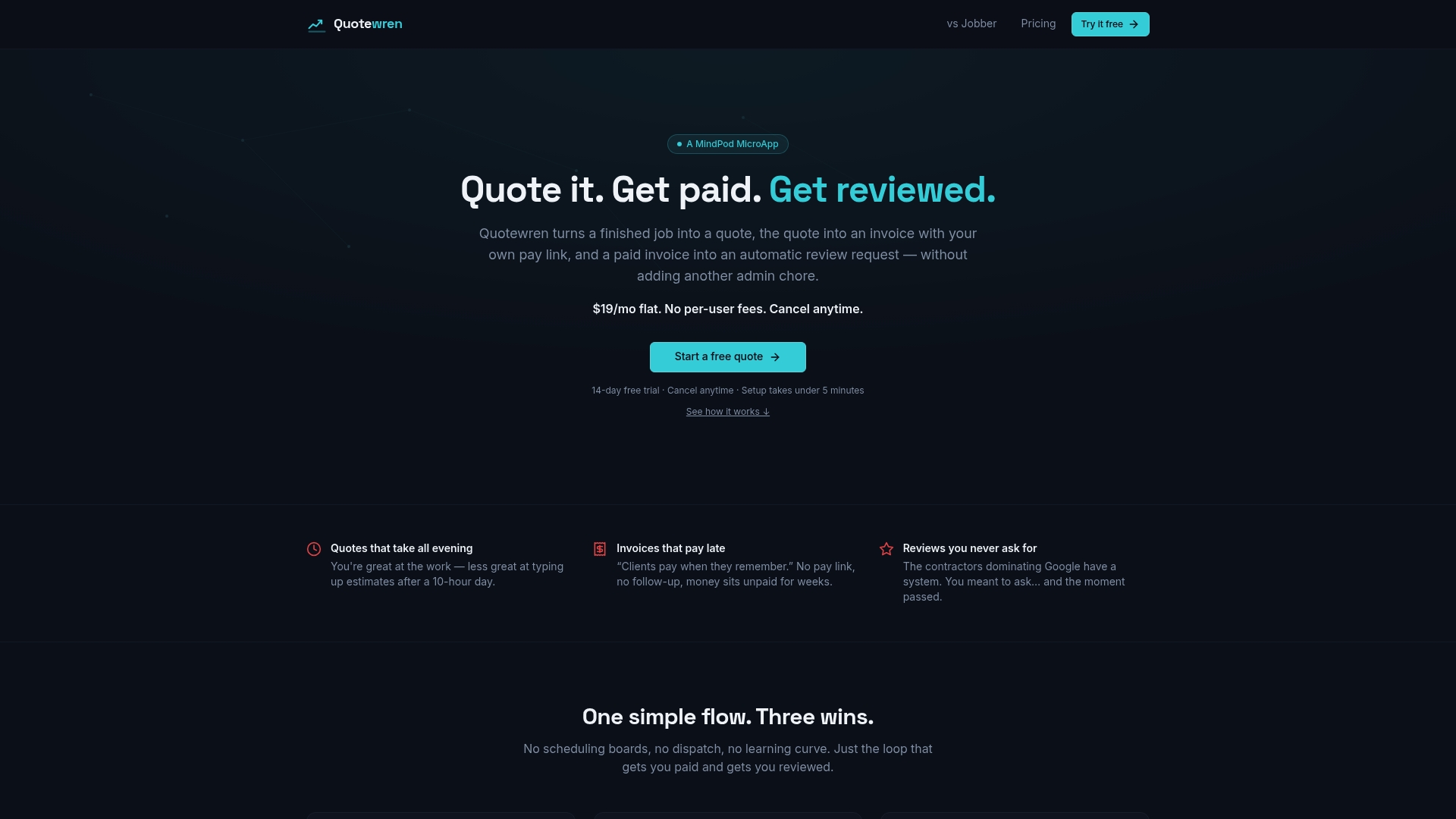
Quotewren turns a finished job into a quote, then an invoice, then a text review request, so you are not typing the same message from your truck every night. Every paid plan includes the review requests, which go out as a three-touch SMS sequence after the job is complete. The Free plan lets you try it with a limited number of documents, the Quotewren plan is $19 per month, and Quotewren Crew is $39 per month. You can see the details on the Quotewren pricing page or start free.
Whatever tool you use, add the consent line to your quotes first. If you need a starting point, our free quote templates for trades are printable and easy to adjust.
FAQ
Can I text customers for reviews without their permission?
The safest answer is no. Get a clear yes to texts before you send a review request, and save proof. Federal rules require the right kind of consent before covered texts, and some states add more requirements.
Is it illegal to ask for reviews?
No. Asking for honest reviews is normal and allowed. What is not allowed is paying for reviews, hiding or suppressing bad ones, or posting fake ones. Ask every customer the same way.
Can a customer sue me over a review text?
Yes, under the TCPA, a person can sue for $500 per violation or their actual loss, whichever is greater. If a court finds it willful or knowing, the award can rise to $1,500 per violation. Consent, a clear opt-out and good records are your best protection.
What should I do when a customer replies STOP?
Stop texting them right away and add them to your do-not-text list. Common words like stop, cancel, end, quit and unsubscribe all count. The FCC says you must honor a request within 10 business days at the latest, but doing it the same day is easier and safer.
Can I offer a discount for a review?
No. The FTC rule prohibits offering compensation or incentives tied to the writing of reviews. Thank customers sincerely and make leaving a review quick instead.
Sources
- Consumer Action: A Small Business's Guide to the Telephone Consumer Protection Act
- NatLawReview: Text Messages and the TCPA
- Federal Register: FCC final rule on revocation of consent, March 5, 2024
- FTC: Final rule banning fake reviews and testimonials
- Does the Telephone Consumer Protection Act Violate Due Process? (Florida Law Review)
- Social proof examples that win local customers