

Yes, customer reviews are one of the fastest, highest-leverage ways for a local business to improve local search visibility. Google weighs review volume, recency, and text alongside owner replies when it ranks the local pack. Start today with a two-minute audit: check the review counts and star ratings of the top three businesses in your trade and zip code, then set a monthly goal to close that gap.
TL;DR:
- Recency and steady review velocity are more impactful for local ranking than sheer review volume once you reach local competitor levels.
- Reviews with detailed service mentions, location keywords, and photos contribute significantly to relevance and trust signals for Google.
- Prioritizing owner responses and encouraging prompt, specific requests after each job are low-effort ways to boost visibility and engagement.
- Avoid manipulative tactics like review gating or incentivizing; authentic, natural reviews safeguard your profile and improve long-term ranking.
- Automating review prompts within four hours of job completion ensures higher response rates and helps maintain a steady review growth rate.
Table of Contents
- Why Reviews Matter for Local SEO Right Now
- The Review Signals That Actually Move the Needle
- How to Collect More Google Reviews Ethically
- How to Reply to Reviews (Positive and Negative)
- Spotting Fake Reviews and Avoiding Policy Violations
- Measuring Progress and Setting Realistic Targets
- Do Reviews on Yelp and Facebook Matter Too?
- Putting Reviews Into Your Local SEO Content
- Reviews and Your Local Pack Ranking
- Getting Authentic Reviews From More Than One Platform
- Reading Review Trends to Guide Your Strategy
- Treat Review Collection as Part of Finishing the Job
- How Quotewren Turns This Playbook Into a Habit
- Sources
- FAQ
Why Reviews Matter for Local SEO Right Now
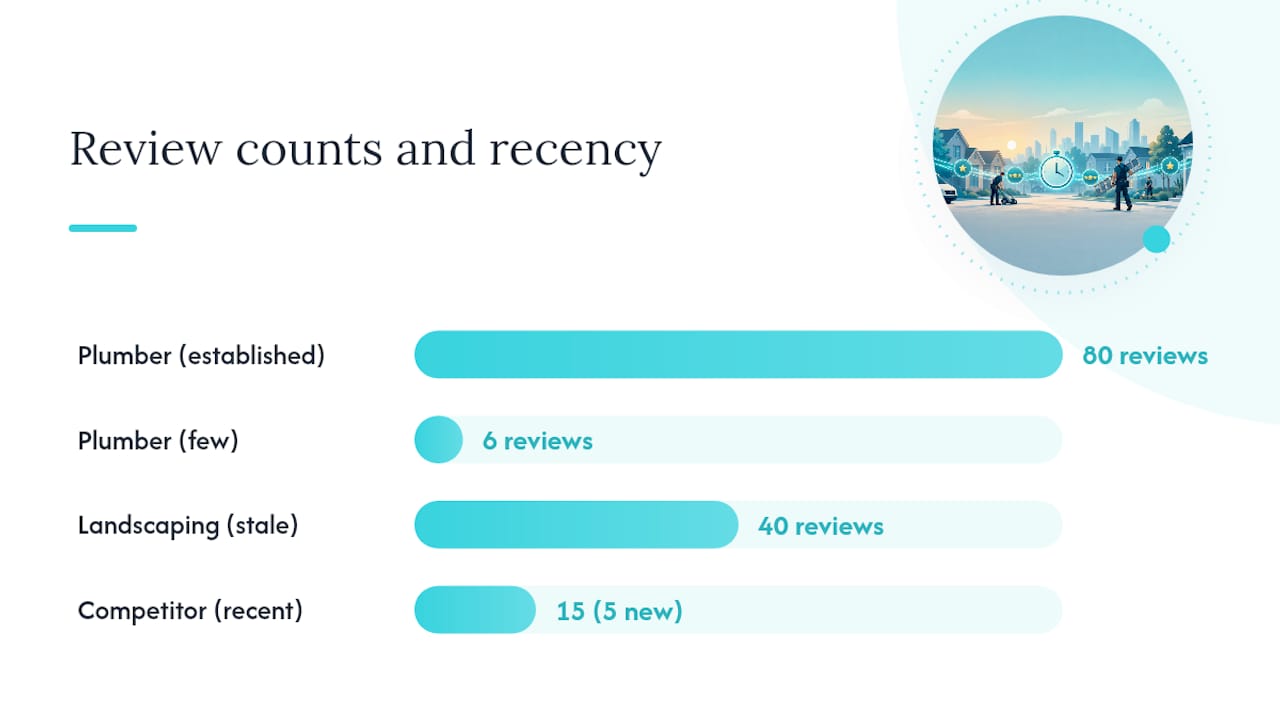
Google ranks local businesses using three pillars: relevance, distance, and prominence. Reviews feed directly into that third one. A plumber with 80 reviews and a 4.7 average looks more established to Google than one with 6 reviews, even if both do equally good work. Prominence is Google's way of guessing which business real customers trust, and reviews are the clearest signal it has.
Here's what a lot of tradespeople miss: Google isn't just counting stars. It reads the words inside your reviews. When a customer writes "fixed our water heater in Denver same day," that sentence acts almost like a mini web page about your business. Review text is becoming an indexed relevance signal, not just a trust badge, and AI Overviews increasingly pull that review text directly to build the summaries that show up above the regular search results.
Recency matters just as much as volume. A landscaping company that got 40 reviews back in 2022 and nothing since looks stale to Google's algorithm, even though 40 reviews sound impressive on paper. A competitor with 15 reviews, five of them from the past month, can outrank that older profile because fresh activity tells Google the business is alive, busy, and still serving happy customers.
A few patterns show up again and again in how reviews translate into local visibility:
- Steady beats stale. A trickle of new reviews every month outperforms a big batch followed by silence.
- Text carries weight. Reviews that mention your service and your city do double duty as both trust signal and relevance signal.
- Volume has a ceiling. Once you're roughly in line with your top local competitors, more reviews help less than fresher ones.
- Photos punch above their weight. A review with an actual photo of the finished job reads as harder to fake and carries outsized trust.
Quick fact: Industry analysis of 2025 to 2026 ranking behavior found that review signals like volume, recency, and response rate now outweigh backlinks as ranking inputs for small local businesses in the local pack and AI Overview results. For years, SEO advice centered on getting other websites to link to yours. That's still worth doing, but for a one-person HVAC company, chasing backlinks is a poor use of a Tuesday afternoon. Chasing reviews is not.
None of this means star rating alone decides who wins the local pack. It's the combination: a business that's relevant to the search term, physically close to the searcher, and backed by an active, credible review profile. Reviews are the one piece of that formula a solo tradesperson can directly influence, day after day, job after job.
The Review Signals That Actually Move the Needle
Not every review carries the same ranking weight. Six specific signals do most of the work, and knowing which ones to prioritize keeps you from wasting effort chasing the wrong number.
Volume. More reviews generally help, but the returns shrink once you're in the same range as your competitors. If the top three electricians in your town average 60 reviews, getting to 70 matters more than getting to 200. Chasing volume past your local competitive bar is time you could spend on the other five signals instead.
Recency and velocity. Google appears to weight recent activity more heavily than old reviews sitting untouched. A steady cadence of new reviews, often cited around 5 to 15 per month depending on the market, outperforms a one-time push where you email every past client on the same day. Bursts look unnatural. A slow, steady drip looks like a real business running real jobs.
Average rating and sentiment. Ratings shape more than trust. They shape whether people click on your listing at all. Data suggests visibility takes a real hit once a business's average rating drops below 4.0, because searchers scroll past low-rated listings even when the business ranks in the top three results.
Review text and keywords. A review that says "great work" tells Google almost nothing. A review that says "replaced our sump pump and cleaned up after in Fort Wayne" tells Google exactly what you do and where. You can't script this, but you can gently prompt for it, which the next section covers.
Photo reviews. Photos are the hardest signal to fake at scale. Anyone can type five stars and a sentence, but uploading a real photo of finished work takes effort that fake reviewers rarely bother with. That effort is exactly why photo reviews carry outsized trust value with both customers and, likely, Google's ranking systems.
Owner response rate. Practitioner data across service businesses shows response rate correlates with better local pack placement and stronger click-through. A profile where the owner replies to reviews reads as actively managed. A profile with 50 reviews and zero replies reads as abandoned, even if the business is thriving.
Here's the ranking order that matters most for a solo operator starting from scratch:
- Recency and velocity, because Google notices activity before it notices totals.
- Owner responses, because they're nearly free and signal you're paying attention.
- Review text quality, because it does double duty as SEO content.
- Photo reviews, for the trust boost they carry.
- Raw volume, which matters, but matters less than the other four once you're competitive.
How to Collect More Google Reviews Ethically
Getting more reviews isn't about being pushy. It's about building one habit into your existing workflow and repeating it every single job. Here's the sequence that works for solo tradespeople who don't have time for a marketing plan.
Step 1: Run the two-minute competitor audit. Search your trade plus your city on Google. Note the review count, star rating, and photo count for the top three results. That's your competitive bar. If the top plumber in your area has 90 reviews at 4.8 stars, your goal isn't "get reviews." It's "get past 90 at 4.8 or better," which gives you something concrete to track.
Step 2: Ask within four hours of finishing the job. Timing beats almost everything else in review collection. Practical guides on service-business review strategy point to a four-hour window as the sweet spot, because the customer still remembers exactly what you fixed and how relieved they felt when it was done. Wait a week and that relief has faded into "yeah, the plumber came by at some point."
Step 3: Use a direct link or QR code, never a generic request. Don't ask someone to "leave us a review" and hope they find your Google Business Profile on their own. Send the exact link that opens the review box, or hand them a printed QR code on the invoice. Friction kills conversion. A compliant QR code setup removes the extra step of searching for your business by name, which is often where interested customers give up.
Step 4: Frame the ask around the specific job, not a generic script. Mention what you actually did. "If you have a minute, we'd appreciate a quick review about the water heater install" works better than a copy-pasted line, because it reminds the customer what to write about, which naturally produces the kind of specific, keyword-rich review text that helps your local relevance.
Step 5: Automate the follow-up, don't automate the personality. A single ask often gets ignored in a busy inbox. A short second nudge two or three days later, sent automatically, catches people who meant to leave a review and forgot. This is where a tool like Quotewren fits into the workflow. Once you mark a job complete and send the invoice, an automated sequence can handle the timing and the follow-up texts so you're not manually tracking who you asked and when.
Step 6: Never pay for reviews, gate them, or offer incentives. This one is non-negotiable, and it's covered in detail in the next section, but it belongs in the playbook too: a review system that only asks happy customers, or that offers a discount for a five-star review, violates Google's policies and puts your whole profile at risk.
Step 7: Track your monthly velocity, not just your total. Write down how many new reviews you got each month. If the number is trending down, that's the signal to tighten up your four-hour habit, not to launch a one-time review campaign that spikes and then dies.
Here's a simple comparison of the two most common collection methods solo tradespeople use:
| Method | Best for | Typical friction |
|---|---|---|
| In-person ask + QR code on invoice | Jobs with face-to-face handoff (HVAC repair, landscaping cleanup) | Very low, customer scans and reviews on the spot |
| SMS or email follow-up after invoice | Jobs where you leave before the customer inspects the work (plumbing repairs, electrical fixes) | Low, but depends on timely sending |
Pro Tip: Put the QR code on the invoice itself, not just a business card. Customers pay attention to invoices because there's a dollar amount on it. A business card gets tossed in a drawer.
For a broader set of tactics beyond the core playbook, six weekend moves aimed at local leads cover related plays worth layering in once the review habit is solid, and a focused plan for getting your first five reviews is useful if you're starting from zero.
How to Reply to Reviews (Positive and Negative)
Reply within 24 to 48 hours. That window matters for two reasons: it shows the reviewer you actually read what they wrote, and it shows Google your profile is actively managed, which is one of the signals tied to better local pack placement and click-through.
For positive reviews, keep it short and specific. Thank the customer by name if the platform shows it, mention the actual job, and add a light, natural mention of another service if it fits. "Thanks, Maria! Glad we could get that breaker panel sorted before the weekend. We also handle outlet upgrades if you ever need one." That second sentence isn't a hard sell. It's a natural way to reinforce what else you do, for both the reviewer and anyone reading later.
For negative reviews, resist the urge to argue in public. Acknowledge the complaint, apologize for the experience without admitting fault you don't owe, and move the resolution offline. "We're sorry the appointment ran late, that's not how we like to operate. Please call us directly at [number] so we can make it right." That reply does two jobs: it shows future customers you take problems seriously, and it gives the unhappy customer a real path to resolution instead of a public back and forth.
When a public reply isn't enough, especially if a review contains false claims or violates platform guidelines, escalate through Google Business Profile support directly rather than debating in the comment thread. Keep records of the interaction, including dates and any texts or invoices that contradict the claim.
A few reply habits worth locking in:
- Sign with a real first name, not "Management" or "The Team."
- Reference the specific service every time, even in a one-line reply.
- Never copy-paste the exact same reply to every review; Google and readers both notice canned language.
- Reply to negative reviews faster than positive ones, since the clock matters more there.
Pro Tip: Keep three reply templates saved in your phone's notes app: one for standard thanks, one for a minor complaint, and one for a serious complaint. Editing a template takes 20 seconds. Writing from scratch after a long job doesn't happen.
A full walkthrough of Google Business Profile setup and reply management, including how to claim your profile if you haven't yet, is covered in this Google Business Profile guide for tradespeople. For faster templates specifically built around quick turnaround, see replying to reviews in 10 to 20 minutes.
Spotting Fake Reviews and Avoiding Policy Violations
Suspicious review patterns usually look the same: a sudden burst of five-star reviews in a single day, reviews with no text or generic one-word praise, or reviews from accounts with no other review history. Google's spam systems often catch and filter these automatically, but not always, and a burst of obviously fake reviews can trigger a manual review of your entire profile.
The riskiest practices are the ones that feel tempting when business is slow:
- Review gating, meaning you only ask customers who indicate they're happy and quietly skip everyone else, violates Google's guidelines because it manipulates the sample.
- Buying reviews from third-party services almost always results in review removal once detected, and repeated violations can suspend your entire Business Profile.
- Incentivizing reviews with discounts or free services in exchange for a five-star rating breaks platform policy even if the review itself is genuine.
Industry guidance is consistent on this point: manipulative tactics risk far more than a single bad review. They risk the whole profile you've spent months building.
If you spot a fake or fraudulent review on your own profile, document it before doing anything else. Screenshot the review, note the date, and check whether it matches an actual customer or job in your records. Then flag it directly through Google Business Profile's reporting tool, citing the specific policy violation. Escalate to Google Business Profile support if the flag doesn't resolve within a couple of weeks. A step-by-step checklist for removing fake reviews walks through the documentation and escalation process in more detail, including what evidence tends to get results.
Measuring Progress and Setting Realistic Targets
Start with the same audit from the collection playbook: record the review count, star rating, and photo count for your top three local competitors. That becomes your benchmark, not some arbitrary number pulled from a blog post. A roofer in a small town of 8,000 people might only need 25 solid reviews to lead the local pack. A roofer in a metro suburb might need 150.
Track five numbers every month:
- New reviews received
- Response rate (percentage of reviews you replied to)
- Current average rating
- Reviews that include a photo
- Month-over-month review velocity
A spreadsheet handles this fine for most solo operators. If you want to see how you're tracking against local competitors over time rather than just snapshotting once, a local rank tracking tool like Maprank shows how your Map Pack position shifts as your review count and recency change, which turns this from a guessing game into something you can actually watch move.
Read your trend line, not any single month. A slow month for reviews right after a big one is normal. A three-month decline means it's time to tighten the four-hour ask habit again.
Do Reviews on Yelp and Facebook Matter Too?
Google carries the most weight for local pack visibility, but it isn't the only platform search engines and customers check. Comparing where to focus effort between Google and Yelp matters because customer research habits vary by trade. Someone hiring a plumber usually goes straight to Google Maps. Someone choosing a restaurant or a moving company often checks Yelp first out of habit.
Facebook reviews (technically called "recommendations" now) carry less direct SEO weight but still influence buyer trust, especially for businesses that run active local Facebook groups or community pages. Industry-specific directories, like HomeAdvisor for home services or Angi for contractors, matter less for organic Google ranking but can still drive direct referral traffic and occasionally show up in search results themselves.
The practical rule for a solo tradesperson with limited hours: build your Google Business Profile first, since it feeds the local pack directly. Once that's solid, claim your Yelp and Facebook pages, keep them accurate, and don't ignore reviews there even if you're not actively chasing new ones. A consistent, positive presence across two or three platforms signals broader business credibility, and research on review credibility points to consistency across sources as one factor that builds trust with both customers and search algorithms.
Putting Reviews Into Your Local SEO Content
Reviews aren't just something that lives on your Google Business Profile. They can strengthen your actual website too. If you have a simple website, even a one-page site, embedding a few real reviews near your service descriptions reinforces relevance for the exact terms customers search: "emergency electrician," "gutter cleaning near me," and so on.
For businesses running a WordPress or Squarespace site, adding review schema markup (structured data that tells search engines "this is a review, this is the rating, this is the business it's about") can make your reviews eligible for star ratings to appear directly in search results. That star display in the organic listing itself, separate from the local pack, often boosts click-through rate simply because it stands out visually against plain text listings.
You don't need to be technical to benefit from this. Many website builders now offer review-embedding plugins that handle the schema markup automatically when you paste in a Google review. If your site doesn't have that, a developer can typically add basic review schema in under an hour for a simple service page.
The bigger content move is simpler than schema: quote a real, specific review on your homepage or service page. "Fixed our furnace the same day we called, highly recommend" does more for a nervous homeowner deciding whether to call you than three paragraphs of marketing copy ever will.
Reviews and Your Local Pack Ranking
The local pack, the map with three business listings that appears above regular search results, is where most local searches end. If you're not in it, you're competing for scraps further down the page. Reviews are one of the clearest, most direct levers you have to influence whether you land in that top three.
Case analysis comparing businesses with dramatically different review counts shows the pattern clearly: a business with dozens of recent, well-distributed reviews consistently outperforms a competitor with a fraction of that activity, even when both offer similar services in the same service area. It's not a guarantee, since relevance and distance still play a role, but among businesses competing at similar distance and relevance, reviews often decide who wins the top three spots.
This is why "just show up in the map" isn't really a strategy. Showing up requires active review management as an ongoing habit, not a one-time setup task. Businesses that treat their Google Business Profile as a "set it and forget it" listing tend to slide down the local pack over months, even without doing anything actively wrong. Competitors who keep collecting reviews simply pass them by.
Getting Authentic Reviews From More Than One Platform
The safest way to build reviews across Google, Yelp, and Facebook without tripping any policy wire is to ask once, broadly, and let the customer choose where to leave feedback rather than demanding a specific platform from every customer.
A simple, compliant approach: include a "leave us feedback" link that gives the customer a choice of platforms, or rotate which platform you highlight in your follow-up message from job to job. Never say "only leave a review if you're happy" on any platform. That's the same review-gating violation whether it happens on Google, Yelp, or anywhere else.
Low-friction nudges work better than heavy asks across every platform. A short text with a direct link converts better than a phone call asking someone to "go write something up." The less effort required, the more likely a genuinely satisfied customer follows through, and genuine reviews are the only kind worth having anyway.
Reading Review Trends to Guide Your Strategy
A single month of review data tells you almost nothing. A six-month trend tells you everything. Watch for three patterns specifically: a slowdown in new reviews, a dip in average rating, and a drop in response rate on your end.
A slowdown in new reviews usually traces back to a broken habit, not a slow month for business. Check whether you've actually been sending the ask within that four-hour window, or whether it's slipped to "whenever I remember," which is often never.
A dip in average rating deserves closer attention than a slowdown in volume. Read the actual negative reviews behind the dip. Are they clustering around one issue, like late arrivals or a specific employee, or are they scattered and unrelated? Clustered complaints point to an operational fix. Scattered complaints might just be normal variation.
Track this monthly, but review it seriously every quarter. That's often enough time to see whether a change you made, like switching to automated follow-up texts or tightening your scheduling window, actually moved the numbers.
Treat Review Collection as Part of Finishing the Job
The businesses that win at local SEO don't treat reviews as marketing. They treat review collection as the last step of the job, right alongside sending the invoice. Quote the work, do the work, invoice the work, ask for the review. Four steps, every time, no exceptions.
That simplicity is exactly why it works. A four-hour ask and a 24-hour reply aren't complicated tactics. They're habits. And habits compound in a way that one-time marketing pushes never do. A landscaper who asks after every job for six months ends up with a review profile that took almost no extra effort to build, just consistency applied to something they were already doing.
Where solo operators lose this habit isn't lack of belief in reviews. It's the operational friction of remembering to send the ask at the right moment while also driving to the next job. That's the part worth automating, not the personality or the sincerity behind the ask. A system that fires off the request the moment a job is marked complete removes the one variable that actually breaks the habit: forgetting.
— jaras
How Quotewren Turns This Playbook Into a Habit
Quotewren is built for the exact workflow this article describes: quote the job, do the work, send the invoice, ask for the review, without adding a single extra task to your day. Instead of remembering to text every customer within that four-hour window, Quotewren's three-touch SMS review engine sends the ask automatically the moment you mark a job complete, then follows up with one or two reminders if the first message goes unanswered.
Quotewren also handles the quoting and invoicing side, including a pay link so customers can settle up without a phone call, which means the review request lands right after the moment they're most satisfied: the job is done and paid for.
Pricing stays simple. The Free plan lets you try the core workflow at no cost. Quotewren offers paid plans for operators who need more room to grow, with details available on their website. There's no complicated feature ladder built for a fleet of trucks, just quoting, invoicing, and automated reviews sized for a solo operator. Check out the Quotewren app to see the free tier and start automating your next review request.
Sources
The claims in this article draw on a mix of academic review research and current industry analysis of local search ranking behavior.
- Local SEO 2026: Why Reviews Now Matter More Than Backlinks
- How Reviews Affect Local Search Rankings (2026)
FAQ
How Much Should I Pay for Local SEO?
Costs vary widely depending on whether you hire an agency or handle it yourself. Reviews are one of the few local SEO levers a solo tradesperson can run for close to nothing beyond time, and tools built specifically for review automation, like Quotewren, start at $19 per month rather than the hundreds agencies often charge for ongoing management.
What Does Local SEO Mean?
Local SEO is the set of practices that help your business show up when someone nearby searches for your service, like "electrician near me" or "AC repair in [city]." It relies on three main factors: how relevant your business is to the search, how close you are to the searcher, and how prominent your business looks based on signals like reviews and citations.
Is SEO Still Worth It in 2026?
Yes, especially for local businesses, because searchers increasingly rely on AI-generated summaries and the local pack rather than scrolling through full search results. Review signals now carry more ranking weight than backlinks for small local businesses, which makes review collection one of the highest-return SEO activities available to a solo operator.
What Is a Review in the Context of SEO?
In local SEO, a review is a customer rating and comment left on a platform like Google Business Profile, Yelp, or Facebook that search engines use as a trust and relevance signal. Search engines read both the star rating and the actual text of the review, which is why specific, detailed reviews mentioning your service and location tend to help more than generic five-star ratings with no comment.
How Fast Should I Ask for a Review After Finishing a Job?
Ask within four hours of completing the work, while the customer still remembers exactly what you did and how relieved they feel that it's fixed. Waiting even a day or two noticeably lowers response rates, which is why automated follow-up systems that fire off the request right after you close out the job tend to produce more consistent results than manual reminders.