

No, you cannot offer incentives for Google reviews. Google's Business Profile policy and the FTC both prohibit paying, discounting, or rewarding customers for reviews, whether positive or negative. The safe path is simpler than people think: ask every customer the same honest question, then remove every bit of friction between them and the review button.
TL;DR:
- Incentives such as discounts or free services violate both Google's policies and FTC regulations, which classify them as deceptive advertising and can lead to legal penalties.
- Google actively detects incentivized reviews through patterns like review spikes, same IP postings, and similar wording, increasing enforcement in 2025 and 2026.
- Asking every customer for an honest review immediately after completing a job, without offering any rewards or filtering, remains the best way to grow reviews compliant with rules.
- Using direct links or QR codes to simplify the review process is allowed and recommended, while avoiding mentioning discounts or gifts in review requests prevents inadvertent violations.
- Automated, neutral review requests sent promptly after service completion improve response rates, especially when following a consistent script and avoiding pressure tactics.
Table of Contents
- What Google and the FTC Actually Say About Incentivized Reviews
- What Happens If You Break the Rules
- How Can You Encourage Reviews Without Breaking the Rules?
- A Review-Request Workflow You Can Start Today
- Scripts and Timing You Can Copy Right Now
- Responding to Reviews and Putting Them to Work
- What We've Learned Building Review Tools for Trades
- Get Reviews Without the Risk (or the Extra Work)
- Sources
- FAQ
What Google and the FTC Actually Say About Incentivized Reviews
Google's Business Profile policy states it plainly: businesses may not offer "payment, discounts, free goods and/or services" in exchange for a review, and they cannot selectively ask only happy customers to review them while skipping unhappy ones (a practice called review gating). This isn't a gray area. Google's own policy language covers cash, gift cards, coupons, free services, and even entering customers into a raffle for leaving feedback.
The FTC backs this up with real teeth. Its guidance for marketers warns that paid or incentivized reviews can count as deceptive advertising, which opens businesses up to fines and legal action, not just a slap on the wrist from a tech company.
Here's the part most small business owners miss:
- Incentives don't have to be cash to count. Discounts, free add-ons, and "enter to win" contests all qualify as violations.
- Review gating (only inviting satisfied customers) is banned even without any reward attached.
- Google has ramped up enforcement, with industry reporting showing tighter detection of incentivized-review patterns in 2025 and 2026.
Quick fact check: the rule applies to every review platform tied to your Google Business Profile, not just direct reviews you personally requested.
What Happens If You Break the Rules
Getting caught isn't rare anymore, and the consequences hit harder than a few deleted reviews. Google can strip your star rating, slap a consumer alert banner on your profile, or suspend it outright, which means your business vanishes from local search results overnight.
The FTC can pursue fines against companies caught paying for reviews, and that kind of legal exposure is not something a solo plumber or electrician wants to deal with while trying to run a business. Beyond the official penalties, there's reputational damage: customers who spot a wave of fake five-star reviews often trust a business less, not more.
Google's detection systems look for specific red flags:
- A sudden spike of reviews in a short window (for example, an unusually large increase in a couple of days after a long quiet period)
- Multiple reviews coming from the same IP address or device cluster, which Google flags as suspicious
- A batch of accounts with no prior review history posting reviews simultaneously
- Reviews that have very similar structure and wording, indicating possible coordination or incentivization
Statistic to remember: enforcement activity increased noticeably through 2025 and into 2026, meaning the odds of getting flagged are higher than they were even a year ago.
How Can You Encourage Reviews Without Breaking the Rules?
You can still build a strong review base fast. You just have to do it the right way, which honestly isn't much harder than the wrong way.
- Ask every single customer the same way. No skipping the guy whose faucet took three trips to fix. Consistency protects you from a review-gating violation and it's simply fair.
- Ask right when satisfaction peaks. The moment you finish the job and the customer is happy with clean work and a fair price is the best time, not three weeks later when they've forgotten your name.
- Send a direct link or QR code. Google actively encourages businesses to make leaving a review easy through direct profile links, and that's a completely compliant way to cut friction.
- Automate the ask, but keep it neutral. An SMS or email that says "we'd love your honest feedback" is fine. One that says "leave a review and get 10% off your next visit" is not.
- Reward your team, not your customers. If you want to motivate good service, pay a bonus to the technician who racks up the most five-star reviews. That's fully compliant and it actually improves the work quality behind the reviews.
Pro Tip: Never mention a discount, gift card, or "thank you" gift anywhere near the word "review" in your messaging, even as a coincidence. Keep the two subjects in totally separate conversations.
A Review-Request Workflow You Can Start Today
Here's a workflow built for the reality of a one-person crew: no office staff, no marketing team, just you and your phone.
- Finish the job and do a quick walkthrough with the customer.
- Say something simple like: "If you were happy with the work, I'd really appreciate a quick review. It's what keeps my business going."
- Send an automated text within minutes with a direct review link attached.
- If there's no response after 48 hours, send one polite reminder. Just one.
- Send a short thank-you message once the review posts, whether it's five stars or three.
The cadence matters more than people expect. Requests sent right after the job wraps up convert far better than anything sent days later, because the customer's satisfaction is still fresh.
A few rules to keep this compliant and useful:
- Send the exact same message to every customer, no exceptions and no filtering out the tough jobs.
- Track your response rate monthly so you know if your script or timing needs adjusting.
- Never tie the request to a discount, referral bonus, or future service credit.
This is exactly the gap Quotewren was built to close. It automates that immediate SMS the second a job is marked complete, so you're not the one remembering to text every single client at 6 p.m. after a ten-hour day.
Scripts and Timing You Can Copy Right Now
You don't need a marketing degree to write these. Here's a starting point.
- In-person script: "Thanks again for choosing us today. If you have two minutes, a quick review of your experience really helps other homeowners find us."
- SMS template #1: "Hey [Name], thanks for trusting us with your [HVAC repair / drain cleaning / panel upgrade] today. Mind sharing your experience here? [link]"
- SMS template #2 (48 hour reminder): "Just a friendly follow-up, if you have a minute to share your experience, it means a lot." [link]"
To build the link itself, grab your direct Google review link from your Business Profile dashboard, then turn it into a printable QR code you can leave on an invoice or a sticker on your work van.
Pro Tip: Stick to one reminder, max. A second or third follow-up starts to feel like pressure, and pressure is exactly what makes a review feel less honest.
Timing stays simple: send the first request within minutes of finishing the job, follow up once at the 48-hour mark if needed, and stop there.
Responding to Reviews and Putting Them to Work
A five-star review deserves a real reply, not a copy-pasted "thanks!" Something like: "Thanks, [Name]! Glad we could get that water heater fixed before the weekend. Call anytime." A one-star review needs a calm, specific response: "Sorry the appointment ran late, [Name]. That's on us, and we'd like to make it right, call us directly at [number]."
A few practical notes:
- Reply within a day or two whenever you can. Slow responses look like nobody's home.
- You can quote a short review snippet in your marketing, but get the customer's okay first if you're using their name or photo.
- If a review is obviously fake, from a competitor, a bot, or someone who was never your customer, report it directly to Google through your Business Profile dashboard.
What We've Learned Building Review Tools for Trades
Quotewren can automate the review request right after a job is marked complete, which helps improve response rates. The pattern holds true across plumbing, electrical, and HVAC work alike. What actually moves the needle isn't a clever incentive. It's removing the fifteen seconds of friction between finishing a job and getting a link in front of someone while they're still happy.
— jaras
Get Reviews Without the Risk (or the Extra Work)
Quotewren provides a system for solo tradespeople that sends out review requests automatically after a job is marked done, without incentives or discounts. It also supports quoting and payment with integrated pay links.
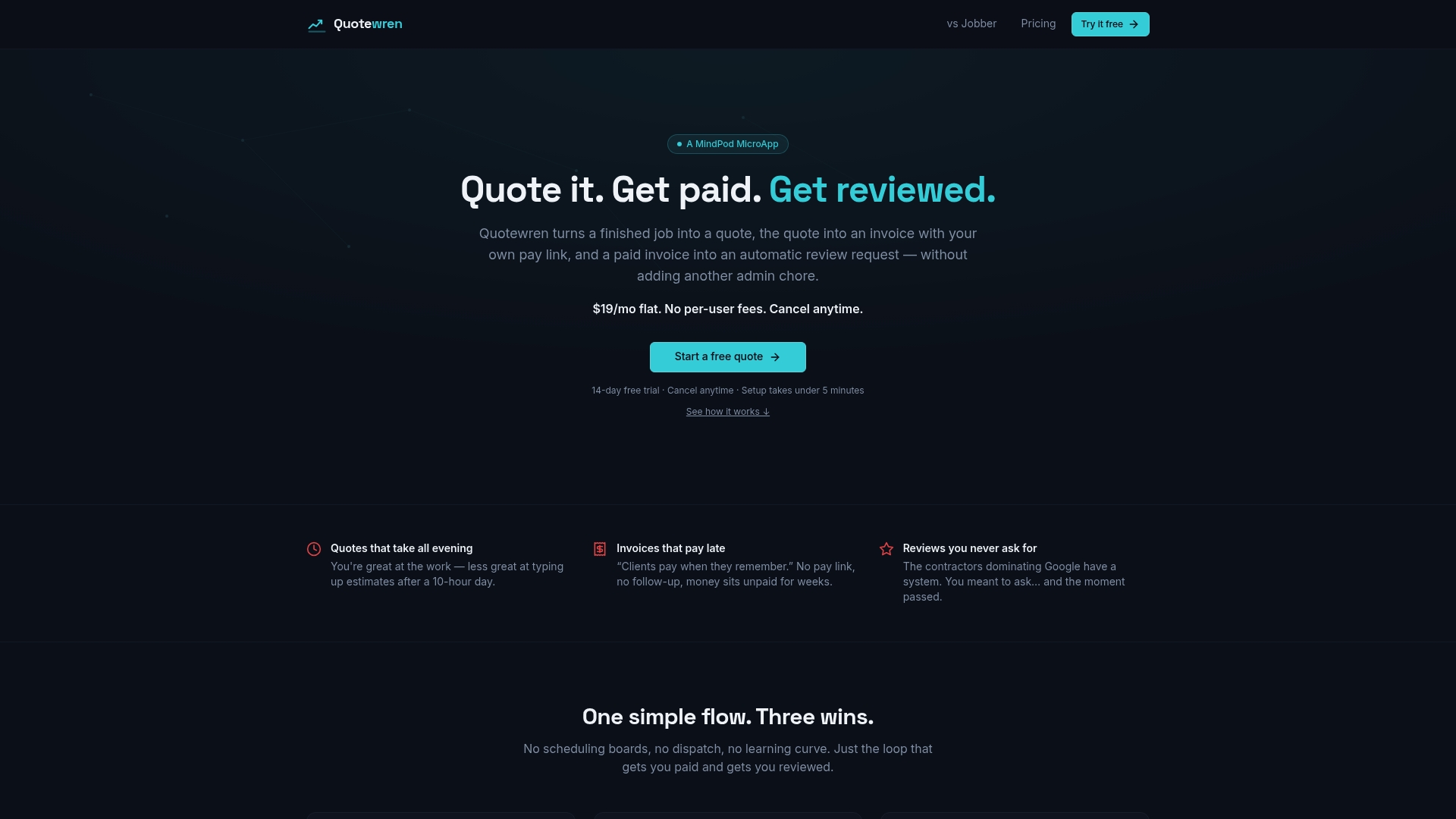
Sending review requests soon after finishing a job improves response rates, and Quotewren can send these automatically for customers without filtering to avoid review-gating issues. Combine that with a service-area approach to your outreach and you've got a compliant system that actually keeps growing your Google presence while you're out working the next job. If you're ready to stop chasing reviews by hand, App and let the next completed job send its own request.
Sources
- Tips to get more reviews - Google Business Profile Help
- Soliciting and paying for online reviews: Guide for marketers — FTC
- Google Is Increasing Enforcement on Incentivized Reviews — DAC Group
- Search Engine Land timing/conversion insight
FAQ
Is It Legal to Incentivize Google Reviews?
No. Google's policy bans it outright, and the FTC treats paid or incentivized reviews as a form of deceptive advertising that can carry real legal consequences.
Can You Incentivize People to Leave Google Reviews?
You cannot offer money, discounts, free services, or contest entries for reviews under any circumstance, even if the review could be negative. You can, however, ask every customer for honest feedback and make leaving one as easy as tapping a link.
Can I Earn Money by Giving Google Reviews?
Not through Google Business Profile reviews. Google Opinion Rewards is a separate app that pays users small amounts for answering surveys, and it has nothing to do with reviewing local businesses.
Is There Any Incentive for Leaving a Google Review?
No customer-facing incentive is allowed, but businesses can reward their own staff for consistently earning great reviews through good service, which stays fully within Google's rules.