

Five reviews is your first real target. That's the point where Google typically shows a visible star rating on your Business Profile, which correlates with a substantial jump in customer trust according to research. After that, aim for 10 to 20 reviews as your baseline, since top local listings average around 47. The number matters less than getting there steadily, with real reviews from real jobs, instead of chasing a big total all at once.
TL;DR:
- Businesses should aim for at least five reviews to get their star rating visible, which significantly increases customer trust and click-throughs.
- Around 10 to 20 reviews is the practical trust baseline, while most top local listings average approximately 47 reviews for high visibility.
- For small markets, a few dozen reviews may suffice to dominate local searches, but in large metro markets, several hundred reviews can be necessary for full competitiveness.
- Steady, recent reviews from genuine jobs outperform large, outdated review stacks, with consistent asking and automated follow-up being the most effective strategies.
- Never incentivize reviews; focus instead on honest requests after every completed job, using simple automation to build your review count over time.
Table of Contents
- What's the Real Google Review Minimum Number?
- How Many Reviews Do Top Local Listings Actually Have?
- Does Review Quality Matter More Than the Count?
- How Do I Actually Get to 10 or 20 Reviews Fast?
- What Does a Realistic Review Workflow Look Like?
- Why the Perfect Number Doesn't Exist, and Why That's Good News
- Turn Finished Jobs Into Reviews Without Lifting a Finger
- Sources
- FAQ
What's the Real Google Review Minimum Number?
There's no official rule from Google that says "you need exactly 5 reviews" or "you need 20 to rank." But data from actual research gives us something close to a real answer, and it's more useful than guessing.
Google's own Business Profile support documentation explains that your profile displays a total review count and an average star score, calculated on a 1 to 5 scale. Once you have a handful of reviews, that star rating becomes visible next to your business name in search results and Maps. Before that, your listing often looks incomplete, even if your work is excellent.
Here's where it gets interesting. The Spiegel Research Center at Northwestern studied how reviews affect buying decisions and found something every solo tradesperson should know: a business with just 5 reviews is about 270% more likely to get chosen than one with zero. That's not a typo. Going from zero to five reviews does more for your credibility than almost anything else you could do this month.
The lift keeps climbing after that, but it slows down. Spiegel's research shows the biggest gains happen early, and the effect flattens out after you’ve built a solid base of reviews. That doesn't mean reviews stop mattering after that point. It means the return on each new review starts to shrink.
Here's what each milestone tends to do for a real business:
- 0 reviews: Your listing looks unfinished. Customers scroll past you for a competitor with even a couple of reviews.
- 5 reviews: Your star rating shows up clearly. This is the tipping point where people start clicking and calling instead of skipping you.
- 10 to 20 reviews: You hit what most local-search analysts call the practical trust baseline, according to industry benchmarking data. Customers stop double-checking you against three other companies.
- 20 to 30+ reviews: Trust growth slows, but consistency and recency start mattering more than raw count.
Pro Tip: Don't wait for a "perfect" number before asking for reviews. According to practitioner guidance on review conversion, waiting for some arbitrary big number costs you leads every week you delay. Ask after every job, starting now.
One separate thing worth knowing: Google Merchant Center has its own product rating policy that requires around 50 reviews before product ratings show up in shopping feeds. That's a totally different system from your Business Profile, and it doesn't apply to service businesses like plumbing, electrical, or landscaping. Don't confuse the two.
How Many Reviews Do Top Local Listings Actually Have?
The number you need depends heavily on who you're competing against. A one-person handyman business in a small town needs far fewer reviews than an HVAC company fighting for attention in a big metro area.
Industry benchmarking data from ReplyOnTheFly shows that businesses ranking in the top 3 local results average roughly 47 reviews. That's an average across all kinds of industries and cities, so your specific number could be higher or lower depending on your market.
Use these general ranges to set a realistic target:
- Quick trust floor: 10 reviews. This gets you past the "looks abandoned" stage and into "looks like a real business" territory.
- Workable target: 10 to 20 reviews. Good enough to compete in most residential trades markets, especially outside major cities.
- Common top-3 average: around 47 reviews. This is where you start showing up consistently in the local map pack for competitive searches.
- Competitive niches: 50 to 100+ reviews. Common in crowded markets like general contracting or cleaning services in big cities, where dozens of companies fight for the same searches.
- Aggressive domination targets: 200+ reviews. Usually only relevant for established companies that have been collecting reviews for years, not something a new solo operator should chase right away.
Before you set your target, spend 15 minutes checking your actual competition. Search for your trade plus your city (something like "emergency plumber Denver" or "lawn care Tulsa") and look at how many reviews the top 3 to 5 listings show. That's your real benchmark, not a generic number from an article.
A quick note on geography: a solo electrician in a town of 15,000 people is not competing with 40 other electricians. You might only need 15 to 20 solid reviews to dominate a small market, while a similar business in a city of two million could need 80 or more just to show up on page one.
Does Review Quality Matter More Than the Count?
Yes, and this is the part most guides skip. A profile with 50 reviews from three years ago tells Google (and customers) a very different story than one with 15 reviews collected steadily over the past six months.
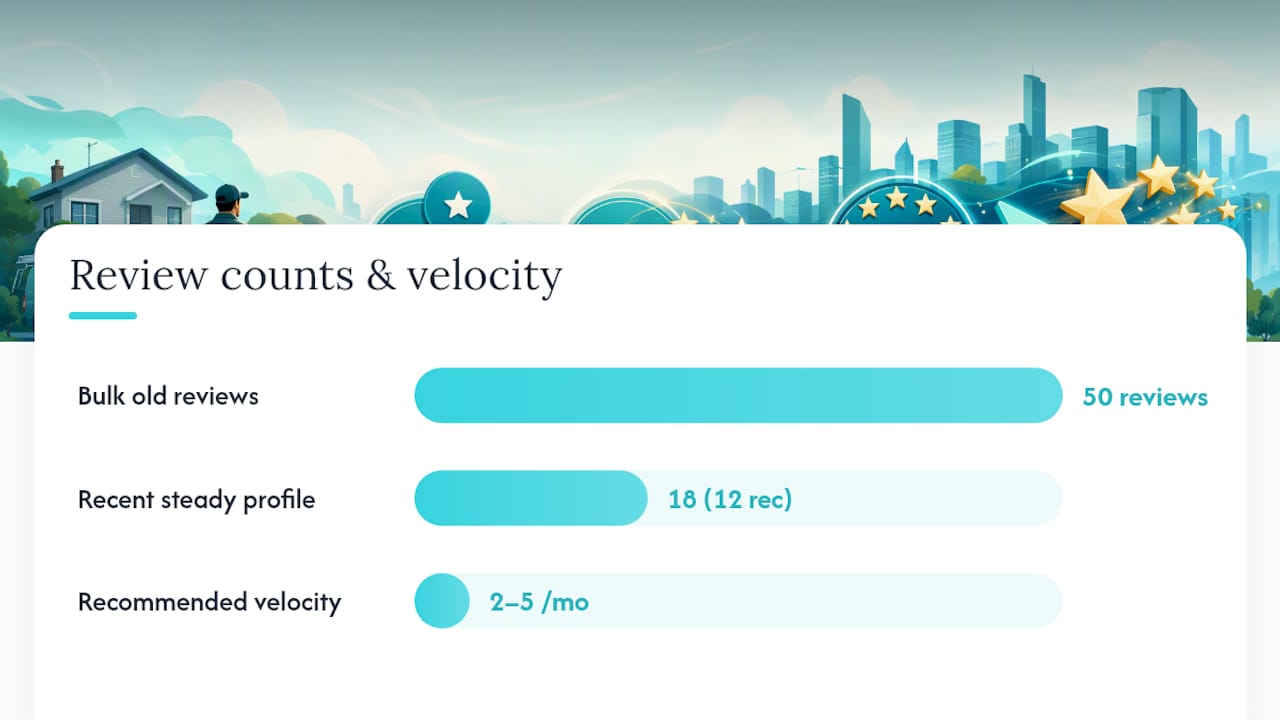
Two concepts matter here: recency and velocity. Recency means how fresh your reviews are. Velocity means how often new ones come in. A local SEO analysis on review quantity versus quality makes a strong case that a steady stream of recent reviews beats a big pile of old ones every time. Picture two electricians: one has 50 reviews, all from 2022 and 2023. The other has 18 reviews, but 12 came in over the last six months. Customers and Google both read the second profile as more active and more trustworthy right now.
Beyond timing, three things separate a great review profile from a mediocre one:
- Detailed review text. A review that says "fixed my water heater fast and explained the whole repair" builds more trust than a lonely five-star rating with no comment.
- A balanced star average. Somewhere between 4.6 and 4.9 stars actually reads as more believable than a flawless 5.0, since customers assume every business has had at least one rough day.
- Owner responses. Replying to reviews, especially the critical ones, shows you're paying attention. It also gives future customers proof you handle problems like an adult.
Pro Tip: Ask a satisfied customer to mention the specific job in their review, like "replaced my kitchen faucet" or "installed a new breaker panel." Specific reviews rank better in customer searches and read as far more genuine than generic praise.
You don't need to spam every customer to build velocity. A steady drip of 2 to 5 new reviews a month, tied to real completed jobs, does more for your ranking than a one-time push to get 30 reviews in a week and then going silent for a year.
How Do I Actually Get to 10 or 20 Reviews Fast?
Start with a quick diagnostic. Check your current review count, your average star rating, and the review count of your top 3 local competitors. That gives you a real number to aim past, not a guess.
Set two goals: a short-term target of 5 reviews if you're starting from zero, and a medium-term target of 10 to 20 reviews within the next few months. Both are realistic if you ask consistently instead of occasionally.
Here's a simple three-touch sequence that works well for trades:
- In-person ask, right after the job. While the customer is happy and the work is fresh, mention it directly: "If you've got a minute, a Google review really helps a small business like mine. I'll text you the link." This is the highest-response moment you'll ever get.
- SMS follow-up with a direct link or QR code, same day or next day. Keep it short: "Thanks again for letting me fix that AC unit today. Here's a quick link to leave a review if you have 60 seconds: [link]." A review link QR code on an invoice or business card makes this even easier for customers who'd rather scan than type.
- Final gentle nudge, 10 to 14 days later. If they haven't responded, one more short message works: "No pressure, but if you got a chance to leave that review, I'd really appreciate it." After this, let it go.
Track three simple numbers each month: how many new reviews came in (velocity), how many of your total reviews are from the last six months (recency), and your overall average rating. A quick monthly check, maybe five minutes on a Sunday, keeps you from letting momentum slide.
One important guardrail: never offer discounts, free work, or anything of value in exchange for a review. Google's review policy prohibits incentivized reviews, and getting flagged for fake or paid reviews can get your listing suspended entirely. Just ask plainly, make it optional, and let the work speak for itself. For more on generating and sharing your Google review link, there's a straightforward setup process that takes about five minutes.
What Does a Realistic Review Workflow Look Like?
The businesses that build strong review counts without burning out on manual follow-up almost always use some version of a three-touch automated pattern: an immediate request right after the invoice goes out, a second nudge 3 to 5 days later, and a final reminder 10 to 14 days after that.
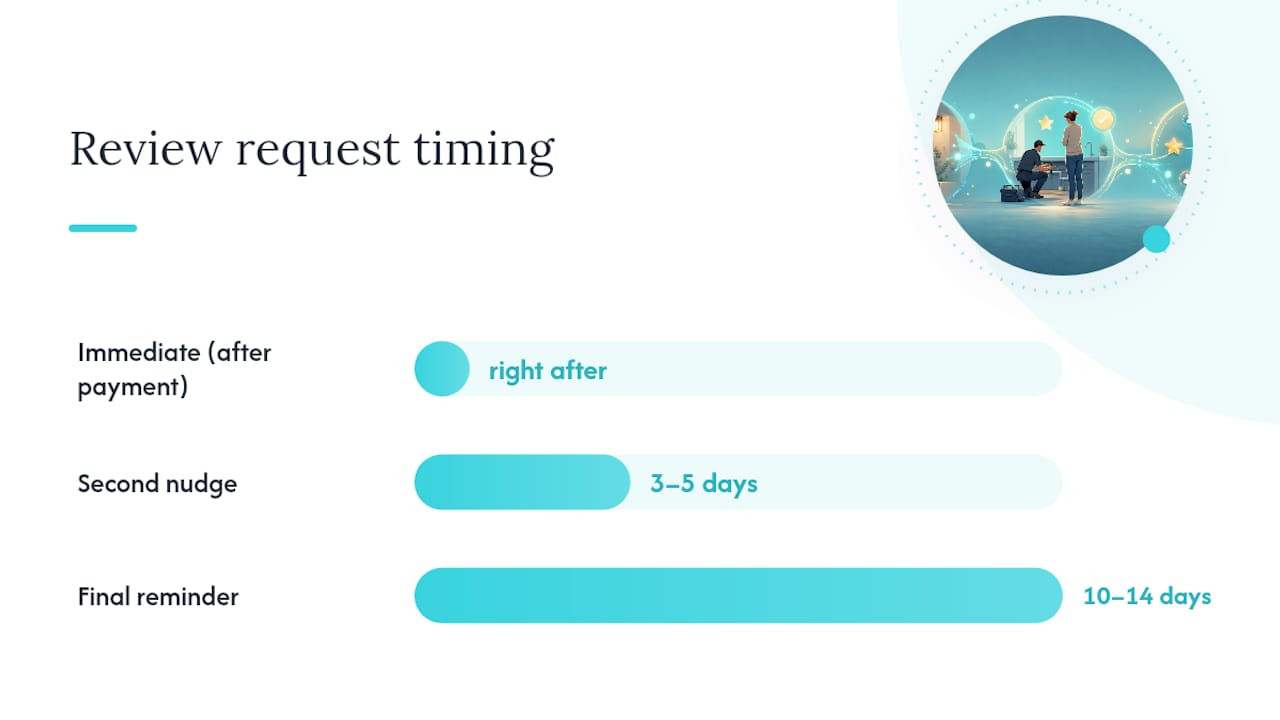
Timing drives the response rate more than wording does. A customer who just watched you fix their water heater or wire a new outlet is far more likely to leave a review in the next hour than three weeks later when the job has faded from memory.
A simple version of this workflow looks like this:
- Send the quote, get it approved.
- Complete the job.
- Send the invoice and collect payment.
- Trigger an automated SMS review request right after payment clears.
- Follow up automatically if there's no response within a few days.
Doing all four steps manually, every single job, every single week, is exactly the kind of task that gets skipped when you're slammed with calls. This is the specific gap Quotewren was built to close. It's software for solo tradespeople that turns a finished job into a quote, then an invoice, then an automated three-touch SMS review request, without you having to remember to send a single text.
Why the Perfect Number Doesn't Exist, and Why That's Good News
Here's my honest take after digging through the research: businesses waste too much energy chasing a magic review count instead of building a habit. There is no secret threshold where Google suddenly "unlocks" rankings for you. The data points to a much simpler truth.
Get to 5 reviews fast, because that's where your star rating becomes visible and the biggest trust jump happens. Then work steadily toward 10 to 20, since that's the range where most customers stop cross-checking you against competitors. After that, stop obsessing over the total and focus on keeping new reviews coming in every month.
Keep every ask honest. Never offer a discount for a review, and never write one yourself pretending to be a customer. It's against Google's policy, and customers can smell a fake review from a mile away anyway. Measure your progress monthly, not daily. Review counts move slowly, and checking obsessively just creates stress without changing your numbers.
The tradespeople who win this game aren't the ones with the cleverest scripts. They're the ones who ask every single time, without fail.
— jaras
Turn Finished Jobs Into Reviews Without Lifting a Finger
Quotewren is built specifically for solo tradespeople who don't have time to chase down customers for reviews after a long day of jobs. Once you send a quote, complete the work, and generate the invoice, Quotewren automatically fires off a three-touch SMS review request, so you're not manually texting every customer and hoping they remember.

The pricing stays simple and affordable compared to bigger platforms built for companies with fleets of trucks and office staff, designed for solo operators. You can start with a free trial to see how the quote to invoice to review flow works on your own jobs, whether you're a plumber, electrician, landscaper, or cleaning pro. If you're ready to stop losing reviews because you forgot to ask, check out Quotewren and set up your first automated review request today.
Sources
- How online reviews influence sales — Spiegel Research Center (Northwestern)
- Understand review scores for local places & businesses — Google Business Profile Help
- How Many Google Reviews Do You Need? Data-Backed Benchmarks — ReplyOnTheFly
- How many reviews needed to convert — RevenueFlows
FAQ
Can You Give a Zero Star Review on Google?
No. Google's rating system requires a minimum of 1 star, so a true zero star review isn't possible on the platform, even for a very negative experience.
What Is Google's 20% Rule?
There's no official "20% rule" published by Google for reviews. If you've seen this mentioned elsewhere, it's likely a misunderstanding or a third-party guideline, not an actual Google policy, so it's best not to build your strategy around it.
How Do I Get a 4.8 Rating on Google Reviews?
Focus on consistent quality work and ask every satisfied customer for a review soon after the job, since a steady mix of genuine 5-star and occasional 4-star reviews naturally lands most small businesses in the 4.6 to 4.9 range that customers trust most.
What's a Good Google Review Number for a Small Business?
Ten to 20 reviews is a solid working target for most local service businesses, while top-3 local listings often average around 47 reviews, according to industry benchmarking data.
How Many Reviews Do I Need to Show a Star Rating?
Roughly 5 reviews is the commonly reported point where a visible star rating appears on your Google Business Profile, based on how Google's review display system works.