

Fix your Google Business Profile, ask for reviews by text within two hours of finishing the job, run a small Local Services Ads test, and quote faster than the other guy. Those four moves bring in the most new work for the least money. Google Business Profile and reviews build steady, cheap volume over months. Paid ads and faster quoting bring leads and closed jobs within days. Do both, and you stop relying on luck for your next job.
TL;DR:
- Claim and complete your Google Business Profile, including service details and at least 10 recent, clear photos, to improve local map rankings.
- Send review requests via SMS within two hours of completing a job, as this significantly increases response rates compared to email.
- Test small-scale Local Services Ads or pay-per-lead campaigns with a low weekly budget for at least two weeks to evaluate their return on booked jobs.
- Build localized website pages for each service area to boost search visibility, focusing on unique content like local landmarks or job images for better rankings.
- Track booked jobs and lead sources directly, prioritizing metrics that measure actual revenue-generating results rather than profile views or impressions.
Table of Contents
- How Do You Get More Local Leads This Week?
- Which Local SEO Moves Actually Turn Into Booked Jobs?
- When Do Paid Local Ads Actually Pay Off?
- Why Reviews Are Your Best Local Lead Machine
- How Do You Turn a Lead Into a Booked Job?
- How Automated Quotes, Invoices, and Reviews Speed Up the Whole Process
- Can Social Media Actually Bring You Local Work?
- Does Sponsoring a Little League Team Actually Bring in Leads?
- Should You Be Writing Blog Posts About Your Trade?
- Are You Ready for Voice Search and Mobile Local Searches?
- What Should a Solo Tradesperson Actually Do First?
- A Simpler Way to Handle Quotes, Invoices, and Review Requests
- Sources
- FAQ
How Do You Get More Local Leads This Week?
You don't need a marketing degree or a big budget to get your phone ringing. You need a short list of high-payoff tasks done in order, starting with the free stuff and moving to the paid stuff once your foundation is solid.
Here's the shortlist, ranked by how fast each one pays off and how much it costs to start.
- Claim and finish your Google Business Profile. This is free, and it's the single biggest lever for showing up in the Maps 3-pack when someone nearby searches "plumber near me" or "electrician open now." Spend 30 minutes this weekend filling out every service you offer, your service area, your hours, and add at least 10 real photos from recent jobs. Blurry stock photos hurt you more than no photos at all.
- Text customers for reviews within two hours of finishing the job. Write one SMS template today and send it manually to your next three customers. You'll see the difference in response rate almost immediately compared to email.
- Test Local Services Ads or pay-per-lead ads with a small weekly budget. Set a cap you're comfortable losing, like $150 to $300 a week, and run it for two full weeks before judging results. Google's own guidance on lead generation for local businesses explains how Local Services Ads route leads straight to your phone and can qualify you for a Google Guarantee badge, which matters when a homeowner is comparing three contractors at once.
- Build one service page and one city page this month. If you're a handyman covering three towns, write a page for "handyman services" and a separate page naming your main town. This hub-and-spoke setup is how bigger local businesses out-rank solo operators, and it's not hard to copy on a smaller scale.
- Run a tightly targeted search or social ad with a defined radius. Set your ad to only show within 10 to 15 miles of your shop or truck, add call extensions so people can tap to call, and load up negative keywords like "DIY" or "how to" so you're not paying for tire-kickers.
- Find two complementary local businesses and swap referrals. A landscaper and a fence installer send each other work constantly. A plumber and a real estate agent do the same. Pick two businesses that touch your customers before or after you do, and ask directly for a referral trade.
None of these require a big spend up front. The free tasks, your Google Business Profile and review requests, cost you time, not money. The paid tests should stay small until you can prove they pay for themselves in booked jobs, not just calls.
Which Local SEO Moves Actually Turn Into Booked Jobs?
Local SEO only matters if it turns into a phone call you can convert, not a spike in profile views you can't spend. The starting point is the same for every trade: a complete Google Business Profile. Profile completeness is one of the strongest signals behind who shows up in the Maps 3-pack, and a complete Google Business Profile with consistent service-area pages tends to outperform a half-filled one by a wide margin on clicks alone.
Once your profile is solid, build your site using a hub-and-spoke structure. One main service page covers everything you do ("HVAC repair and installation"), and separate spoke pages cover each city or neighborhood you actually serve. The mistake most contractors make is cloning the same page with a different city name swapped in. Google notices, and so do readers. Give each city page something real: a photo from a job in that town, a short note about a local quirk (older homes with knob-and-tube wiring, HOA rules about visible AC units), or a mention of a nearby landmark. Practitioner data on contractor SEO structure shows unique service-area pages rank faster than cloned ones, and publishing roughly two city pages a month tends to show measurable growth in impressions within 90 days.
Citations matter too. A citation is just your business name, address, and phone number listed on directories like Yelp, Angi, or the Better Business Bureau. Keep that information identical everywhere. If your Google Business Profile says "Dave's Plumbing LLC" but your Yelp listing says "Dave Plumbing," that mismatch quietly erodes trust with Google's ranking systems.
- Claim your profile on Google, Bing Places, Apple Maps, Yelp, and Angi.
- Match your business name, address, and phone number exactly across every listing.
- Update your hours and service area the moment they change.
- Remove or fix duplicate listings from old addresses or previous business names.
The real test isn't rankings. It's booked jobs. Track where each call or form fill came from, whether it turned into a job, and how long it took you to quote it. Measuring booked jobs instead of impressions is the only way to know which channel actually pays you back, according to guidance on tracking contractor lead sources. At 30 days, expect early movement in your Maps ranking. At 90 days, expect your new city pages to start pulling search traffic. At 180 days, a consistent review flow and full citation list should show up as a steady trickle of calls that didn't exist before.
When Do Paid Local Ads Actually Pay Off?
Paid ads work best once your Google Business Profile and reviews are in decent shape. Throwing money at ads that point to a thin, unverified profile is like advertising a shop with no sign out front.
Local Services Ads (LSAs) and regular search ads solve different problems. LSAs are built specifically for service businesses like yours, and Google's own lead generation guidance explains why they tend to work better for trades than standard search ads: you pay per lead, not per click, and Google's badge system (Google Guarantee or Google Screened) adds instant credibility that a homeowner sees before they even call. A cold search ad has no such trust signal built in.
Search ads still have a place, especially for jobs LSAs don't cover well in your area. If you're running search ads, follow a few non-negotiable rules:
- Set your radius tight. A roofer covering a 15 mile radius should not be paying for clicks from 40 miles away.
- Turn on call extensions so mobile users can tap to call without visiting a landing page first.
- Load negative keywords aggressively. Words like "free," "DIY," and "jobs" filter out people who aren't hiring you.
- Write ad copy that names the exact service and the town, not generic phrases like "quality service you can trust."
Set a weekly budget you can afford to lose for the first two to four weeks, and define what counts as a "valid lead" before you start (a real phone call, not a hang-up; a form fill with a real phone number, not a bot). Run two small test campaigns side by side, LSAs against search ads, for the same two to four week window, and compare cost per valid lead rather than cost per click. Practitioner analysis on combining paid and organic channels found contractors running both together generate more total leads at a lower blended cost than either channel alone.
Why Reviews Are Your Best Local Lead Machine
Reviews do double duty. They convince a stranger to call you instead of your competitor, and they feed Google's local ranking algorithm at the same time. No other tactic on this list pulls that kind of weight for free.
Timing beats almost everything else. Ask within two hours of finishing the job, while the customer still remembers how good the work looked and how nice you were to have in their house. Waiting a week means competing with a dozen other things on their mind. And text wins over email by a wide margin: SMS review requests sent shortly after job completion see response rates substantially higher than email requests, which is evidenced by industry benchmarks that show a clear advantage for SMS over email in response rates.
Here's a simple three-touch cadence that works for most trades:
- Same day, within 2 hours: "Hey [name], it's [your name] from [business]. Thanks for having me out today! Mind leaving a quick Google review? [link]"
- Day 3, if no response: "Just following up, would really appreciate a review if you have 60 seconds. [link]"
- Day 7, final nudge: "Last ask, promise! If the [job type] is holding up well, a short review helps other folks in [town] find us. [link]"
Automating this cadence removes the awkwardness of asking in person and the risk of forgetting entirely once you're on to the next job. This ties directly into how Google Business Profile reviews show up on your profile and how to reply to them the right way.
Pro Tip: Never argue with a negative review in the comments. Thank the customer for the feedback, apologize briefly, and offer to make it right by phone. A calm, professional reply often does more for your reputation than the bad review itself hurts it.
Review velocity, meaning how steadily new reviews come in over time, matters more to your Google ranking than a big one-time batch. If you want a comparison of where to focus your review efforts across platforms, Google Reviews versus Yelp breaks down which one actually moves the needle for tradespeople.
How Do You Turn a Lead Into a Booked Job?
A lead that doesn't turn into a signed job is just noise. The gap between a good lead source and a good business usually comes down to how fast you quote and how clearly you follow up.
For simple, visible jobs, quote on the spot. A leaky faucet, a broken outlet cover, a lawn mowing job, you can look at it and give a number right there. Save scheduled estimates for anything that needs a closer look: a full panel upgrade, a roof replacement, a kitchen remodel. Confusing the two frustrates customers who expected a fast answer and didn't get one.
Keep quotes short and specific: the job, the price, what's included, and a deposit requirement. A deposit, usually 10 to 30 percent, does two things at once. It secures the job on your calendar and it filters out the tire-kickers who were never going to hire anyone.
- Quote day: Send the written quote within an hour if possible, with a clear deposit link.
- +48 hours: "Hey, just checking if you had any questions on the quote I sent. Happy to walk through it."
- +5 days: "Still interested in getting this taken care of? I've got an opening next week if you want to lock it in."
Track two numbers religiously: time-to-quote (how long between the request and your sent quote) and close rate by lead source. If your Local Services Ads leads close at 40 percent but your social media leads close at 8 percent, that tells you exactly where to put your next dollar. Quote follow-up templates and cadence can save you from rebuilding these messages from scratch every time.
How Automated Quotes, Invoices, and Reviews Speed Up the Whole Process
The fastest way to lose a lead is to be slow after the job is done. The workflow that works looks like this: finish the job, send a branded quote or invoice right there in the driveway, trigger an automatic SMS review request, then follow up with an invoice reminder if payment doesn't land in a few days.
- A plumber finishes a water heater install, sends the invoice from their phone before leaving, and the customer gets a review text two hours later while the new hot water is still a nice surprise.
- An electrician quotes a panel upgrade on the spot, texts a deposit link to lock the date, then gets an automatic review request the moment the final invoice is marked paid.
Automating the review ask at the exact moment a job wraps raises review velocity without you having to remember to do it manually every single time, which matters most on your busiest weeks, exactly when you're most likely to forget. Invoice reminders set up the same way keep cash flowing without you chasing checks by phone.
Can Social Media Actually Bring You Local Work?
Social media won't replace your Google Business Profile, but it fills a gap Google can't: showing your actual work to people before they need you. A before-and-after photo of a bathroom remodel or a video of a tree removal builds trust faster than any written review.

Facebook still matters most for local trades, especially neighborhood groups where people ask "anyone know a good electrician?" almost daily. Join the groups covering your service area and answer questions honestly, even when you're not the one getting hired. That builds a reputation as the person who actually knows what they're talking about, and it pays off weeks or months later when someone remembers your name.
Instagram works best for visual trades: landscaping, remodeling, painting, tile work. Post job photos consistently, tag your city, and use a couple of local hashtags. You don't need a content calendar or a posting schedule that feels like a second job. Two or three posts a week from your actual work is plenty.
Nextdoor deserves a mention too, since it's built entirely around neighborhood recommendations. A single glowing recommendation from a happy customer on Nextdoor can bring in several calls from the same street.
The goal isn't going viral. It's staying visible to the same few thousand people in your service area so your name comes up when someone finally needs a hand.
Does Sponsoring a Little League Team Actually Bring in Leads?
It's not the fastest lead channel on this list, but it's one of the most durable. Sponsoring a youth sports team, showing up at a local street fair, or donating a few hours of labor to a community cleanup puts your name in front of the exact people who might hire you, minus the sales pitch.
A roofer who sponsors the local high school football team gets their name on the scoreboard banner every Friday night for a season. A cleaning business that donates a free deep-clean to a raffle at the church fundraiser gets mentioned by name in front of a room full of homeowners. Neither of these feels like an ad, and that's exactly why they work.
Look for events tied to your trade specifically. A landscaper sponsoring a garden club plant sale makes more sense than sponsoring a chili cook-off. A handyman donating a repair day to a Habitat for Humanity build gets seen by exactly the kind of neighbors who need small jobs done around the house.
Keep a simple log of what you sponsor and what it costs, then watch whether new customers mention it when they call. You'll rarely see a direct trackable link, but you will notice your name coming up more often in conversations you're not part of, which is the whole point of building a local reputation instead of chasing a click.
Should You Be Writing Blog Posts About Your Trade?
A blog sounds like the least useful thing on this list for a busy contractor, but a handful of well-chosen posts can quietly pull in searches your competitors never bother to answer.
Think about the questions customers actually ask you on the job. "Why is my water heater making a banging noise?" "How often should gutters get cleaned in [your climate]?" "What does it cost to rewire an older home?" Each of those is a real search someone in your town is typing into Google right now. Answer one clearly, name your city, and you've got a page that can rank for months with almost no ongoing effort.
You don't need to publish weekly. One solid post a month, tied to a real question you've answered a dozen times in person, beats ten generic posts nobody searches for. Keep it plain: a short answer up top, a bit of detail, and a mention of your service area. Link it from your service pages so it supports your local SEO structure instead of sitting off on its own.
This is a slow-build tactic. Don't expect a blog post to bring calls in week one. Expect it to be one more quiet, free asset working in the background six months from now, alongside your reviews and your city pages.
Are You Ready for Voice Search and Mobile Local Searches?
Most local searches for trades happen on a phone, often while someone is standing in a flooded bathroom or staring at a dead outlet. That changes how you need to show up.
Voice search, whether through a phone assistant or a smart speaker, skews toward natural, conversational phrasing: "Who's the closest plumber open right now?" instead of "plumber near me open now." Your Google Business Profile hours, phone number, and service area need to be airtight, because voice assistants pull answers directly from that data. A wrong phone number or outdated hours doesn't just lose the lead, it actively sends the assistant to a competitor instead.
Your website needs to load fast and work cleanly on a small screen, because a homeowner mid-emergency isn't going to zoom and pinch through a slow, cluttered site. Your phone number should be tappable, sitting near the top of every page, not buried at the bottom under a contact form. If someone has to hunt for how to call you, they'll just call the next name in the search results.
Mobile local search also rewards businesses with fast reply times. If a lead texts or calls and doesn't hear back within minutes, they've usually already moved on to the next listing. Speed isn't just a nice-to-have here. It's often the whole difference between winning and losing a same-day emergency job.
What Should a Solo Tradesperson Actually Do First?
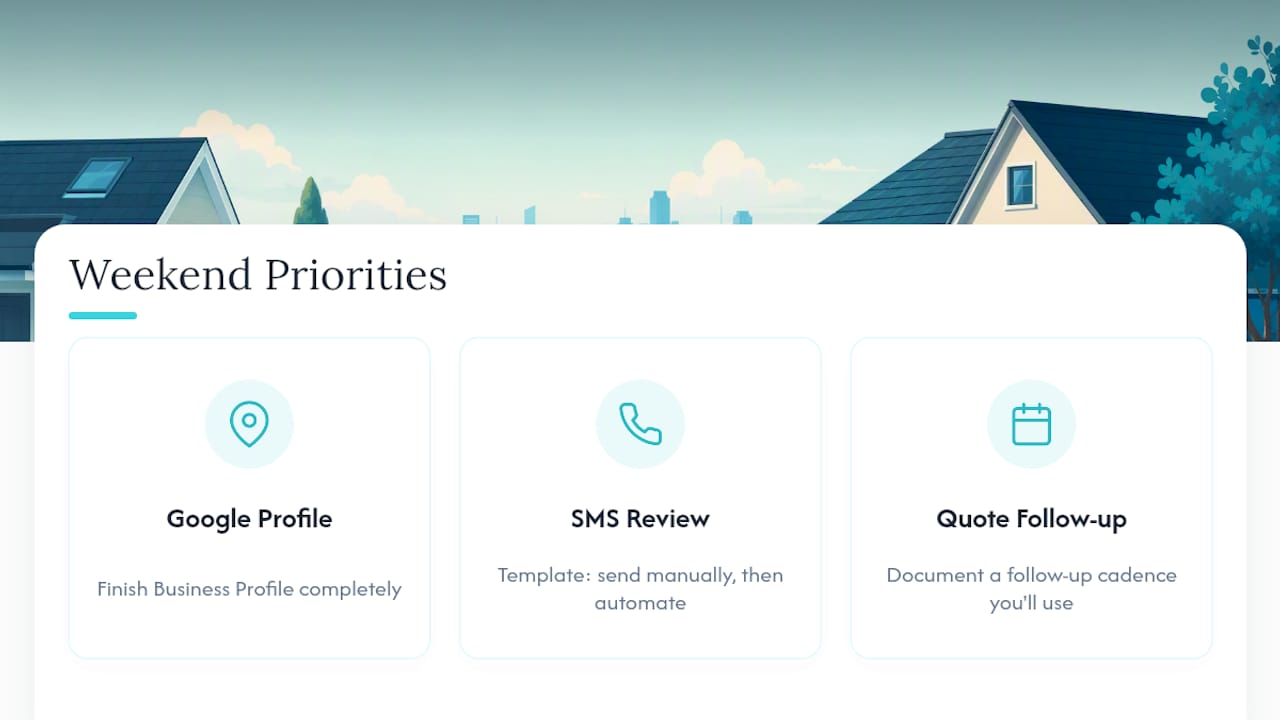
Every tactic in this article works, but not every tactic deserves your Saturday morning right now. If you've got two hours this weekend, spend it on three things: finish your Google Business Profile completely, set up an SMS review request template you can send manually until you automate it, and write down a real quote follow-up cadence you'll actually use.
Run your first paid test small. Two weeks, one channel, a budget you won't miss if it flops. Judge it on booked jobs, not clicks or impressions.
Weekly maintenance should take less time than one job site cleanup: check new reviews, respond to any negative ones, and glance at which lead source is closing the most work. The biggest trap is chasing vanity numbers, like profile views or ad impressions, instead of tracking what actually turns into a signed job. The second biggest trap is buying the cheapest leads available. Cheap leads are usually shared with five other contractors, and you'll spend more time losing bids than working jobs.
— jaras
A Simpler Way to Handle Quotes, Invoices, and Review Requests
Quotewren is built for exactly the workflow this article walks through: finish the job, send a quote or invoice on the spot, and let a three-touch SMS sequence handle the review ask automatically. You don't need to remember to text every customer at the two-hour mark. It happens the moment you mark a job complete.
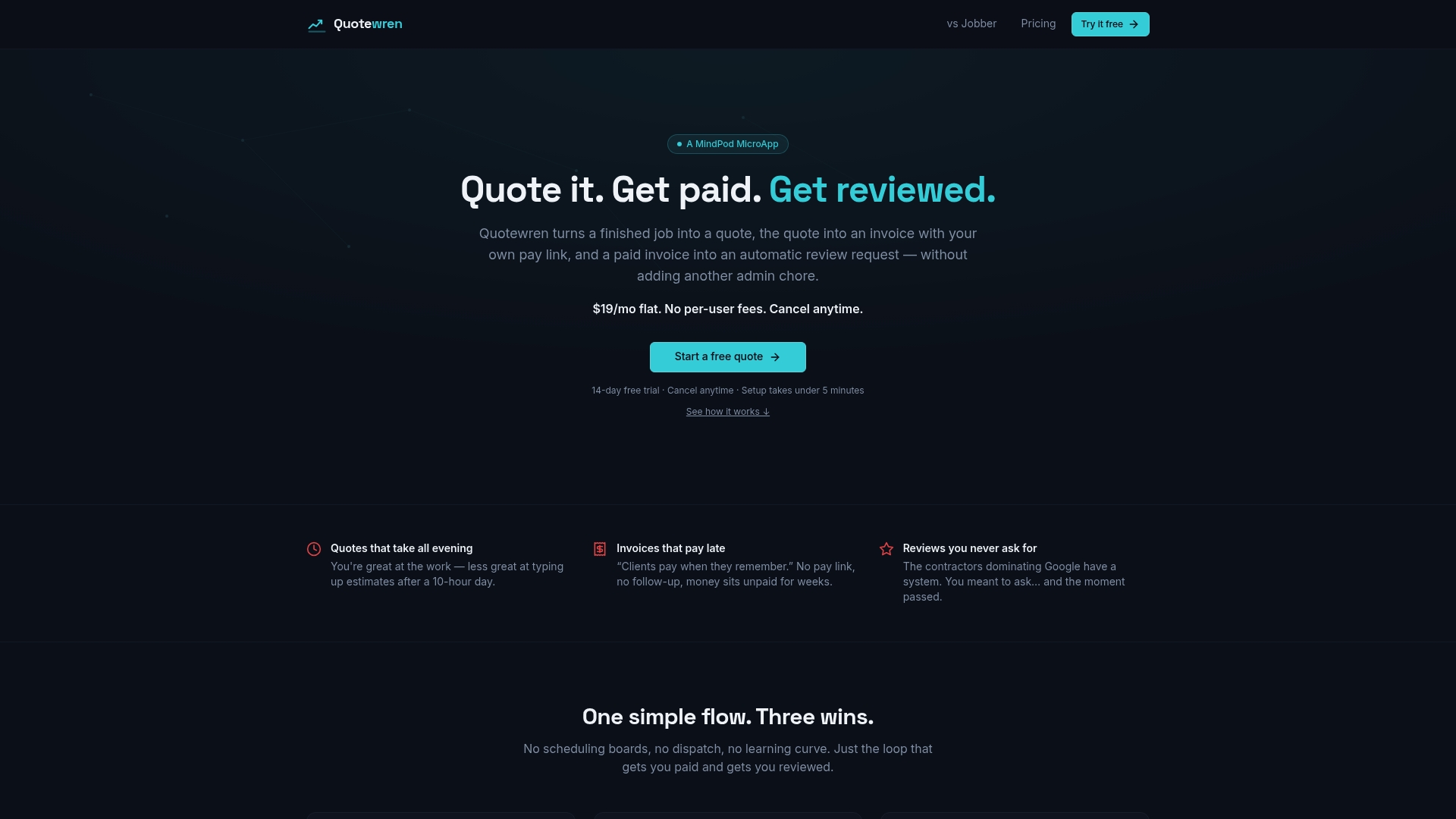
Compared to juggling a separate invoicing app, a separate texting tool, and a mental note to "ask for reviews later," Quotewren keeps quoting, getting paid, and getting reviewed in one simple flow built specifically for solo operators, not fleets. That means faster payment, since invoices and pay links go out while you're still standing in the customer's driveway, and steadier review velocity, since the ask never depends on you remembering after a long day. If you're spending more time chasing paperwork than doing billable work, check out Quotewren and see how the quote-to-review flow fits into your week.
Sources
- Guide to lead generation for local businesses - Google Ads
- Local SEO for Contractors: Rank Higher and Book More Jobs
- Local SEO for Home Service Contractors
FAQ
How Do You Generate Leads Locally?
Complete your Google Business Profile, ask for reviews by text right after each job, run a small Local Services Ads test, and build a couple of unique service-area pages on your website.
How Do You Generate a Lot of Leads Fast?
Paid channels like Local Services Ads or tightly targeted search ads move fastest, often producing calls within days, but they work best layered on top of a complete, review-rich Google Business Profile rather than used alone.
How Do You Get More Leads for Free?
Optimize your Google Business Profile, ask every customer for a review by text, swap referrals with two complementary local businesses, and post real job photos on social media consistently.
How Much Does It Cost to Get Local Leads?
Costs vary by trade and area, but many contractors start Local Services Ads or search ad tests with a small weekly budget and adjust based on cost per booked job, not cost per click.
Can Quotewren Help Me Get More Local Leads?
Quotewren doesn't run ads for you, but its automated review request feature after each finished job helps build the steady flow of Google reviews that improves local ranking and conversion over time.