

Prioritize Google Reviews first. Keep Yelp as a secondary presence when your trade or local market calls for it. Google Reviews power what shows up in Search and Google Maps, which is where most homeowners look when their water heater dies or their AC quits in July.
Here's your move this week:
- Claim (or verify) your Google Business Profile
- Write a short, one-line review request script you can say out loud after a job
- Get a QR code or short link ready to text or hand to customers on the spot
Do those three things before you worry about Yelp at all.
Key Takeaways
Google Reviews drive local search and Maps visibility directly, while Yelp offers narrower, category-specific value that rarely moves your Google ranking.
| Point | Details |
|---|---|
| Prioritize Google first | Claim your Google Business Profile and request reviews there before spending time on Yelp. |
| Recency beats raw count | Google rewards businesses with a steady flow of recent reviews, not just a high total. |
| Yelp filters aggressively | Yelp's recommendation algorithm hides many legitimate reviews, especially from newer accounts. |
| Match platform to trade | Restaurants and salons lean Yelp; plumbers, electricians, and HVAC techs lean Google. |
| Automate the ask | Quotewren sends timed SMS review requests right after invoicing so more happy customers actually leave a Google review. |
Table of Contents
- Google Reviews Vs Yelp: A Side-By-Side Comparison
- How Reviews Shape Your Spot in Local Search
- Spotting Fake Reviews and Keeping Your Reputation Clean
- A One-Week Plan to Fix Your Review Presence
- Who Actually Uses Google Reviews and Yelp
- What Each Platform Does for Your Reputation
- Messaging, Booking, and Other Platform Features
- How Businesses Respond to Reviews on Each Platform
- Where Each Platform Actually Reaches Customers
- Where Tradespeople Should Actually Focus
- Turn Every Finished Job Into a New Google Review
- Sources
- FAQ
Google Reviews Vs Yelp: A Side-By-Side Comparison
Both platforms collect star ratings and written feedback, but they work differently under the hood, and those differences change how much effort you should spend on each one.
Google Reviews show up directly in Google Search results and Google Maps, right next to your business name when someone searches "plumber near me" or "emergency electrician." Yelp reviews live mainly on Yelp's own site and app, though Yelp business pages can also rank in Google's organic search results (just not in the map pack). Yelp star ratings also feed Apple Maps, so if you get a lot of iPhone-using customers, Yelp still carries weight there.
Posting friction is another big split. Anyone with a Google account can leave a Google review in under a minute. Yelp uses an "engaged user" filter that tends to trust reviews from people with an established Yelp history, and it automatically hides reviews it decides aren't reliable enough into a "not recommended" section. That means a happy customer who rarely uses Yelp might leave you a glowing review that never shows up on your public page at all.
Moderation philosophy differs too. Google leans on recency and activity, rewarding businesses that keep earning fresh reviews over time. Yelp runs everything through its recommendation algorithm, which is stricter and less transparent, and according to BrightLocal's research on Yelp business reviews, Yelp reviews also tend to run longer and more detailed than a typical two-sentence Google review.
The SEO impact is where the two platforms really part ways. Google reviews feed directly into your Local Pack ranking, the three-business map listing that shows up above organic results for local searches. Yelp reviews don't move that needle directly. Yelp pages can rank in organic search and build brand visibility, but Flento's local SEO analysis confirms Yelp has no direct influence on where you land in Google Maps.
| Dimension | Google Reviews | Yelp |
|---|---|---|
| Visibility | Google Search and Maps, front and center | Yelp site/app, feeds Apple Maps stars |
| Posting friction | Low, any Google account works | Higher, engaged accounts favored |
| Moderation | Recency and activity signals | Recommendation filter, hides many reviews |
| SEO/Local Pack impact | Direct ranking factor | No direct Maps ranking impact |
| Industry strength | Home services, contractors, most local trades | Restaurants, bars, hospitality, salons |
Restaurants and hospitality businesses still lean heavily on Yelp because that's where diners habitually check before booking a table. Home service trades, electricians, plumbers, HVAC techs, and handymen get far more mileage out of Google, simply because that's where the emergency searches happen.
How Reviews Shape Your Spot in Local Search
Google decides who shows up in the Local Pack using a mix of signals, and reviews are one of the biggest levers a solo tradesperson can actually control. Three things matter most:
- Review count. More reviews generally signal a more established, trustworthy business to Google's algorithm.
- Recency and velocity. A business that earned 40 reviews and stopped two years ago looks weaker than one steadily picking up a few new reviews every month.
- Owner responses. Replying to reviews shows Google (and customers) that you're active and engaged with your listing.
Yelp works differently. Yelp business pages can rank in Google's regular organic search results, and Yelp star ratings feed directly into Apple Maps rankings, but Yelp activity does nothing to move your position in Google's map pack. If your leads come mostly from Android users and Google Maps searches, that gap matters a lot.
Search engines like Google handle the overwhelming majority of web searches, according to Statista's global market-share data, which is exactly why a Google-first strategy pays off faster for most local trades.
Track three numbers, ideally in a simple spreadsheet or right inside your Google Business Profile insights dashboard: reviews received in the last 90 days, your response rate, and how often reviews mention specific services. A review that says "fast emergency pipe repair, showed up in 30 minutes" does double duty. It builds trust with readers and helps you rank for that exact search phrase.
Statistic to remember: a one-star jump in average rating correlated with a 5 to 7 percent revenue increase for restaurants in a Harvard Business School study on online reviews. The study focused on restaurants, but the underlying logic (higher ratings mean more trust, more clicks, more calls) applies just as well to a plumber or electrician.
Spotting Fake Reviews and Keeping Your Reputation Clean
Yelp's recommendation filter exists to catch fake or solicited reviews, but it's a blunt tool. It often hides legitimate five-star reviews from real customers simply because their Yelp account is new or inactive. That's frustrating when you know the review is genuine, but Yelp's own policies explicitly discourage asking customers directly for reviews, which is part of why the filter is so aggressive.
Google has the opposite problem. Its lower barrier to posting means more volume, but also more noise, including the occasional review from a competitor or an angry customer who was never actually a client.
A few patterns are worth watching for:
- A burst of five or six reviews posted within the same hour or day, often a sign of a review-gating scheme or a competitor attack
- Reviews with no specific details about the job, service, or location
- Reviewer profiles with no photo, no history, and one single review ever posted
When you respond to reviews, keep it short and professional. Thank the customer by name if the review is positive. If it's negative, acknowledge the concern, state what you did or will do about it, and invite them to continue the conversation offline. Never argue in public. Yelp's own guidance for businesses recommends using reviews, good and bad, to spot patterns in your operations and fix what keeps coming up.
If a review violates platform policy (fake, from a non-customer, or contains harassment), both Google and Yelp have a "flag" or "report" option on the review itself. Document your case with screenshots and job records before you report it. For serious cases involving defamation or clearly fabricated claims, a local attorney familiar with online defamation can advise on next steps, though most disputes resolve through the platform's own reporting tools.
Pro Tip: Keep a simple text file or note with the date, customer name, and job address for every completed job. If a fake review ever shows up claiming to be a customer who doesn't match your records, you'll have proof ready in seconds instead of scrambling to remember.
A One-Week Plan to Fix Your Review Presence
You don't need a marketing degree to fix this. You need one focused week.
- Day 1: Claim and fully fill out your Google Business Profile: hours, service area, photos of finished jobs, and a clear list of services. Do the same basic setup on Yelp if your trade leans hospitality-adjacent or you get walk-in-style customers.
- Day 2: Write a one-line review request script. Something like, "Thanks for choosing us today. If you've got 30 seconds, a Google review helps other homeowners find us." Generate a QR code linking straight to your Google review page and print it on invoices or leave-behind cards.
- Days 3 to 7: Build a simple follow-up rhythm. Send a thank-you text within 24 hours of job completion. Send the actual review request around day 3, once the customer has had time to see the work hold up. If nothing comes in, send one gentle reminder around day 7. Never send more than that. Yelp in particular penalizes businesses that appear to be pressuring customers for reviews.
- Ongoing: Respond to every review, good or bad, within 72 hours. Log any recurring complaints (late arrivals, pricing confusion, communication gaps) and actually change something. Yelp's revenue-focused case studies show that businesses that treat reviews as a feedback loop, not just a scoreboard, tend to see the biggest gains over time.
Pro Tip: Tie your review request to the moment you send the invoice, not weeks later. The job is fresh in the customer's mind, and you're already asking them to complete one action (paying you). Adding a second short ask right next to it feels natural instead of like a separate, awkward follow-up.
Who Actually Uses Google Reviews and Yelp
Google Reviews reach nearly every kind of searcher, because they're baked directly into Google Search and Maps, the tools most people already open by habit when they need a local service. That includes homeowners searching in a panic at 11 PM because a pipe burst, someone comparing three landscapers before a Saturday quote, or a renter looking for a same-day locksmith.

Yelp's user base skews toward people specifically in the habit of researching before they buy, particularly around dining, nightlife, and personal care. Yelp built its brand on restaurant and bar discovery, and that culture still shapes who opens the app. Younger, urban users and people evaluating experience-driven purchases (a haircut, a spa visit, a first date restaurant) are more likely to check Yelp specifically, sometimes in addition to Google, sometimes instead of it.
For a solo tradesperson, this split matters practically. If you're an electrician or HVAC tech, most of your prospective customers are searching Google out of habit, not opening Yelp to browse. If you run a specialty service with an experience component, like a mobile pet groomer or a boutique cleaning service, some of your customers may genuinely check both.
Community discussions back this up anecdotally. A Reddit thread on where people actually check reviews shows users regularly noticing that the same business can carry noticeably different star averages across the two platforms, since the review pools and filtering rules simply aren't the same population of customers.
What Each Platform Does for Your Reputation
Your online reputation isn't one score. It's really two overlapping scores that different customers see at different moments, and managing them requires slightly different habits.
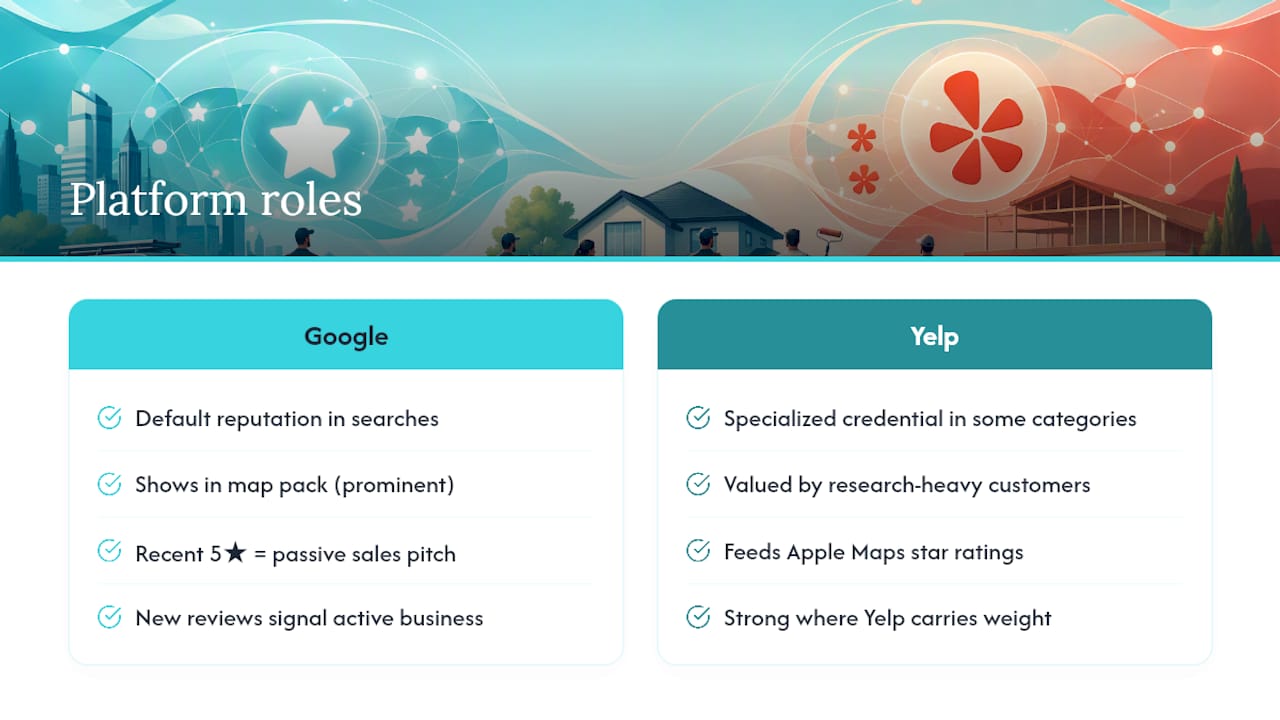
Google Reviews function as your default reputation anywhere someone searches your business name or your trade plus your city. Because Google reviews show up so prominently in the map pack, a string of recent five-star reviews acts like a constant, passive sales pitch running in the background every time someone searches. A steady flow of new reviews also signals to Google that you're an active, real business, which supports your ranking over time.
Yelp reputation works more like a specialized credential. In categories where Yelp carries weight (restaurants, bars, salons, some home services), a strong Yelp presence signals credibility to a specific subset of research-heavy customers, and it feeds Apple Maps star ratings for iPhone users browsing nearby options.
The risk with treating both platforms equally is dilution. Chasing Yelp reviews aggressively when your trade doesn't fit its user base pulls energy away from Google, where your actual leads originate. The smarter reputation strategy for most solo tradespeople is concentrated: build a deep, current bench of Google reviews first, then treat Yelp as a supplementary listing you keep accurate and occasionally nudge, rather than a parallel campaign.
Messaging, Booking, and Other Platform Features
Beyond star ratings, Google and Yelp offer different tools that can shape how customers actually reach you.
Google Business Profile includes a built-in messaging feature that lets customers text your business directly from your Search or Maps listing, along with the ability to post updates, add service menus, and list your booking link if you use a scheduling tool. Google also supports Google Posts, short update snippets that appear on your profile, useful for announcing seasonal specials like gutter cleaning before winter or AC tune-up discounts before summer.
Yelp offers its own messaging system, Yelp Request a Quote, which lets potential customers send project details directly to businesses, along with a Yelp Reservations tool aimed mainly at restaurants. Yelp also supports business highlights, like badges for "Yelp Guaranteed" services in select categories.
For a solo tradesperson, Google's messaging and service-menu features tend to matter more day to day, since that's where the higher volume of local search traffic already lives. Yelp's request-a-quote tool can generate solid leads in trades like landscaping or cleaning, where customers often want a quick estimate before committing to a call, but it's a secondary channel rather than a primary one for most contractors.
How Businesses Respond to Reviews on Each Platform
Both platforms let you reply publicly to reviews, but the tools and expectations differ enough to matter.
On Google, you respond directly from your Google Business Profile dashboard, and your reply appears immediately underneath the customer's review for anyone to see. There's no review or approval delay, and you can edit your response later if needed. Google also lets you respond to reviews via the Google Business Profile mobile app, useful when you're on a job site and want to fire off a quick thank-you between calls.
Yelp works similarly for public replies, but Yelp also offers a private message option that lets you reach out to a reviewer without posting anything public first. That's useful for touchy situations, like a customer who left a negative review over a miscommunication about pricing, where you'd rather resolve it quietly before anything shows up in public.
Response speed matters on both platforms. A business that replies to reviews regularly signals to future customers (and to Google's ranking algorithm) that someone is actually paying attention. Yelp's own business guidance specifically recommends using both public and private responses to de-escalate problems and show prospective customers you take feedback seriously.
Where Each Platform Actually Reaches Customers
Google's footprint is close to universal. Wherever there's a Google Maps pin and a working internet connection, your Google Business Profile can show up, which covers rural service areas as easily as dense cities. That matters if you're a landscaper or HVAC technician covering a wide county route rather than a single neighborhood.
Yelp's coverage is heavier in urban and suburban markets, particularly areas with a strong dining and nightlife scene. Yelp's user density thins out fast in smaller towns and rural service areas, which is exactly where a lot of independent electricians, plumbers, and handymen actually do their work.
Practically, this means a tradesperson working a rural or small-town service area may find Yelp effort largely wasted, while the same effort on Google Business Profile pays off regardless of population density. In dense metro markets, especially for trades that overlap with home renovation or design (kitchen remodelers, interior painters), Yelp's audience is large enough to be worth a light, ongoing presence alongside your Google focus.
Where Tradespeople Should Actually Focus
The conventional advice floating around online tends to treat Google and Yelp as equal priorities, something you should "manage" side by side with the same amount of energy. That advice doesn't hold up once you look at where solo tradespeople actually get their leads. A plumber searching for reputation-building tips doesn't need a balanced strategy. They need to know which platform their next customer is actually using, and for the overwhelming majority of home service trades, that's Google.
What gets overlooked is how much Yelp's own rules work against a tradesperson trying to build reviews fast. The engaged-account filter and the ban on direct solicitation mean you can do everything right and still watch good reviews vanish into the "not recommended" pile. Google has no equivalent friction. Ask, and if the customer follows through, the review posts.
My honest read: spend 80 to 90 percent of your review effort on Google, matching what Flento's industry analysis recommends for most local businesses, and treat Yelp as a listing you keep current, not a campaign you run. Claim it, fill it out, respond if something comes in, and move on. The tradespeople who win the review game aren't the ones spread thin across five platforms. They're the ones who made asking for a Google review a habit built into every single job.
Turn Every Finished Job Into a New Google Review
Most solo tradespeople know they should be asking for reviews. Almost none of them actually do it consistently, because remembering to ask, finding the link, and following up all take time you don't have between jobs.
Quotewren was built around that exact gap. Once you mark a job complete and send the invoice, Quotewren automatically fires off a three-touch review request by text, timed to hit while the work is still fresh in the customer's mind, without you having to remember a thing. Since Google reviews carry the most weight for local search visibility, that automation is aimed squarely at the platform that actually moves your ranking, not scattered across every review site at once. It also means your invoicing and your review requests run through the same simple workflow, so faster payment and a steadier flow of fresh Google reviews happen from the same five minutes of setup.
If you're ready to stop letting good reviews slip through the cracks, start a free trial with Quotewren and see your first automated review request go out after your next completed job.
Sources
- Flento: Yelp vs Google Reviews: Which Platform Actually Matters More for Local SEO in 2026?
- BrightLocal: Yelp business reviews
- Yelp for Business blog: Using reviews to help your business shine and improve
FAQ
What's more reliable, Yelp or Google reviews?
Google reviews are generally more reliable for gauging overall local reputation because the larger pool of reviewers reduces the impact of any single fake or filtered review. Yelp reviews tend to be more detailed, according to BrightLocal, but its filter can hide a large share of legitimate feedback.
What is the most trustworthy review site?
There's no single most trustworthy site across every industry. Google Reviews carries the broadest trust for most local trades because of its scale and direct tie to search visibility, while Yelp holds more trust specifically in restaurants, bars, and hospitality.
Do Google reviews exist anymore?
Yes, Google Reviews remains one of the most active review systems available, fully integrated into Google Search and Google Maps. Tools like Quotewren focus specifically on Google review requests because that's where most local search traffic and customer decisions still happen.
How do I look up people's Google reviews?
Search the business name on Google or open its listing in Google Maps, then tap or click the review count to see individual reviews. You can also see a reviewer's public profile and review history by clicking their name, though privacy settings limit some personal details.