

Yes, Google reviews help your ranking, especially in the map pack where local customers actually find you. Google confirms that review count and average rating factor directly into local search results. They matter less for your regular website ranking, but they still move the needle there too, through clicks and trust. The fix is simple: build a steady, honest habit of asking every customer for a review right after the job is done.
TL;DR:
- Most reviews are more influential in local map pack rankings when their volume, recency, and detailed comments increase, rather than just high star ratings.
- Consistently asking every customer for a review immediately after service, with automated follow-up tools, leads to a steady growth in reviews and better prominence signals.
- Fake or manipulative review practices can get your profile penalized, while honest, regular feedback from real customers builds genuine trust and credibility.
- Review metrics such as total count, average rating, and recent activity are key indicators to monitor weekly or monthly for tracking progress.
- Improving local rankings through reviews also indirectly benefits organic website clicks, star snippets, and overall online trust.
Table of Contents
- Do Google Reviews Help Ranking in the Map Pack?
- Which Review Details Actually Move Your Ranking?
- Local Pack vs. Organic SEO: What Reviews Actually Change
- How to Build a Review Habit That Actually Works
- Watch Out for These Google Review Mistakes
- How to Know If Your Review Strategy Is Working
- How Quotewren Keeps Your Review Pipeline Running
- What Solo Tradespeople Get Wrong About Reviews
- Try Quotewren to Automate Your Review Requests
- Sources
- FAQ
Do Google Reviews Help Ranking in the Map Pack?
Google ranks local results using three main factors: relevance, distance, and prominence. Reviews live inside that third factor, prominence, which is Google's way of measuring how well known and trusted a business is.
Google's own help documentation states plainly that review count and score are used to figure out local ranking. That means a plumber with 85 reviews and a 4.7 average has a real edge over a competitor with 12 reviews, all else being equal.
Here's what feeds into that prominence score:
- Review count. More reviews signal that real customers trust you enough to leave feedback.
- Average rating. A higher score builds credibility with both Google and the person searching.
- Review text. When customers mention specific services like "water heater repair" or "gutter cleaning," it gives Google topical clues that can help you show up for those exact searches.
None of this replaces having a complete Google Business Profile with the right category and service area. Reviews are one input, not the whole formula.
Which Review Details Actually Move Your Ranking?
Not every review carries the same weight. Four things matter most: how many you have, what your average score is, how recent they are, and what they actually say.
- Volume beats a tiny perfect score. An electrician with forty reviews at 4.5 stars usually outranks one with five reviews at 5.0 stars in a competitive market. Search Engine Land reports that quantity, recency, and content each play a distinct role in visibility.
- Rating has a floor. Many "best" or "top" filtered searches favor listings above roughly a 4.0 average. Fall below that and you can lose visibility for those filtered searches entirely.
- Recency and steady flow beat one big push. A business earning two or three reviews a month looks healthier to Google than one that got fifteen reviews in a single week and then went quiet for a year.
- Photos and specific details help. A review that says "fixed our AC compressor same day" and includes a photo tends to stick near the top of your profile and carries more trust than a generic five-star rating with no comment.
Pro Tip: Ask happy customers to name the actual job in their review, like "replaced our kitchen faucet" instead of just "great service." That small detail can help you show up for people searching that exact repair.
Local Pack vs. Organic SEO: What Reviews Actually Change
Reviews have a direct effect on one thing: your spot in the local map pack. They have an indirect effect on your regular website ranking, sometimes called organic or blue-link results.
For the map pack, review count and rating are baked into Google's ranking formula. There's no guesswork there. For your website's organic listing, reviews work differently:
- They boost your click-through rate. People scrolling search results tend to click the business with more stars and reviews first, even if it's not ranked first.
- Star ratings can show up as rich snippets next to your listing when your site has AggregateRating schema set up correctly. Shopify's guide on review SEO confirms this can lift clicks without actually changing your position on the page.
- More clicks and longer time on your site send positive engagement signals, which can help your organic ranking over time, indirectly.
So reviews push the map pack directly and nudge organic rankings from the side.
How to Build a Review Habit That Actually Works
You don't need a marketing team to get more Google reviews. You need a routine you actually follow after every job.
- Ask every customer, every time. Once the invoice is paid and the job is done, send a text with a direct link or QR code to your Google review page. Don't skip the customers who paid late or the ones with a smaller job. Asking everyone, not just your favorites, keeps you on the right side of Google's rules.
- Set a monthly goal based on your competition. Set a monthly goal based on your competition by checking their profiles once a month to see where they stand, and aim to surpass their review growth. Check their profiles once a month to see where they stand.
- Respond to every review, good or bad. A quick, polite reply to a three-star review about a scheduling delay shows future customers you take feedback seriously. Google also documents how to manage and respond to reviews directly in your Business Profile.
- Share standout reviews on your website. With the customer's permission, post a review that mentions your specific service, like "rewired our whole garage," on your site. It adds relevance signals Google can pick up on.
- Track four numbers monthly: total review count, average rating, how recent your last five reviews are, and your map pack position for your top two or three services.
Expect changes to show up slowly. Some markets shift within a few weeks. Others take a few months, especially in cities with a lot of established competitors. If you want a second set of eyes on your map pack position over time, tools like Maprank track ranking by location, which helps you see if your review push is actually working.
Pro Tip: Keep your review link somewhere it can't get lost, like a text message you send the same day you close out the invoice. Waiting a week to ask usually means the customer forgets or never sees your request.
Watch Out for These Google Review Mistakes
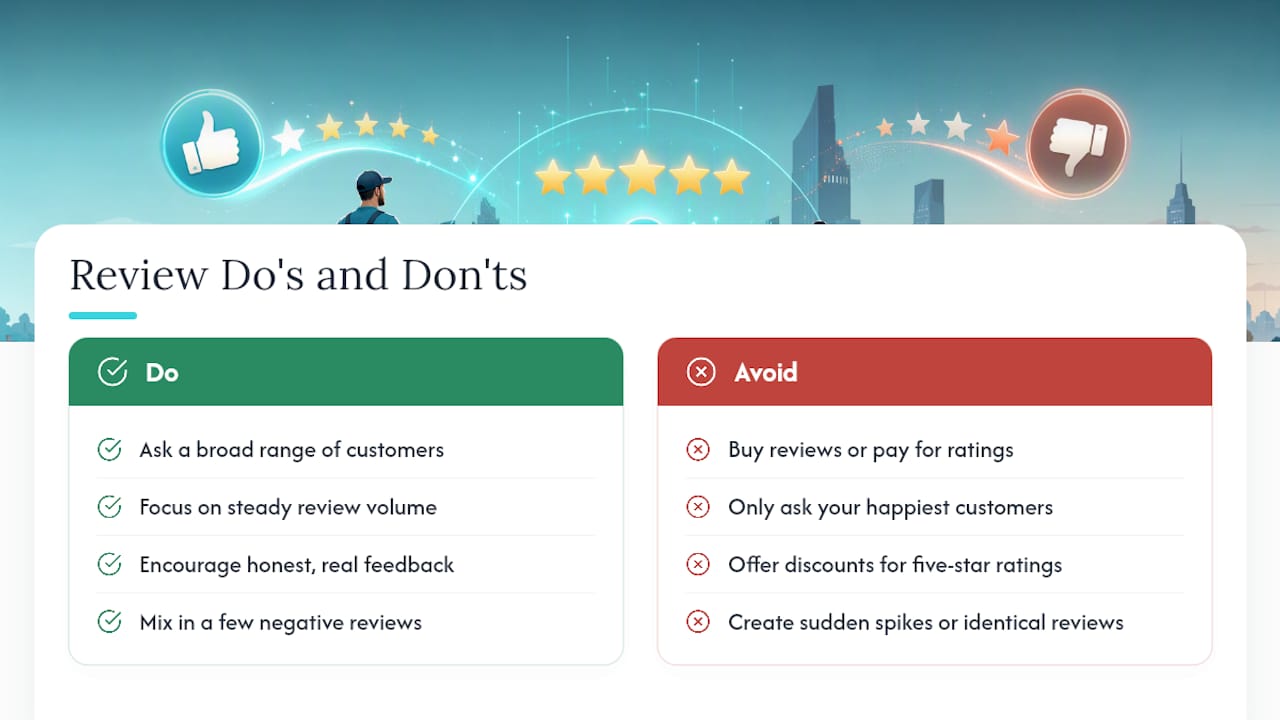
Buying reviews, only asking your happiest customers, or offering a discount in exchange for a five-star rating all break Google's rules. This kind of selective solicitation, sometimes called gating, can get your reviews removed and put your whole profile at risk.
Google also watches for warning signs like a sudden spike of ten reviews in one day, several reviews using nearly identical wording, or reviews coming from accounts with no other activity. Search Engine Land documents how these patterns get flagged and removed.
Here's the part most business owners get backwards: you don't need a perfect 5.0 score. A few honest negative reviews mixed into a strong overall rating actually builds more trust with customers than a suspiciously flawless profile. Focus on steady volume and real feedback instead of chasing perfection.
How to Know If Your Review Strategy Is Working
Four numbers tell you almost everything: total review count, average rating, how recent your latest reviews are, and your map pack position for the services you care about most.
- Check these numbers weekly if you're actively building reviews, or monthly once you have a steady routine going.
- Compare your review count to two or three competitors in your service area. If they're gaining three reviews a week and you're gaining one, that gap will show up in the rankings eventually.
- Don't expect overnight movement. Industry guidance on review timing points to steady, consistent review flow as more effective than short bursts, and results tend to build over weeks or months, not days.
Set a realistic target, like five new reviews a month, and track it the same way you'd track any other part of your business.
How Quotewren Keeps Your Review Pipeline Running
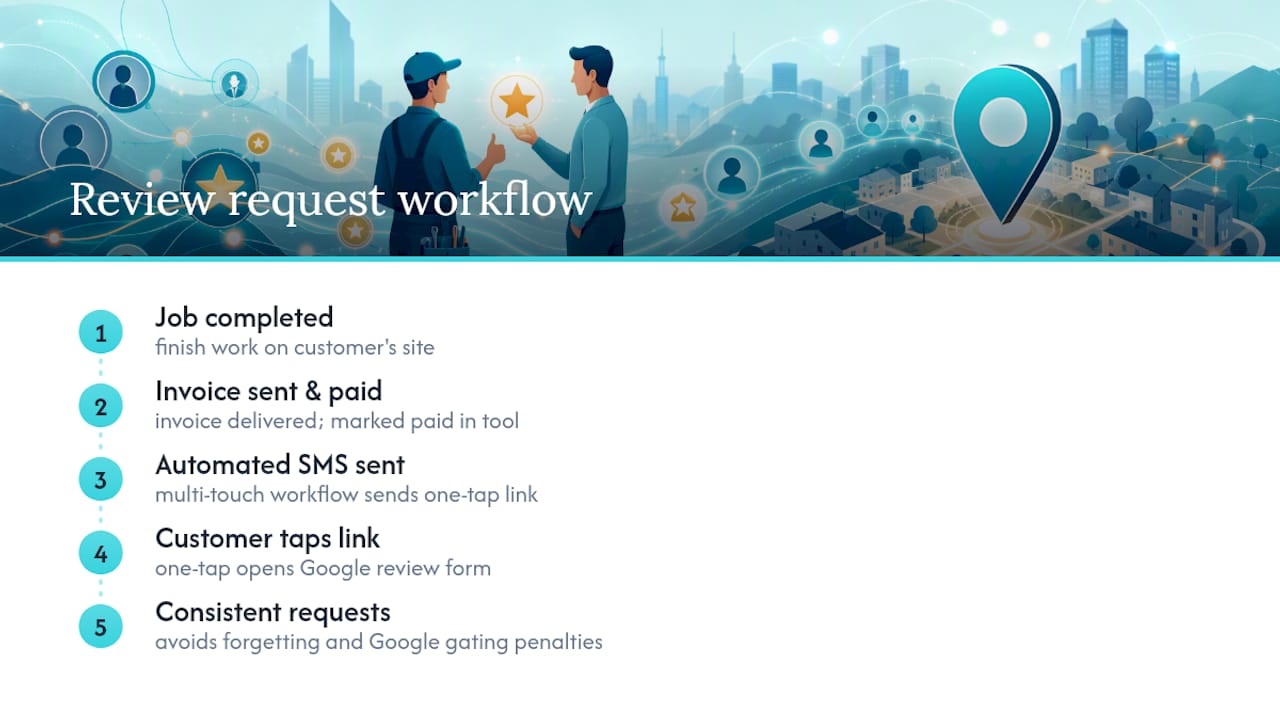
Most tradespeople don't lose reviews because customers refuse to leave them. They lose reviews because nobody asks. The gap can be addressed by sending automated review requests through a multi-touch SMS workflow right after a job wraps up.
Here's how it plays out in real life: you finish rewiring a customer's kitchen outlets, send the invoice through a tool, and the moment it's marked paid, the customer gets a text with a one-tap link to leave a Google review. No sticky notes, no forgetting, no playing favorites with which customers you ask. Every completed job triggers the same request, which keeps you clear of the gating problem Google penalizes.
What Solo Tradespeople Get Wrong About Reviews
Most solo operators either ignore reviews completely or panic and try to get fifty in a week. Both are mistakes. A slow business gets a slow trickle of feedback that never builds any real prominence with Google. A rushed batch of reviews can look suspicious and get flagged.
The businesses that win at this treat review requests the same way they treat sending an invoice: automatic, consistent, and tied to the moment a job wraps up. Pair that habit with a fully filled out Google Business Profile, and you'll see steadier movement than any short-term push could deliver.
— jaras
Try Quotewren to Automate Your Review Requests
Quotewren is the tool that handles the part most tradespeople skip: asking for the review. Once you finish a job and send the invoice through a tool, the system can send a follow-up text with a direct review link, so every customer gets asked, not just the ones you remember.
That consistency is the difference between a profile stuck at fifteen reviews for two years and one that climbs steadily month after month. If you want help figuring out where to send that review link once you have it, check out this guide on getting your Google review link set up fast. When you're ready to stop chasing reviews manually, start with Quotewren and let the follow-up happen on its own.
Sources
- Local ranking: How Google ranks local results — Google Business Profile Help
- How Google reviews power up your local SEO — Search Engine Land
- How customer reviews affect SEO — Shopify
- Reviewly
FAQ
How many Google reviews do I need to rank higher?
There's no fixed number, but businesses with dozens of reviews consistently outrank those with only a handful in competitive service areas. Focus on steady monthly growth rather than hitting a specific count.
How many 5 star reviews does it take to offset a 1 star review?
There's no set ratio Google publishes, and chasing that math misses the point. A strong overall average built on genuine volume matters more than trying to bury one bad review under a pile of new ones.
How much is a 5 star Google review worth?
Its exact dollar value isn't published anywhere, but a strong rating drives more clicks and boosts trust enough to influence which business a customer calls first. The bigger value comes from consistent reviews building your overall prominence over time.
What helps Google ranking the most for local businesses?
A complete Google Business Profile, steady review growth, and consistent NAP (name, address, phone) accuracy across the web all help. Reviews are one of the most controllable factors, since you can influence them daily through your own outreach with a tool like Quotewren.
Do reviews help my regular website show up in Google search, not just the map pack?
Indirectly, yes. Reviews improve your click-through rate and can trigger star rich snippets through schema markup, both of which support your organic listing without directly changing where it ranks.