

Tell affected customers in plain language, give one-off clients 2 to 4 weeks' notice and recurring or subscription customers 30 to 60 days, and include the new price, the effective date, and a contact for questions. Explain the reason honestly: research on price increase messaging found that explaining price increases as due to market factors significantly cut customer attrition compared to giving no reason. Below you'll find timing rules, copy-ready templates, and scripts for handling pushback.
TL;DR:
- Customers on subscription plans generally need 30 to 60 days' notice, while one-off clients require only 2 to 4 weeks to prepare for a price change.
- Explaining the increase as due to market factors or rising costs significantly reduces customer attrition, especially when cited honestly.
- Clear communication must include the new price, effective date, specific services affected, and contact details for questions, with invoices updated in advance.
- Personal outreach or targeted messages for long-term or high-volume clients improve acceptance compared to generic notices.
- For recurring billing, compliance with FTC rules requires transparent disclosures, explicit cancellation options, and consistent messaging across channels.
Table of Contents
- Best-practice checklist for timing, audience, and message framing
- Templates and copy-ready examples to use or adapt
- Wording, subject lines, and personalization that reduce backlash
- Timing and delivery logistics: lead times, channel mix, and effective dates
- Legal and compliance check for recurring charges and auto-renewals
- Handling customer responses: scripts for objections, refunds, and negotiations
- Other channels: in-person notices, printed invoice notes, and social posts
- Practitioner perspective: what actually works for solo tradespeople
- How Quotewren helps you send the notice and keep the cash flowing
- Sources
- FAQ
Best-practice checklist for timing, audience, and message framing
Before you write a single word, get your facts straight. A price increase notice works best when it's short, specific, and sent early enough that nobody feels ambushed.
Start with timing. One-off jobs like a bathroom faucet swap or a one-time lawn cleanup need less runway than recurring services like monthly HVAC maintenance or a weekly cleaning contract. Recurring customers have budgets and billing cycles built around your current price, so they need more time to adjust or opt out.
Next, think about who gets special treatment. Not every client needs the same message.
- Long-term clients who've been with you for years often deserve a personal call or a grandfathered rate for a set period.
- High-volume customers, like a property manager who sends you five jobs a month, are worth a direct conversation before the mass email goes out.
- New or one-time customers can usually get the standard notice without extra handling.
- Price-sensitive segments, such as fixed-income homeowners on a maintenance plan, may need advance notice plus a payment plan option.
When you explain the increase, be honest about the reason. If it's rising material costs, higher fuel prices, or simply the market rate for your trade, say so. The UT Haslam research found that customers view market-based explanations, like limited availability or rising demand for skilled trades, as fair when the claim is true, and that fairness perception is what reduces churn.
Every notice needs four facts stated clearly: the new price, the effective date, exactly which services or products it applies to, and who to contact with questions. Leave any of these out and you'll spend the next two weeks answering the same email.
Pro Tip: Update your invoice template with the new price before you send a single notice, so there's no gap between what you announce and what you bill.
Finally, set yourself a reminder. Block time on your calendar to follow up with anyone who hasn't responded within a week, and note in your invoicing system which clients got a grandfathered rate so you don't accidentally overcharge or undercharge them later.
Templates and copy-ready examples to use or adapt
You don't need to write these from scratch. Adapt the wording below to your trade and your voice, then send.
- Email for a recurring or subscription service. Use this for monthly pest control, lawn care contracts, or HVAC maintenance plans.
Hi [Name], starting [date], the monthly rate for your [service] plan will change from [$old price] to [$new price]. This reflects [reason, such as rising supply costs]. Your next invoice on [date] will show the new rate. If you'd like to adjust your plan or have questions, reply here or call [phone]. No action is needed if you'd like to continue as-is.
- Letter or email for a one-off job. Use this when quoting a new job at a higher rate than a returning customer might expect.
"Hi [Name], thanks for reaching out again. Our current rate for [service] is now [$new price], effective [date], due to [reason]. I wanted to flag that before sending your estimate so there are no surprises. Let me know if you'd like to move forward or have any questions."
- Grandfathering template for long-term clients. Use this to reward loyalty without freezing your prices forever.
"Hi [Name], you've been a great customer for [X years], so I want to give you a heads-up personally. New clients are now paying [$new price] for [service], but I'm holding your rate at [$old price] through [date] before it adjusts to [$new price or a partial increase]. Just wanted you to hear it from me first."
- Payment plan or phased increase offer. Use this for price-sensitive clients on a maintenance contract.
"Hi [Name], I know a price change can be tough to plan around. Instead of the full increase at once, I can phase it in: [$price] starting [date], then [$price] starting [later date]. Let me know if that works better for you."
For solo tradespeople who invoice on-site, keep these shorter tools ready:
- Invoice note: "Effective [date], our standard rate for [service] increases to [$new price]. Thank you for your continued business."
- SMS reminder: "Quick heads-up: our rates for [service] change to [$new price] starting [date]. Details in your email. Questions? Call [phone]."
- In-person script: "Just so you know, our pricing for [service] is going up to [$new price] starting next month. I sent details to your email, happy to answer anything now."
Guides like Same Day Painter Invoices show how a brief note on a finished invoice can carry this kind of message without a separate mailing. If you want a full library of copy you can lift and adjust, 5 Copy Ready Invoice Wording Examples for Solo Trades has more.
Wording, subject lines, and personalization that reduce backlash
The words you choose in the first line decide whether a customer reads the whole notice or fires off an angry reply. Keep the subject line direct. Avoid vague or cheerful lines that feel like they're hiding something.
- Direct: "Price update for your [service] starting [date]"
- Benefit-focused: "What's changing (and staying the same) with your [service]"
- Avoid: "Important update!" or "Big news about your account," both of which read as evasive or salesy.
Open the message by acknowledging the relationship before you state the change. A line like "You've been a great customer, so I wanted to give you advance notice" does more work than jumping straight to numbers. Then state the change in one plain sentence: what's changing, by how much, and when.
Personalize based on value, not guesswork. A client who calls you three times a year for small jobs can get the standard email. A client who's paid for four kitchen remodels over five years deserves a phone call or at least a name-specific note, not a form letter. The Get Paid Faster guide has more examples of subject lines that get opened instead of ignored, which applies just as well to price notices as it does to payment reminders.
Timing and delivery logistics: lead times, channel mix, and effective dates
Give one-off jobs 2 to 4 weeks' notice before the new price takes effect. Give recurring services and subscriptions 30 to 60 days, longer if your contract requires it.
- Primary channel: email, since it's documented and easy to reference later.
- Backup: a short note on the next invoice, so anyone who missed the email still sees it before paying.
- Optional: SMS for time-sensitive reminders, and a mailed letter for older clients who don't check email often.
State the effective date the same way everywhere it appears: on the notice, the next invoice, and any future quotes. If you're using progress invoicing for staged jobs, make sure the new rate only applies to work billed after the effective date, not work already in progress. Document grandfathered pricing directly in your invoicing software so nobody on your team accidentally bills the wrong rate.
Legal and compliance check for recurring charges and auto-renewals
If you run any kind of subscription or recurring billing, the FTC's amended Negative Option Rule requires clear disclosure of material terms, informed consent for auto-renewals, and a simple way for customers to cancel. A price increase notice on a recurring plan needs to meet all three.
Three steps keep you compliant:
- State the new price and effective date clearly in the notice itself, not buried in fine print.
- Include a working cancellation link or phone number in the same message.
- Update your checkout or sign-up language so new customers see current pricing terms, not outdated ones.
The FTC's final rule text lays out enforcement authority for violations of these disclosure and cancellation requirements, and legal guidance on the amended rule warns that unclear disclosures on recurring charges can trigger enforcement action. If you bill recurring clients, it's worth a quick review of your billing flow now rather than after a complaint.
Handling customer responses: scripts for objections, refunds, and negotiations
Most pushback falls into three categories, and a short script handles each one.
- Upset customer: "I understand this is frustrating. The increase reflects [honest reason], and I wanted you to hear it directly from me rather than see it on an invoice."
- Price-questioning client: "Happy to explain. [Reason, such as material costs or demand for the trade] means the new rate is [$price], effective [date]. I can also walk you through what's included."
- Long-term client asking to negotiate: "I can offer you [$price] through [date] as a loyalty rate, then it adjusts to [$new price]. Want me to send that in writing?"
If you agree to a payment plan or a phased increase, put it in writing immediately, even a short email confirming the terms. Log the outcome in your invoicing system and set a reminder for when the transitional rate ends, so it doesn't quietly become permanent by accident.
Other channels: in-person notices, printed invoice notes, and social posts
For tradespeople who collect payment on-site, like most plumbers, electricians, and handymen, the invoice itself is often the easiest place to deliver the message. A single line, "Effective [date], rates for [service] increase to [$new price]," does the job without a separate conversation.
- Keep SMS short and use it for reminders, not full explanations. A text should point back to the email or invoice for details.
- If you post pricing updates on social media, state facts only: new price, effective date, and what it applies to. Skip the comment section debates and direct anyone with questions to call or email instead.
- Guides like Handyman Invoicing for Solo Pros show how to build these short scripts directly into your existing invoicing habits.
Practitioner perspective: what actually works for solo tradespeople
The notices that work best are short and attached to something the customer already opens, like an invoice. A one-line note on a finished job's invoice reaches people faster than a separate email they might skip. For clients worth protecting, a quick text or call beats a form letter every time, even if it takes five extra minutes.

Picture a solo electrician raising rates for a maintenance contract: a short invoice note covers most clients, while a two-minute call to the property manager who sends the most work keeps that relationship steady. Clear invoices and quick follow-ups cut down on disputes and keep payments coming in on schedule.
How Quotewren helps you send the notice and keep the cash flowing
Once you've written your price increase message, the real work is making sure every invoice reflects it and every follow-up happens without you chasing it manually. Quotewren lets you build branded invoices, add a short price-change note directly to the invoice, and automate follow-up messages after a job wraps up.
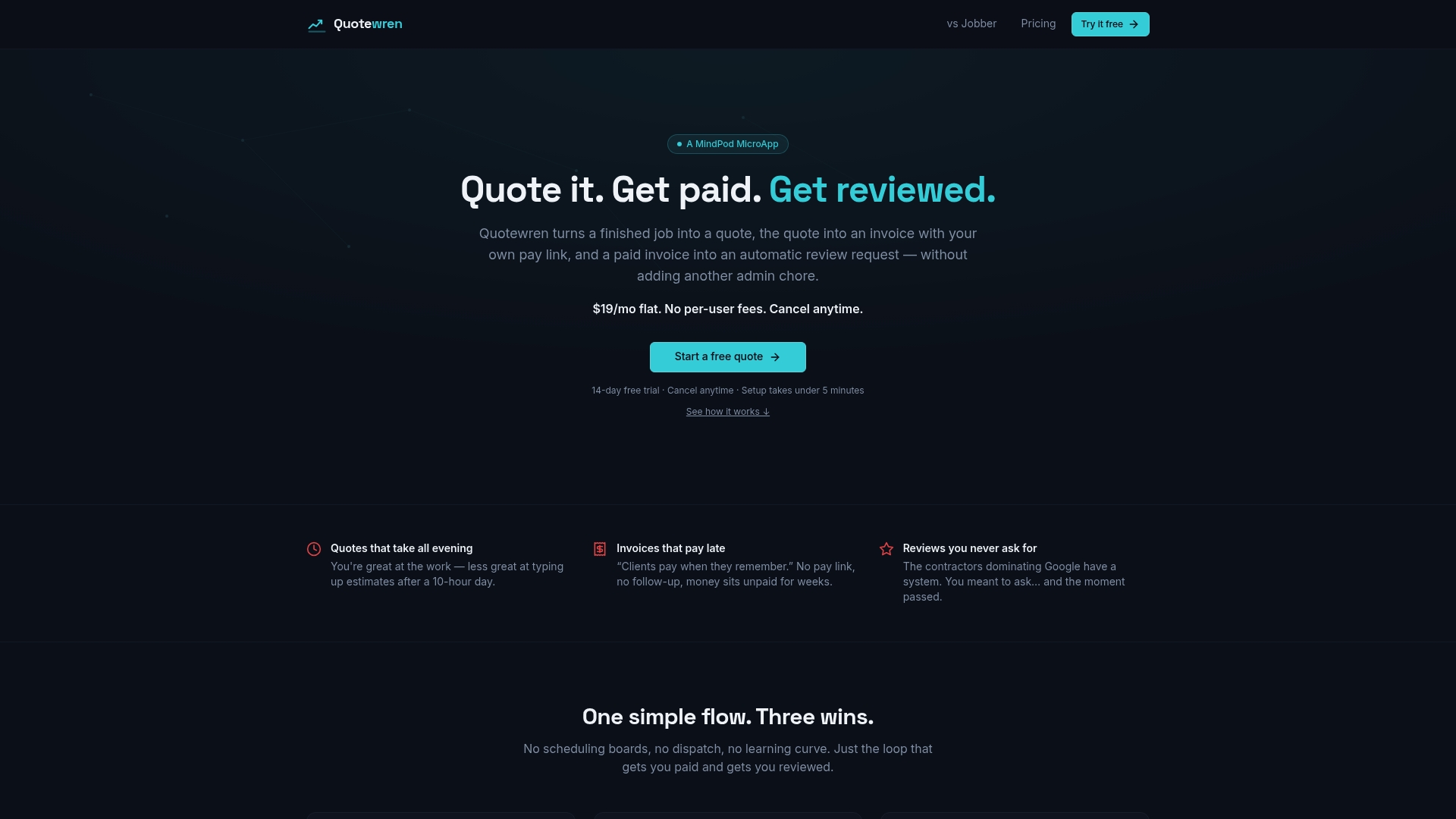
Say you raise your rate for a monthly lawn service. You send the updated invoice with a one-line note about the new price, and Quotewren automatically follows up for payment and, once that's settled, sends a review request. That's the same workflow covered in Solo Tradespeople: Create Branded Invoices in Under 10 Minutes, built right into your billing. Plans start at Quotewren for $19 a month, with a free tier to try it first. Head to App to set up your first branded invoice today.
Sources
For the full text behind the compliance steps above, read the FTC's Negative Option Rule directly. For the research on messaging and customer attrition, see the Haslam College study summary. For invoice terms that align your effective date with your billing, see Stop Waiting 83 Days for Payment.
- UT Haslam researcher finds messaging matters in price increase notifications
- Click to cancel: FTC’s amended Negative Option Rule — what it means for your business
FAQ
How do I announce a price increase?
Tell customers directly through email or an invoice note, stating the new price, the effective date, and the reason if it's honest and specific. Give one-off clients less notice than recurring or subscription customers, and always include a contact for questions.
How much notice should I give for a price increase?
One-off jobs typically need 2 to 4 weeks' notice, while recurring services or subscriptions need 30 to 60 days, longer if a contract requires it. Longer notice on subscriptions gives customers time to adjust their budget or cancel if needed under the FTC's disclosure and cancellation rules.
How do I write a price increase letter?
State the new price, the effective date, what services it applies to, and a brief honest reason, then close with contact information for questions. Keep it short, plain, and attached to something the customer already checks, like an invoice or email.
How do I announce a rate increase for a recurring service?
Give recurring or subscription customers 30 to 60 days' notice by email, clearly stating the new rate, the effective date, and how to cancel if they choose not to continue. This kind of clear disclosure is also required under the FTC's Negative Option Rule for auto-renewing charges.