

Progress invoicing means billing a project in stages instead of waiting until the whole job is done. You invoice for the percentage complete or the milestone finished, get paid, then move to the next phase. It works best on multi-month, material-heavy, or multi-phase jobs, like a kitchen remodel, a full-home repipe, or a multi-stage electrical panel upgrade, because it keeps cash coming in and sets clear expectations with the client before work even starts.
TL;DR:
- Progress invoicing is best suited for multi-phase or material-heavy projects, providing predictable cash flow by billing at set stages rather than at project completion.
- Choosing the right billing model depends on project scope: percentage-of-completion suits gradual progress, milestone billing aligns with specific approvals, and equal slices offer simplicity.
- Every progress invoice should include detailed records of work done, cumulative billed amounts, retainage withheld, and clear references to change orders and payment terms.
- Accurate and objective acceptance criteria, combined with timely approvals and consistent record reconciliation, minimize payment disputes and delays.
- Implementing automated workflows and clear contractual language ensures smooth progress invoicing, helping contractors maintain steady cash flow and avoid administrative errors.
Table of Contents
- What Is Progress Invoicing and Why Does It Help Contractors?
- How Does Progress Invoicing Work Step by Step?
- Which Billing Model Fits Your Job?
- What Should Every Progress Invoice Include?
- How Do You Set Up Your Progress-Invoicing Workflow?
- What Mistakes Do Contractors Make With Progress Invoicing?
- Copyable Progress Invoice Template and Checklist
- What Are the Legal and Tax Considerations of Progress Invoicing?
- What Are the Benefits and Drawbacks of Progress Invoicing?
- How Does Progress Invoicing Affect Your Cash Flow?
- How Do You Avoid Disputes and Payment Delays?
- A Contractor's View on Progress Invoicing
- How Quotewren Makes Progress Invoicing Simple
- Sources
- FAQ
What Is Progress Invoicing and Why Does It Help Contractors?
Progress invoicing goes by a few names. You'll also hear it called progress billing, staged billing, or an "application for payment" on bigger construction jobs. All three mean the same thing: you split a contract into invoices tied to work completed, instead of billing once at the end.
This matters because most solo tradespeople can't afford to float six weeks of labor and materials on a single job. Progress billings are invoices issued at set stages of a project for work completed to date, and they typically show the contract total, percent complete, cumulative billed, and remaining balance. That structure protects your cash flow and gives the client a paper trail they can trust.
Progress invoicing differs from other billing methods in a few clear ways:
- Lump-sum billing means one invoice after the entire job is finished. Fine for a two-day job, risky for anything longer.
- Recurring retainers charge a flat fee on a set schedule, regardless of how much work happened that period. Common for maintenance contracts, not project work.
- Hourly billing charges by time logged, which works for handyman calls but breaks down on fixed-scope jobs where the client wants price certainty.
Progress invoicing sits in the middle. It gives you predictable cash without asking the client to gamble on an open-ended hourly bill.
How Does Progress Invoicing Work Step by Step?
Once you understand the concept, the workflow itself is straightforward. Here's how to run it on a real job.
- Set your total contract value (TCV) and pick a billing model. Decide upfront whether you'll bill by percent complete, by milestone, or in equal slices. Write this into the contract, not just the estimate.
- Build a schedule of values (SOV) or milestone list. Break the job into phases (demo, rough-in, install, finish) and assign a dollar amount to each. If you're withholding retainage, spell out the percentage and when it gets released.
- Measure progress and capture acceptance evidence. Before you invoice, confirm the work is actually done to the agreed standard. A signed sign-off sheet, a dated photo set, or a quick email confirmation from the client all count as acceptance evidence.
- Issue the progress invoice. Show the amount for this period, the cumulative billed to date, any retainage withheld, and a short preview of what the next invoice will cover.
Pro Tip: Send your first progress invoice the same day you finish that phase, not at the end of the week. Clients pay faster when the invoice lands right after they see the completed work, while it's still fresh in their mind.
This four-step loop repeats for every phase until the job wraps. On the final invoice, you close out any remaining retainage and true up the total against the original contract value. If you're using software that links estimates to invoices, most of this tracking happens automatically instead of living in a spreadsheet you have to remember to update.
Which Billing Model Fits Your Job?
Not every job needs the same billing structure. Picking the right model up front saves you from awkward conversations mid-project.
- Percentage-of-completion: You bill based on the share of work finished, often measured with the cost-to-cost method (costs incurred divided by total estimated costs). This fits jobs like a full kitchen remodel where progress is gradual and hard to break into clean chunks.
- Milestone invoicing: You bill when a named milestone is hit and accepted, such as "rough electrical passed inspection." A milestone billing approach typically requires a client acceptance event before you invoice, which works well for multi-stage installs like a solar or HVAC replacement.
- Equal slices: You split the total into even payments (a third down, a third mid-job, a third at completion). Simple for both you and the client, and common on repipes or roof replacements.
- Cost-plus: You bill actual costs plus an agreed markup, useful when scope is likely to shift, like a fire or water damage restoration job.
Retainage typically runs 5% to 10% on construction-style contracts. Show it as a separate line on every invoice so the client sees exactly what's being held back and why, rather than wondering where the missing money went.
What Should Every Progress Invoice Include?
A clean invoice gets paid faster because it leaves nothing for the client to question. At minimum, put these fields on every progress invoice you send:
- Project name and contract reference number
- Invoice date and the billing period it covers
- This period's amount (what you're billing right now)
- Cumulative billed to date, so the client sees total payments against the contract
- Remaining contract balance
- Retainage withheld, shown as its own line, not buried in the total
- Approved change orders, listed separately with their own dollar amounts
- Payment terms and remittance details (how and where to pay)
Accounts payable teams expect to see cumulative billed and remaining balance on every progress invoice. Skip either one, and you'll field phone calls asking for a breakdown you should have sent the first time. This is especially true if you're billing a property manager or general contractor instead of a homeowner. They process dozens of invoices a month and won't chase down missing details for you.
How Do You Set Up Your Progress-Invoicing Workflow?
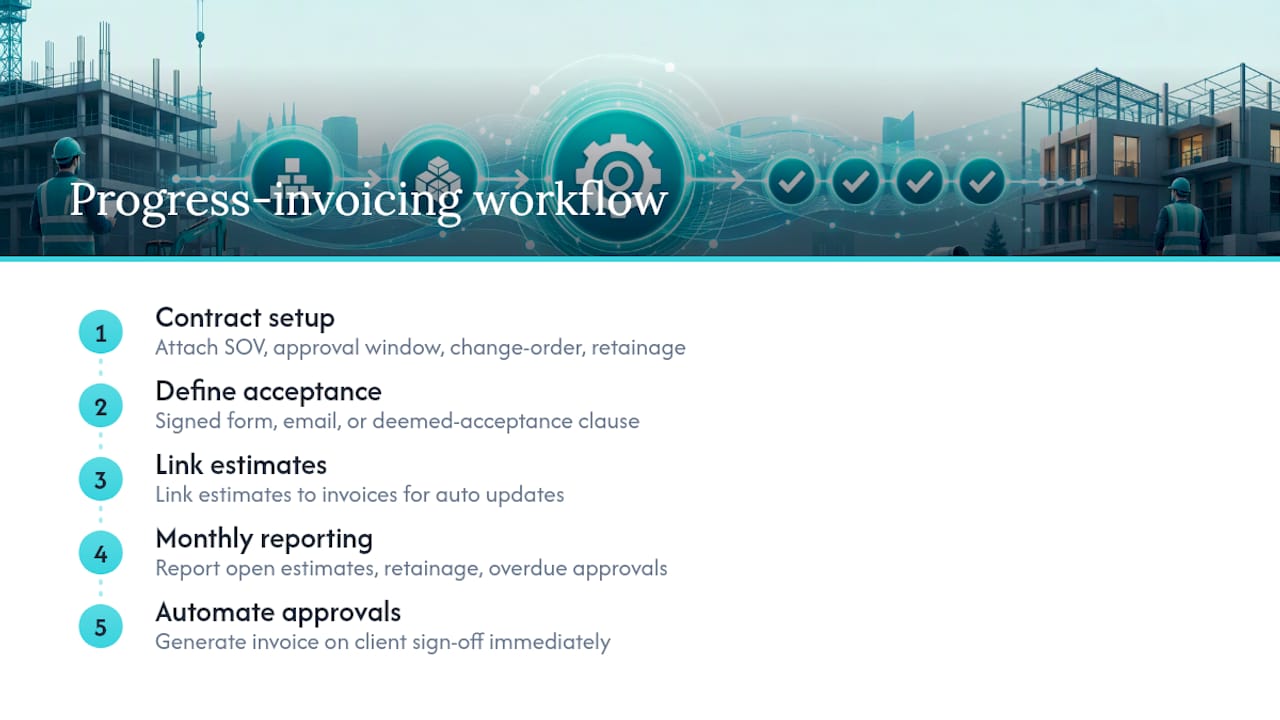
Getting this right starts before the first tool touches the job site. Your contract needs a few specific pieces of language, or your billing schedule has no teeth.
Build your contract with an SOV or milestone exhibit attached, a stated approval window (say, five business days), a clear change-order process, and a retainage clause spelling out the percentage and release trigger. Without these, you're negotiating payment terms mid-dispute instead of pointing to what both parties already signed.
Document acceptance consistently. That can be a signed acceptance form, an email reply confirming the work, or a deemed-acceptance clause. One approach states that if the client doesn't respond within a set number of business days, the milestone counts as accepted, which keeps slow responders from stalling your cash flow indefinitely.
On the software side, keep estimates linked to invoices so cumulative billed updates automatically instead of living in your head or a sticky note on the dashboard. Run a monthly report on open estimates, outstanding retainage, and any milestone that's overdue for approval.
Automation connecting approval to invoice creation cuts down on manual timing errors, according to milestone billing guidance. When a client signs off on a phase, the invoice should generate right then, not three days later when you finally get to your desk.
What Mistakes Do Contractors Make With Progress Invoicing?
Most progress invoicing problems trace back to a handful of repeat offenders. Fix these and you'll avoid the majority of payment disputes.
- Vague milestones. "Rough-in complete" means different things to different people. Write objective acceptance criteria into the contract instead, like "all rough electrical passes city inspection."
- Not updating the schedule of values after change orders. Change orders need to be written and referenced on the next invoice. Skip this step and you'll end up underbilling or overbilling without realizing it.
- Poor cumulative billing records. If you can't show billed-to-date on demand, you're inviting a dispute. Reconcile your billing against the contract every month, not just at the end of the job.
- Delayed approvals and missed payments. Build remedies into the contract: late fees after a set number of days, and the right to pause work if an invoice goes unpaid past the deadline.
Pro Tip: Keep a simple running log, even a notes app entry, showing the date you finished each phase and the date the client signed off. It takes thirty seconds and saves you hours if a payment dispute ever goes to a collections letter or small claims court.
Copyable Progress Invoice Template and Checklist
You don't need fancy software to start. Here's the minimum invoice format to copy for your next job.
Invoice lines to include:
- Project reference and phase name
- This period amount
- Cumulative billed to date
- Retainage withheld (if applicable)
- Net amount due
Contract exhibit checklist:
- Schedule of values or milestone list with dollar amounts
- Retainage percentage and release trigger
- Approval window (business days for client response)
- Change-order process and how it updates billing
When you present the payment schedule to a new client, walk them through it before signing: show them exactly what triggers each invoice and give a quick preview of what the next one will look like. Clients who see the schedule up front rarely argue with it later.
What Are the Legal and Tax Considerations of Progress Invoicing?
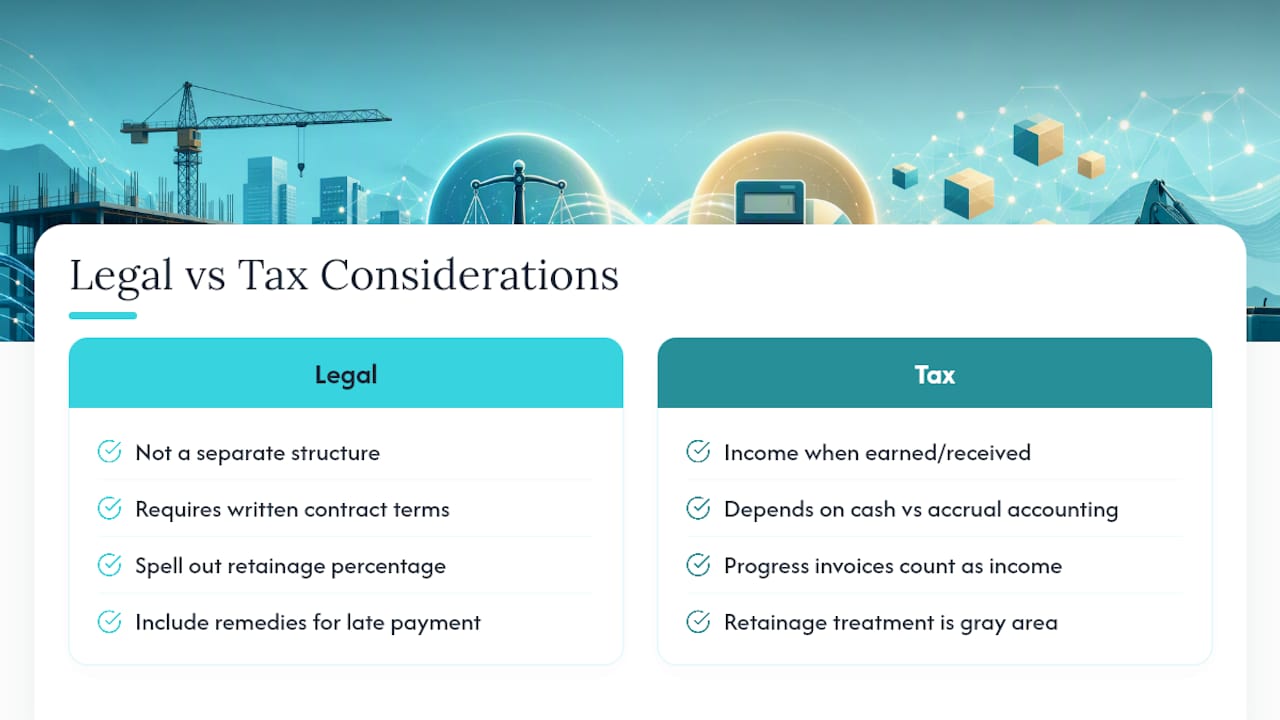
Progress invoicing itself isn't a separate legal structure. It's a billing method layered on top of your existing contract, so the legal protection comes from how you write that contract, not from the invoicing schedule alone. Spell out payment terms, retainage percentages, and remedies for late payment directly in the signed agreement, because a verbal understanding about "billing as you go" won't hold up if a client disputes an invoice later.
On the tax side, most small contractors report income when it's earned or received, depending on whether you use cash or accrual accounting. Progress invoices you issue and collect during the year count as income in that period, even if the job itself isn't finished. This can actually help you, since income lands more evenly across the year instead of piling up in one lump sum at project close, which makes quarterly estimated tax payments easier to predict.
Retainage held by the client creates a gray area worth flagging with your tax preparer. Some contractors report retainage as income when it's billed, others when it's actually collected. Either approach can be defensible, but you need to pick one and apply it consistently across your business, not switch job to job.
If you work with general contractors or property management companies, check whether your state requires specific language for lien rights or prompt-payment protections. These rules vary by state and by project type, so a licensed attorney or your state contractor's board is the right resource for your exact situation, not a generic guide like this one.
What Are the Benefits and Drawbacks of Progress Invoicing?
The upside is real, but it comes with a few trade-offs worth knowing before you build your billing schedule around it.
On the benefit side, progress invoicing keeps cash moving through the job instead of tying it all up until completion. You spend less on financing materials out of pocket, and clients get smaller, easier-to-approve invoices instead of one intimidating final bill. Breaking a big total into transparent pieces also reduces client anxiety, since they can see exactly what they're paying for at each stage rather than wondering if the final number will surprise them.
The drawbacks are mostly administrative. You have to track more invoices, update your schedule of values every time a change order comes through, and stay on top of retainage that doesn't get released until the job closes out. Clients who are slow to approve milestones can stall your cash flow just as badly as a single late final payment would. And if your acceptance criteria are vague, you'll spend time arguing about whether a phase is really "done" instead of collecting for it.
None of this outweighs the benefit for most multi-phase jobs, but it does mean progress invoicing works best when you commit to the paperwork side of it, not just the billing side.
How Does Progress Invoicing Affect Your Cash Flow?
Cash flow is the whole reason most solo tradespeople adopt progress invoicing in the first place. Instead of fronting six weeks of materials and labor on a remodel and hoping the final payment covers it, you collect money as each phase wraps, which means your bank account reflects work you've already finished rather than work you're still floating.
This matters most for material-heavy trades. An electrician ordering a full panel and subpanel setup, or an HVAC contractor buying a full system before installation, can burn through thousands of dollars before ever touching the client's money. A milestone invoice tied to material delivery or rough-in completion gets that cash back in your hands weeks earlier than waiting for the final walkthrough.
It also smooths out the feast-or-famine cycle that hits a lot of solo operators. Instead of one big deposit and one big final check with nothing in between, you've got a predictable trickle of payments landing throughout the job. That predictability makes it easier to plan payroll if you've got a helper, order materials for the next job without dipping into savings, and avoid the credit card float that eats into your margin. The tighter your cumulative billing records, the easier it is to see exactly where you stand on any given job at any given moment.
How Do You Avoid Disputes and Payment Delays?
Most billing disputes come down to unclear expectations, not bad faith. Fix the clarity problem and most delays disappear with it.
Set objective, written acceptance criteria for every milestone before the job starts, not after a disagreement pops up. "Framing inspected and passed" leaves no room for argument the way "framing looks good" does. Pair that with a defined approval window in the contract, five to seven business days is typical, so a client who goes quiet doesn't stall your next invoice indefinitely.
Show your cumulative billed total on every single invoice, not just the current period. This one habit alone prevents most of the "wait, how much have I already paid you?" conversations that turn into disputes. Reconcile change orders in writing before the work happens, not after, and attach them to the invoice where they apply so nothing gets billed as a surprise.
Finally, set your late-payment terms up front and actually enforce them. A stated late fee after 10 or 15 days, paired with a documented right to pause work on unpaid invoices, gives you leverage without needing to escalate to a lawyer or a lien filing every time a payment runs late.
A Contractor's View on Progress Invoicing
Switching to staged billing feels like a small change until the first check lands mid-job instead of six weeks later. Expect the first 90 days to be about building the habit: writing clear milestones, sending invoices on time, and getting comfortable naming a dollar amount before the whole job is done. One reminder worth repeating to every client upfront: show them the payment schedule before they sign, not after the first invoice surprises them.
— jaras
How Quotewren Makes Progress Invoicing Simple
Quotewren is built for the moment you finish a phase and need money moving, not a spreadsheet update. It turns a finished quote into a progress invoice with a payment link attached, so the client can pay easily after you complete that stage of the job.

Instead of juggling a separate SOV tracker, a payment app, and a sticky note reminding you who still owes what, this software keeps your quote, invoice, and cumulative billed total connected in one place. Once a client pays, automated follow-up sends a review request while the job is still fresh in their mind, which helps solo tradespeople build their online review presence. For payment links that get invoices paid faster, and for reminders that chase down late progress payments without you having to make an awkward phone call, the workflow runs in the background while you're back on the job. Try Quotewren free and send your next progress invoice from your phone before you leave the job site.
Sources
- Understanding progress billings: key concepts and benefits | Investopedia
- Progress billing: how and why to use it | Sage
- What is milestone billing? Templates, schedules & automation | LedgerUp
FAQ
What Does Progress Invoicing Mean?
Progress invoicing means billing a client in stages as work is completed, rather than waiting for one final invoice at the end of the entire project.
How Do I Turn on Progress Invoicing in My Software?
Most invoicing tools, including Quotewren, let you convert an accepted quote directly into a progress invoice, so you set up the billing stages when you create the estimate rather than flipping a separate switch later.
What Is Another Name for a Progress Invoice?
Progress invoices are also called progress billings, staged billing, or an application for payment, especially on larger construction-style contracts.
How Do I Use Progress Invoicing in QuickBooks?
QuickBooks lets you create a progress invoice directly from an existing estimate by choosing to bill a percentage or a specific amount of that estimate, and it automatically tracks how much of the total has been invoiced so far.
How Much Retainage Should I Withhold?
Retainage typically runs 5% to 10% on construction-style contracts, though the exact percentage should be spelled out in your signed contract rather than assumed.