

Use a clear header, itemized line descriptions, explicit payment terms, and a short, polite invoice email. That combination gets invoices paid faster and cuts down on the "wait, what is this for?" phone calls. Below, you'll find copy-ready invoice wording examples for headers, line items, payment terms, and emails, plus trade-specific snippets you can paste straight into your next invoice.
TL;DR:
- Clear, detailed line items reduce billing disputes by showing exact scope, quantities, and rates, especially for materials and pass-through fees.
- Using a consistent invoice header with job details, licensing info, and clear due dates helps clients verify legitimacy and understand when payment is expected.
- Incorporating a straightforward follow-up sequence from friendly reminders to firm notices encourages prompt payment without risking client relationships.
- Placing payment links and terms in prominent locations on the invoice and email streamlines the payment process, speeding up cash flow.
- Maintaining a standardized format with numbered invoices, clear wording, and polite closing lines builds client familiarity and improves collection efficiency.
Table of Contents
- Copy-Ready Invoice Wording Examples by Purpose
- What Goes in Your Invoice Header
- Line-Item Descriptions That Prevent Disputes
- Payment Terms and Late-Fee Wording
- Payment Methods and Pay-Link Wording
- Invoice Email Subject and Body Examples
- Trade-Specific Invoice Wording for Electricians, Plumbers, and HVAC Techs
- Ready-to-Use Invoice Templates for Common Jobs
- Why Clear Wording Cuts Down on Payment Disputes
- A Tradesperson's Quick Checklist for Better Invoices
- Let Quotewren Handle the Wording and the Follow-Up
- Sources
- FAQ
Copy-Ready Invoice Wording Examples by Purpose
Most invoice disputes come from vague wording, not from the price itself. Here are the phrases that pull double duty: they sound professional and they leave nothing to guess about.
Payment request and balance lines:
- "Balance due: $[amount]. Thank you for your business."
- "Amount due upon receipt: $[amount]."
- "Total due by [date]: $[amount]."
- "This invoice reflects the final balance after your $[amount] deposit."
Due-date and "Net X" phrasing:
- "Payment due upon receipt."
- "Payment due within 15 days of invoice date (Net 15)."
- "Payment due within 30 days of invoice date (Net 30)."
- "Due date: [date]. Please remit payment by this date to avoid a late fee."
Reminder escalation — friendly to firm:
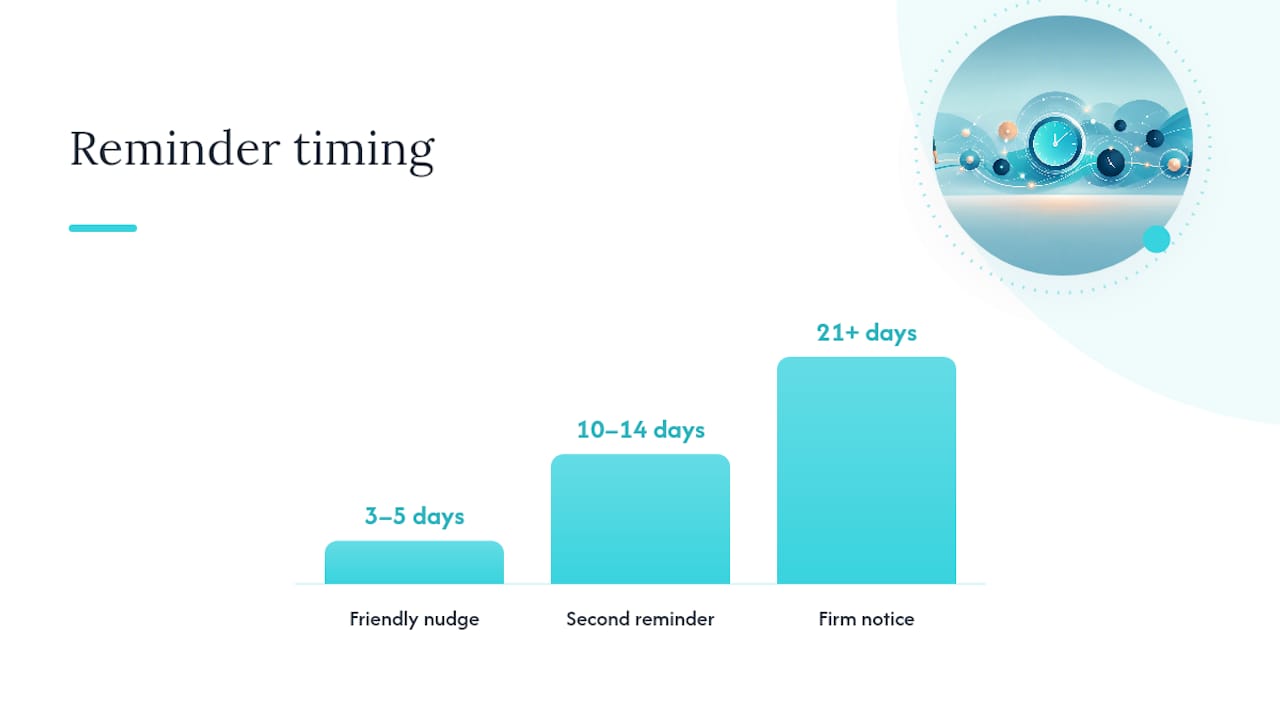
- Friendly nudge (3 to 5 days after due date): "Just a quick reminder that Invoice #[number] for $[amount] was due on [date]. Let me know if you have any questions."
- Second reminder (10 to 14 days overdue): "This invoice is now [X] days past due. Please send payment by [date] or reach out if there's a holdup."
- Firm notice (21+ days overdue): "Invoice #[number] is significantly overdue. Please remit $[amount] by [date]. A late fee may apply per the terms noted on your invoice."
Each step should sound like it's coming from the same person, just with less patience each time. Don't jump straight from friendly to threatening. That jump reads as erratic, and it can cost you the repeat customer.
Closing lines that protect the relationship:
- "Thank you for the opportunity to work on [Project Name]." This line, recommended by Constant Contact for invoice emails, works just as well printed at the bottom of the invoice itself.
- "We appreciate your business and look forward to working with you again."
- "Questions about this invoice? Just reply to this email or call [phone number]."
- "Thanks for trusting us with your [service type, e.g., 'plumbing repair']."
Pro Tip: Keep one closing line saved as a text replacement on your phone. Typing "thx" and having it expand into your full closing line saves you from rewriting the same sentence fifty times a month.
Landscapers, cleaners, and handymen often skip the closing line entirely, treating the invoice as a pure transaction. That's a missed chance. A one-line thank-you costs nothing and makes the invoice feel like it came from a person, not a robot spitting out a bill.
What Goes in Your Invoice Header
Your header is the first thing a client or accounts payable clerk sees, so it needs to answer four questions fast: who sent this, what job is this for, how much is owed, and by when. Here's the exact wording to use.
- Business identity line: "[Your Business Name] | License #[number] | EIN: [number]" — include the license number for any trade that requires one (electrician, plumber, HVAC), since it builds instant trust with a client checking your credentials.
- Bill to / service address: "Bill To: [Client Name], [Billing Address]" and, if different, "Service Address: [Job Site Address]." Separate these when you invoice a property manager or a general contractor who isn't the person who lives at the job site.
- Invoice meta block: "Invoice #: [number] | Issue Date: [MM/DD/YYYY] | Service Date: [MM/DD/YYYY] | Due Date: [MM/DD/YYYY]." Tying the invoice number to your job ticket number, as recommended in Novo's electrician invoice guide, makes it easy to trace any invoice back to the original job.
- Totals labels: "Subtotal," "Sales Tax (materials only)," "Deposit Applied: −$[amount]," "Balance Due: $[amount]." Stripe's guidance on invoice details recommends a clean totals block so the final number is easy to spot without reading every line.
Line-Item Descriptions That Prevent Disputes
Vague line items are the number one reason clients call and argue about a bill. "Labor: $400" tells a client nothing. "4 hours labor replacing kitchen faucet and shutoff valves: $400" tells them exactly what they paid for. Clear, itemized descriptions reduce disputes because the client can see what was done and why it cost what it cost.
Write descriptions action-first, then add scope and outcome:
- "Diagnosed and repaired short circuit in kitchen outlet; replaced damaged wiring (2 hrs)."
- "Replaced 40-gallon water heater; tested for leaks and confirmed hot water restored."
- "Installed 12 linear feet of 6-inch gutter, front elevation."
- "Mowed, edged, and blew off 0.5-acre lot; bagged clippings per client request."
Show quantities and rates in the same line, not buried in a lump sum: "3 hrs @ $85/hr = $255." Clients trust a rate they can check over a flat number they have to take on faith.
Material markups should be visible, not hidden. If you mark up parts, show it plainly: "Circuit breaker, 20A: $45 (includes standard markup)." Common markups in the trades run 20% to 50% over wholesale, and showing the marked-up price on the line beats folding it into an unexplained "parts" total that invites questions.
Permit pass-throughs get their own line, worded exactly as a pass-through: "Permit fee (City of [Town], electrical permit #[number]): $85, billed at cost." Trip charges and after-hours work follow the same rule:
- "Trip charge, same-day service: $50."
- "After-hours emergency call (after 6 PM): $125 flat rate."
- "Weekend emergency service call, no-heat diagnosis: $150."
Pro Tip: If you're not sure how detailed to get, write the line the way you'd explain it out loud to the client standing in their driveway. If it sounds clear spoken, it'll read clear on paper.
Payment Terms and Late-Fee Wording
Your payment terms belong on the invoice itself, not buried in a separate contract the client signed six months ago. PandaDoc's library of invoice terms shows dozens of variations, but for solo trades, three terms cover almost every job:
- Due on receipt: Best for one-time service calls where you want payment before you leave the property, or right after.
- Net 15: A middle ground for repeat residential clients you trust but who need a couple of weeks to pay.
- Net 30: Standard for general contractors, property managers, and commercial accounts that run payments through an accounts payable process.
Sample due-date wording: "Payment terms: Net 15. Due date: [date]." Put it near the totals block, in bold, where it can't be missed.
For late fees, use wording that states your policy without overclaiming what the law allows: "A late fee of up to around one and a half percent per month may apply to balances unpaid after a certain number of days, subject to state law." That phrase, "subject to state law," matters. Late-fee caps vary by state, and PandaDoc's terms examples note that clear late-fee language on the invoice itself is what actually aligns expectations and speeds payment — not a fee buried in fine print the client never read.
Place your terms and late-fee line in the same visible zone as your totals, not in a footnote at the bottom of the page. If a client has to hunt for your terms, you can't enforce them fairly. For a deeper breakdown of state-by-state considerations, see this guide on invoice late fees for tradespeople.
Payment Methods and Pay-Link Wording
The fewer steps between "invoice received" and "invoice paid," the faster you get your money. That starts with how you word your payment options.
- "Pay online (secure): [pay link]" — put this front and center, ideally in the first few lines of both the invoice and the email that delivers it.
- "We accept ACH bank transfer, credit/debit card, or check made payable to [Business Name]."
- "A 3% card processing fee applies to credit card payments; ACH and check payments have no added fee."
- "Mail checks to: [address]. Please include Invoice #[number] on the memo line."
Naming your pay link clearly, rather than just dropping a raw URL, removes friction and speeds up collection, according to CMDK's research on invoice email templates. Put payment instructions in two places: right under the totals block on the invoice, and again in the first two lines of the email. For more on structuring this, check out this guide on invoice payment links.
Invoice Email Subject and Body Examples
Your invoice email needs to work even if the person opening it skims for three seconds. Lead with the number, not the small talk.
Subject line formula: "Invoice #[number] from [Business Name] – Due [Date]." Shopify's guidance on invoice emails recommends including the word "Invoice," the invoice number, your business name, and the due date right in the subject line, so accounts payable staff can process it without opening the attachment first.
First send, sample body:
- "Hi [Client Name], attached is Invoice #[number] for $[amount], due [date]."
- "Pay online here: [pay link], or see payment options below."
- "Thank you for the opportunity to work on [Project Name]. Let me know if you have any questions."
Keep the invoice number, amount, and pay link in the first two lines. A short, clear body with those details up front increases the odds of on-time payment, and attaching a PDF gives both sides a permanent record.
Reminder ladder:
- Friendly reminder (a few days past due): Subject: "Reminder: Invoice #[number] Due [Date]." Body: "Just checking in. Invoice #[number] for $[amount] was due [date]. Pay here: [pay link]."
- Payment overdue (10 to 14 days past due): Subject: "Overdue: Invoice #[number] from [Business Name]." Body: "This invoice is past due. Please send payment by the indicated date to avoid a late fee."
- Final notice: Subject: "Final Notice: Invoice #[number] Due Immediately." Body: "This is a final notice for Invoice #[number], now past due. Please remit payment promptly."
For more structure on timing these emails, see this setup guide for invoice reminders.
Trade-Specific Invoice Wording for Electricians, Plumbers, and HVAC Techs
Trades invoices carry extra weight because clients expect proof of licensing and clear accounting for permits, parts, and job-site details. A basic freelancer invoice header won't cut it here.
Header wording for licensed trades:
- "[Business Name] | Licensed Electrician, License #[number] | EIN: [number]"
- "Job Site: [address] | Bill To: [client or GC name and address, if different]"
Line-item phrasing:
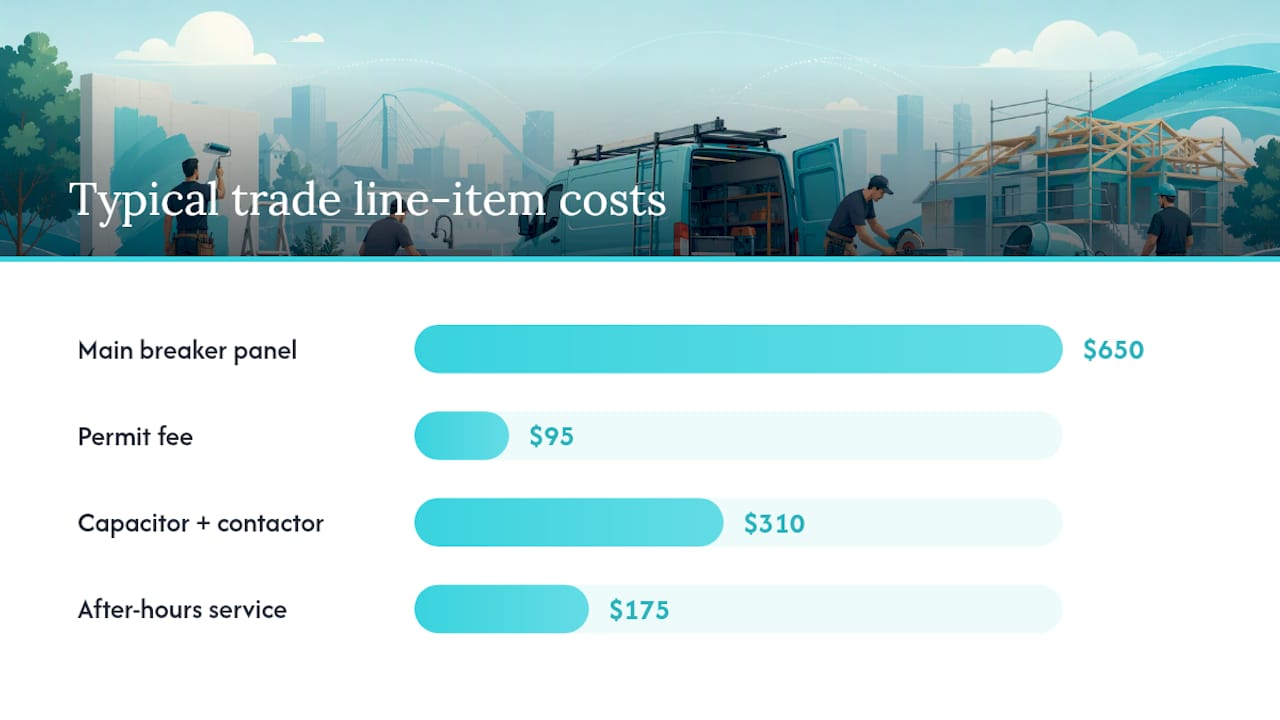
- "Replaced 200A main breaker panel; labor and disposal of old unit included: $650."
- "Permit fee (electrical, City of [Town]): $95, billed at cost, no markup."
- "Diagnosed no-cool complaint, replaced capacitor and contactor: $310 (parts and labor)."
- "Emergency after-hours service, burst pipe, 9 PM call: $175 flat rate plus parts."
Terms by client type: Residential customers usually get "Due on receipt" or "Net 15." Commercial clients and general contractors typically expect "Net 30," since their accounts payable teams run on a monthly cycle. State it plainly: "Residential terms: Net 15. Commercial/GC terms: Net 30 per master service agreement."
Warranty wording: "Workmanship warranted for 1 year from service date. Manufacturer parts warranty applies separately; see manufacturer documentation."
Pro Tip: If you bill both homeowners and general contractors, keep two invoice templates saved with different default terms. Trying to remember which client gets which term every time you invoice is how Net 30 accounts end up unpaid at day 45.
Plumbers and HVAC techs can adapt this same structure directly. See more trade-specific phrasing in the plumber invoicing guide and the HVAC invoicing guide for terms tailored to no-heat and no-cool emergency calls.
Ready-to-Use Invoice Templates for Common Jobs
Three job types cover most solo trades and freelance work: the single-visit residential job, the multiphase project, and the ongoing freelance or consulting engagement. Each needs slightly different wording.
| Template type | Best for | Key wording to include |
|---|---|---|
| Single-visit invoice | One-time service calls (repair, cleaning, mowing) | "Service completed [date]. Total due upon receipt: $[amount]." |
| Project/milestone invoice | Multi-day jobs, renovations, installs | "Milestone 2 of 3: Rough-in complete. Deposit applied: −$[amount]. Balance due: $[amount]." |
| Freelancer/consultant invoice | Design, writing, consulting work billed hourly or by project | "[X] hours @ $[rate]/hr for [project name]. Total due: $[amount]. Net 15 terms apply." |
For the project invoice, always spell out how the deposit was handled: "Deposit received [date]: $[amount]. This invoice reflects remaining balance only." That single sentence prevents the most common project-billing dispute, which is a client forgetting they already paid a deposit. For more examples covering line items across job types, see this invoice line items checklist.
Why Clear Wording Cuts Down on Payment Disputes
Every invoice has six zones: the business header, the bill-to and service address, the invoice meta block, the line-item table, the totals block, and the footer with payment instructions and warranty terms. That six-zone layout, laid out clearly in Novo's electrician invoice template, lets a client scan top to bottom and pay without calling you to ask a single question.
Most billing friction doesn't come from price disagreements. It comes from a client not understanding what they're being asked to pay for, or not seeing when it's due. A vague line item like "misc materials: $180" invites a phone call. "Materials: 2 GFCI outlets, wire nuts, electrical tape: $180" doesn't.
- Six-zone checklist: header, bill-to, invoice meta, line items, totals, footer.
- Automate your pay link and your review request the moment a job wraps, so the invoice and the follow-up happen without you remembering to do it manually.
- Track which clients pay on Net 15 versus Net 30 so your reminder timing matches the actual terms you gave them.
Pro Tip: A job isn't done when the work is done. It's done when the invoice is paid and the review is posted. Treat those three steps as one workflow, not three separate tasks you have to remember.
The most common billing friction point isn't a client refusing to pay. It's a client who genuinely doesn't understand the invoice they received and sets it aside until you follow up. Clear wording removes that excuse entirely.
A Tradesperson's Quick Checklist for Better Invoices
Good invoice wording isn't complicated, but it does require consistency. The businesses that get paid fastest aren't the ones with the fanciest templates. They're the ones that use the same clear structure every single time, so clients learn what to expect and never have to guess.
Five things to fix on your next invoice:
- Give every invoice a number, tied to the job ticket, no exceptions.
- Put the pay link in the first two lines of the invoice and the email, not buried at the bottom.
- Write every line item the way you'd say it out loud to the client.
- Set Net terms up front, in writing, before the job even starts.
- Close with one polite line of thanks. It costs nothing and it keeps the door open for the next job.
None of this requires new software or a steep learning curve. It requires picking a format and sticking to it long enough that your clients start recognizing your invoices as clear, professional, and easy to act on.
— jaras
Let Quotewren Handle the Wording and the Follow-Up
Software tools can turn everything in this guide into a few clicks instead of a blank template every time. For a solo electrician, plumber, or landscaper juggling five job sites in a week, that's the real difference: less time formatting invoices, more time getting paid for the work already done.
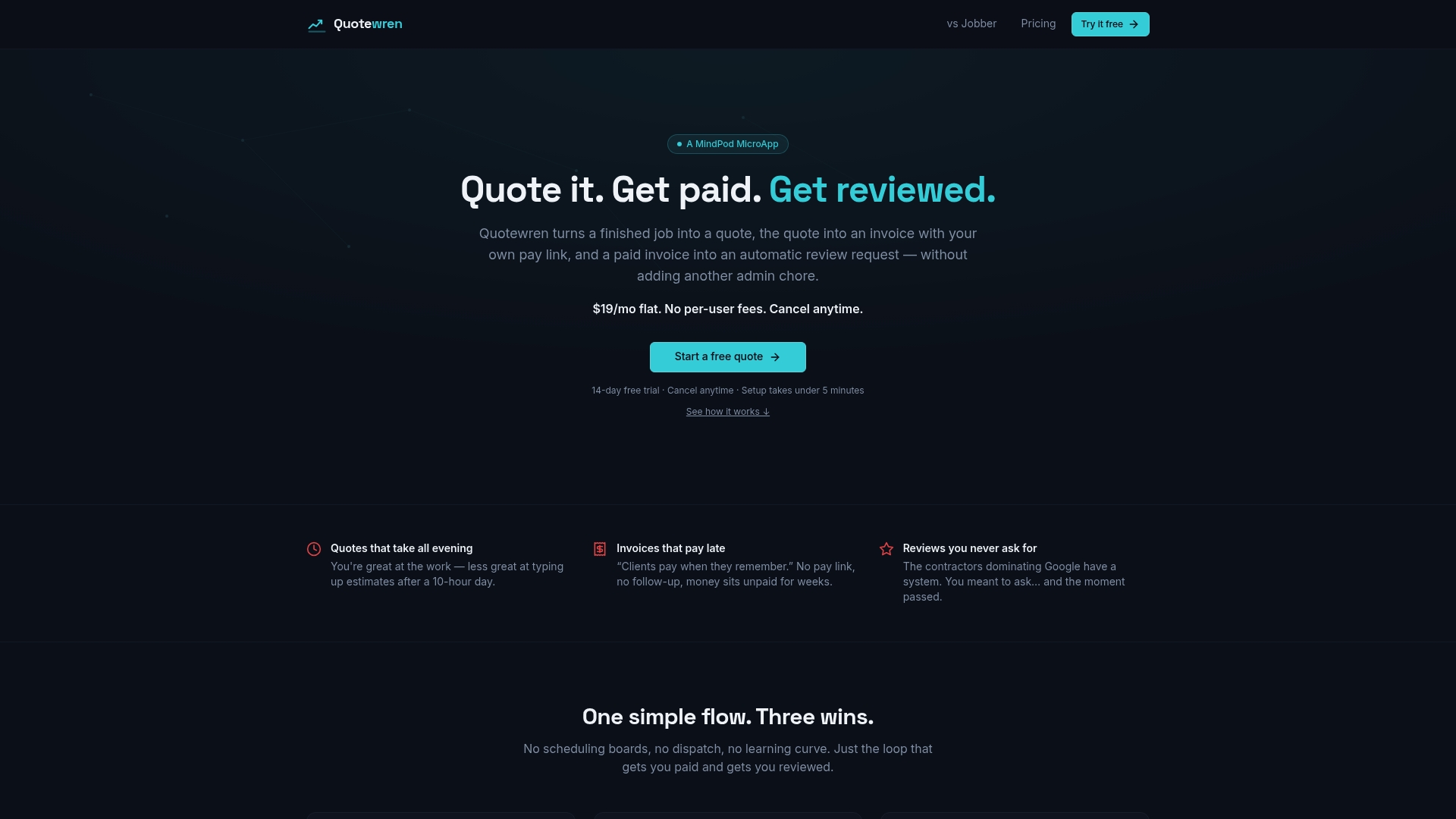
Some tools offer features to build invoices with headers, line items, and totals blocks pre-structured, to avoid retyping labels like "Balance Due" or "Deposit Applied" every time. These may include business name, license info, and job details filled in automatically, integrated pay links for online payment, and automated review request follow-ups after a job closes to assist with client feedback.
If you're tired of rebuilding the same invoice from scratch every week, start with Quotewren and see how quickly a job goes from finished to paid to reviewed.
Sources
For deeper reading on the phrasing and structure covered here, see Shopify's invoice email guide, PandaDoc's terms and conditions examples, Stripe's breakdown of invoice details, and Novo's electrician invoice template. Service businesses outside the trades can also review this wedding planner invoice management guide for comparable client-communication wording.
- 15+ invoice terms and conditions examples (PandaDoc)
- Invoice Email Templates That Get You Paid on Time (CMDK)
- Invoice template for electricians (Novo)
FAQ
What is a good message to put on an invoice?
A good message states the amount due, the due date, and a short thank-you line, such as "Thank you for the opportunity to work on [Project Name]." Keep it brief and specific rather than generic.
What are common invoice terms?
The most common terms are "Due on receipt," "Net 15," and "Net 30," each referring to how many days a client has to pay after the invoice date. Trades often use Net 15 for residential clients and Net 30 for commercial or general contractor accounts.
How do I write a simple invoice?
Include a business header with your name and contact info, a unique invoice number, itemized descriptions of the work, a totals block showing the balance due, and clear payment terms. A tool like Quotewren can generate this structure automatically so you don't have to build it from scratch each time.
What do I write on an invoice?
Write your business identity, the client's name and service address, invoice and due dates, itemized labor and materials with quantities and rates, a totals block, and payment instructions with a pay link. Close with a short polite line to keep the relationship friendly.