

Net 30 is the most common default, but it's not what protects your cash flow. The real fix is stacking a deposit, progress billing, a clear calendar due date, and a direct pay link on every invoice you send. Prompt Payment Acts set minimum standards on public jobs, and some software tools can help handle the follow-up so you're not the one chasing checks.
TL;DR:
- Using deposits, progress billing, clear due dates, and direct pay links on invoices significantly improves cash flow management for contractors.
- Progress billing should be based on a detailed schedule of values, breaking the project into milestones with corresponding invoices, especially on longer jobs.
- Always request a deposit upfront and specify exact payment due dates to avoid confusion and reduce payment delays.
- Incorporate automated reminders and late fees disclosed in advance to encourage timely payments and handle overdue invoices efficiently.
- Ensure each invoice includes all mandatory details, such as license numbers, job descriptions, itemized costs, and proper referencing of contracts or purchase orders.
Table of Contents
- What Are the Most Common Contractor Invoice Terms?
- How Do Progress Billing and Retainage Work on Longer Jobs?
- How Should You Structure Payment Terms to Protect Cash Flow?
- What Should Every Contractor Invoice Include?
- Sample Invoice and Contract Wording You Can Copy
- What's the Right Way to Escalate an Unpaid Invoice?
- How a Quote-to-Invoice Workflow Speeds Up Payment
- A Quick Checklist Worth Following Today
- Get Paid Faster Without Chasing a Single Client
- Sources
- FAQ
What Are the Most Common Contractor Invoice Terms?
Most contractors default to Net 30 without thinking about whether it fits the job. That's a mistake. The payment term you pick should match the risk of the client, not just habit.
Here's what the standard terms actually mean:
- Due on receipt: Payment is expected the day the client gets the invoice. Best for one-off jobs, small repairs, or new clients you don't have a track record with yet.
- Net 15: Payment due 15 days after the invoice date. A good middle ground for repeat residential clients.
- Net 30: Payment due 30 days after the invoice date. Standard for commercial accounts and property managers who process invoices through an accounts payable department.
- Net 45 / Net 60: Payment due 45 or 60 days out. Common with general contractors, large builders, or institutional buyers, but risky for a solo operator who needs cash sooner.
- 2/10 Net 30: The client gets a 2% discount if they pay within 10 days, otherwise the full amount is due in 30 days.
Say you invoice a property management company a few thousand dollars on March 1 with 2/10 Net 30 terms. If they pay by March 11, they owe $2,940. If they wait past that window, they owe the full $3,000 by March 31. Run the math before you offer a discount like this: giving up $60 to get paid three weeks earlier only makes sense if that cash actually solves a real problem, like covering payroll or a supply order. If you don't need the money that fast, skip the discount and just collect the full amount on Net 30.
A simple rule works for most trades: use Due on Receipt or Net 15 for new or high-risk clients, and reserve Net 30 for established commercial accounts with a payment history you trust. Public agency work often runs on statutory timelines instead of terms you choose. Federal and state Prompt Payment Acts set fixed deadlines for public works payments, and those rules can override the terms you'd normally write into a quote.
How Do Progress Billing and Retainage Work on Longer Jobs?
If a job runs longer than two or three weeks, don't wait until the end to invoice. Progress billing lets you get paid as you go, so you're never floating the full cost of materials and labor out of your own pocket.
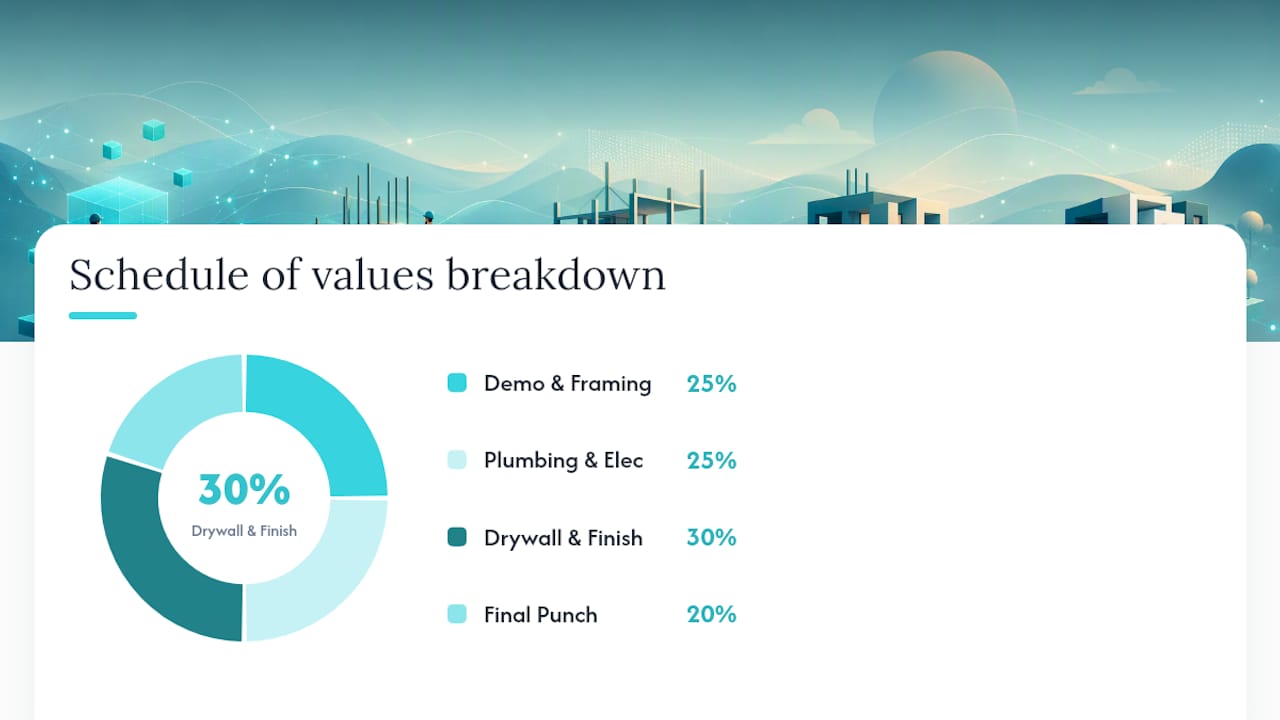
The standard tool for this is a schedule of values, which breaks the total contract price into line items tied to phases of work. A kitchen remodel might look like this:
- Demo and rough-in (25% of contract value), billed after demo and framing pass inspection.
- Plumbing and electrical rough-in (25%), billed once rough inspections pass.
- Drywall, cabinets, and finish carpentry (30%), billed at substantial completion.
- Final punch list and walkthrough (20%), billed after the client signs off.
Each phase gets its own invoice, called a pay app in commercial construction, and you bill monthly or at each milestone instead of waiting for the whole job to wrap.
Retainage complicates this picture. Many contracts, especially commercial ones, hold back 5% to 10% of each pay app until the project reaches substantial completion. Retainage rules vary by state, and some states cap the percentage or require early release once a job hits a certain completion threshold. If a contract asks for 10% retainage on a job with thin margins, negotiate an early release trigger, like dropping to 5% once you pass 50% completion, instead of accepting the full holdback until the final walkthrough.
Pro Tip: Never sign an unconditional lien waiver until the check has actually cleared. A conditional waiver says "I'll release my lien rights once I'm paid." An unconditional waiver says "I've already been paid," full stop. Signing the wrong one before the money hits your account can cost you your legal leverage.
The final pay app should include your retainage release, and construction invoicing best practices call for a completed schedule of values, approved change orders, and continuation sheets attached before that last invoice goes out.
How Should You Structure Payment Terms to Protect Cash Flow?
The single biggest cash-flow mistake in the trades is fronting your own money on materials and labor with no deposit. Fix that first, before anything else.
A few working guidelines:
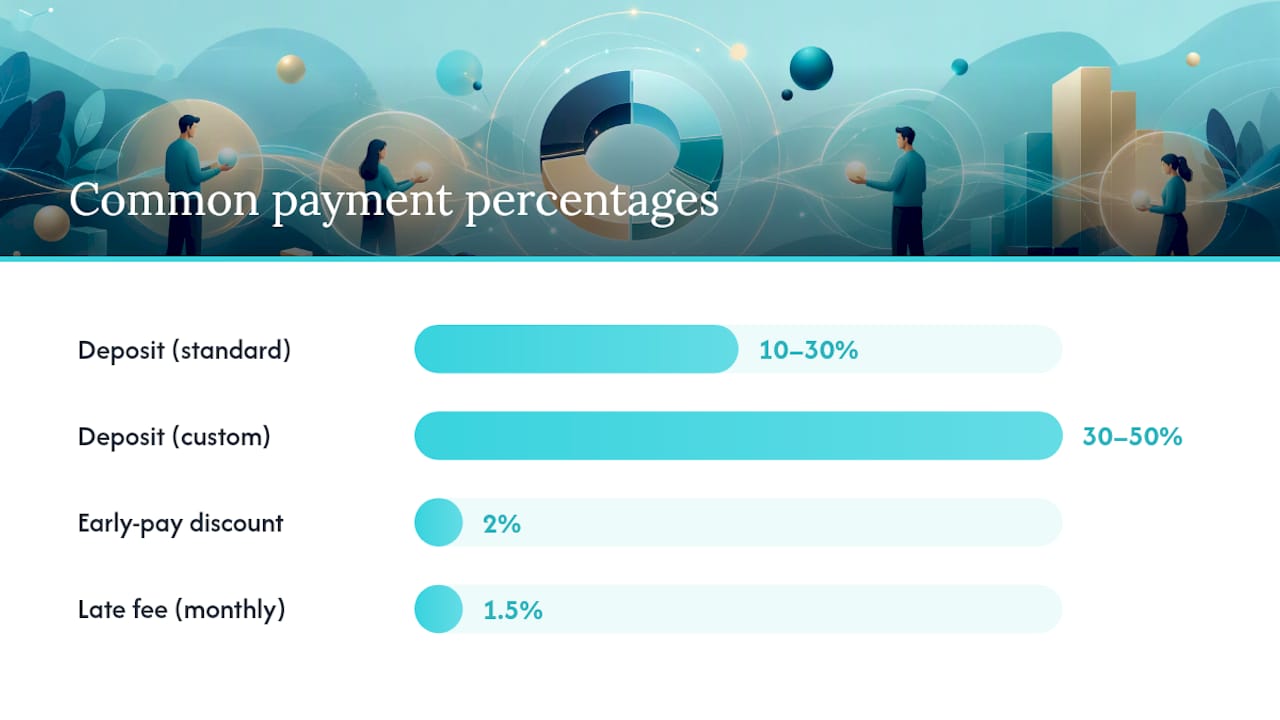
- Ask for a 10% to 30% deposit on any job over a few thousand dollars, and go higher (30% to 50%) for custom work with expensive special-order materials, like custom cabinetry or specialty HVAC equipment.
- Show the exact calendar date payment is due, not just "Net 30," so there's no confusion about when the clock started. "Due April 14, 2026" leaves no room for argument. "Net 30" leaves room for a client to claim they thought the clock started somewhere else.
- Split anything over two weeks into progress payments tied to milestones, not just time elapsed.
- Put a direct pay link on every invoice. Square's invoicing tools let you request deposits and split balances into scheduled milestone payments right from the invoice, which removes the extra step of the client having to call you or mail a check.
Payment links matter more than most contractors realize. A client who has to write a check, find a stamp, and mail it will delay payment for reasons that have nothing to do with whether they're happy with your work. A text-to-pay link removes that friction, and cutting the friction is often what actually moves the payment date up, not the payment term itself.
On method, ACH transfers usually carry lower processing fees than card payments but can take a day or two longer to clear. Cards clear faster on your end (often the same day the invoice shows paid) but cost more in fees. For most solo trades work, offering both and letting the client pick is the simplest approach.
Pro Tip: If you offer an early-pay discount, keep the late fee too. A 2% discount for paying in 10 days and a 1.5% monthly late fee for paying after 30 days push the client toward the middle, which is exactly where you want them: on time, without you having to chase anything.
What Should Every Contractor Invoice Include?
A missing field on an invoice is one of the easiest ways to hand a slow-paying client an excuse. Cover these basics every time:
- Your business name, address, and phone number
- Your contractor license number, where your state requires one
- The client's name and job-site address
- A unique, sequential invoice number
- The invoice date and the exact due date
- A clear description of the scope of work performed
- Itemized line items for labor, materials, and any equipment rental
- The subtotal, any tax, and the total amount due
- Warranty terms on labor or materials, if applicable
- Accepted payment methods
- Your late-fee policy, stated plainly
Some states treat a missing or mismatched contractor license number as more than a paperwork problem. It can void your right to collect payment through the courts if a dispute ends up in front of a judge. Double-check your license number matches exactly what's on file with your state licensing board before it goes on an invoice.
If you work with a property management company, general contractor, or an institution like a school district or hospital system, expect stricter rules. UCSF's contractor billing guidelines require every invoice to reference a contract or purchase order number and itemize charges before it can be processed, and some universities go further. Loyola University Chicago's invoice guidelines require the project manager's name, a project number, receipts for any reimbursable expenses, and a fully executed lien waiver before a pay app gets approved. Skip any one of those and your invoice sits in a drawer.
Put your due date and late-fee disclosure somewhere the payer can't miss it, either right under the total or in a bolded line at the bottom of the invoice. Burying it in fine print gives a client room to claim they never saw it.
Sample Invoice and Contract Wording You Can Copy
You don't need a lawyer to write clear payment terms. You need language that says exactly what happens and when. Here's wording you can drop straight into an invoice or a quote.
For the invoice footer:
- "Payment due by [date]. Accepted methods: check, ACH, credit card. A 1.5% monthly late fee applies to balances unpaid after the due date."
- "A 10% deposit was collected on [date]. Remaining balance of $[amount] due upon completion."
- "Retainage of 5% ($[amount]) will be released upon final walkthrough and signed acceptance."
For the contract or quote itself:
Pay-when-paid and pay-if-paid clauses show up mostly in subcontractor agreements with general contractors, and the two are not the same thing legally. A pay-when-paid clause just sets timing. It says the sub gets paid once the general contractor gets paid, but the sub still gets paid eventually either way. A pay-if-paid clause tries to shift the actual risk of nonpayment onto the sub, meaning if the general contractor never gets paid, the sub might not either. Several states don't enforce pay-if-paid clauses at all, so if you're a sub asked to sign one, read it carefully and know your state's rules before you agree.
One rule matters more than any specific wording: a late fee only holds up if it was in the original signed contract or quote. Adding a late fee to an invoice after the fact, with no mention of it in the agreement the client signed, gives them a real argument to refuse it. For more detail on wording that holds up, see this practical guide to invoice late fees.
What's the Right Way to Escalate an Unpaid Invoice?
Most overdue invoices aren't a client refusing to pay. They're a client who forgot, got busy, or is waiting on their own customer to pay them first. Work through an escalation plan calmly, in order, before you assume the worst.
- Send an automated reminder 3 to 7 days before the due date. A friendly nudge before the deadline catches most invoices before they go late at all.
- Call directly once the invoice hits 7 days past due. A phone call gets more traction than a second email, and it lets you find out fast if there's a real problem on their end.
- Send a formal past-due notice at 30 days, restating the amount owed, the original due date, and any late fee now accruing.
- Consider a stop-work notice if your contract allows it and the client owes for active work. This only applies mid-job, and only if your contract explicitly gives you that right.
- File a mechanics lien or pursue small claims court after 60 to 90 days, depending on the invoice amount and your state's filing deadlines, which can be tight after the last day of work.
The lien waiver question comes up constantly at this stage. Sign a conditional waiver when you're submitting it alongside an invoice, before the check has cleared. It only takes effect once payment is actually received. Save the unconditional waiver for after the money is confirmed in your account, never before.
The DSO data from Levelset shows the average contractor in the U.S. waits several weeks to collect on completed work, nearly three months. That gap between when you finish the job and when you actually see the money is exactly why an escalation plan matters. Waiting passively past 30 days without a system in place is how that 83-day average happens in the first place. For more on setting up the reminder step automatically, see this guide to invoice reminders.
How a Quote-to-Invoice Workflow Speeds Up Payment
Chasing payment by hand, one email and one phone call at a time, is the biggest time drain for a solo operator. A tool built around the trades handles the sequence for you: quote, invoice, pay link, and review request, all connected instead of scattered across email, text, and a paper invoice book.
Some invoicing workflows offer features like turning a quote into a branded invoice with an integrated pay link, so the client can pay quickly by card or ACH without hunting for bank details. Automated SMS review requests may also be sent shortly after job completion to help with gathering customer feedback. These workflows can streamline billing and payment collection compared to paper invoice books.
If you want to see how it fits your own jobs, the fastest way is to run a real quote and invoice through it yourself.
A Quick Checklist Worth Following Today
The contractors who get paid fastest aren't the ones with the longest contracts. They're the ones who follow one simple rule: deposit up front, progress billing on anything longer than two weeks, a direct pay link on every invoice, an automated reminder before the due date, and a late fee that's disclosed in writing before the job even starts.
None of this requires a lawyer or a new business model. It requires deciding your terms before you send the first invoice, not after the second one goes unpaid. Every example in this article, the schedule of values, the retainage negotiation, the lien waiver timing, exists because someone learned it the hard way on a job that ran long and paid slow.
Start with the deposit. That single habit fixes more cash-flow problems than any late-fee clause ever will.
— jaras
Get Paid Faster Without Chasing a Single Client
Quotewren turns the terms in this article into something you don't have to manage by hand. It's built for solo tradespeople who don't have time to track fifteen open invoices in a notebook, not a bloated platform built for a 40-truck fleet.

The workflow is simple: turn your finished job into a branded quote, convert that quote into an invoice with a pay link already built in, and let Quotewren handle the follow-up. Clients get a text or email with a direct way to pay, cutting the days you'd otherwise spend waiting on a mailed check. Once the invoice is paid, Quotewren automatically sends a three-touch SMS review request, so you're building your Google review count without lifting a finger after the job's done.
If you're still invoicing out of a notebook or a generic template, try Quotewren and run your next job through it. The free trial lets you send real quotes and invoices before you commit to a paid plan.
Sources
- Contractor billing guidelines — UCSF Supply Chain Management
- CONTRACTOR PAY APPLICATION/INVOICE SUBMISSION GUIDELINES — Loyola University Chicago
- Manage invoice deposits and payment schedules | Square Support Center - United States
- A Contractor's Guide to Construction Invoicing — Procore
FAQ
What should a contractor invoice include?
A complete invoice needs your business name and license number, the client's name and job address, an invoice number, the invoice and due dates, itemized labor and materials, the total due, payment methods, and your late-fee policy stated in writing.
What are standard invoicing terms for contractors?
Net 30 is the most common default for commercial work, while Due on Receipt or Net 15 suits smaller residential jobs and new clients. Larger institutional buyers sometimes require Net 45 or Net 60, and public projects often follow statutory Prompt Payment Act deadlines instead.
How do I invoice someone as a contractor?
Send an invoice that lists the completed scope of work, itemized costs, a specific due date, and a payment link or accepted payment methods, ideally right after the job or milestone is finished rather than waiting weeks. Tools that convert a quote directly into an invoice, like Quotewren, cut out the step of re-entering job details by hand.
What are typical payment terms for independent contractors?
Most independent contractors use a deposit of 10% to 30% up front, followed by Net 15 or Net 30 terms for the remaining balance, with progress billing added for any job running longer than two or three weeks.