

A quote expiration policy is a simple rule that tells clients exactly how long your price and terms stay good before you need to re-check them. The best default for solo tradespeople is a clear calendar date, not a vague "30 days" note, paired with one or two reminders before that date hits. Skip this step and you're stuck honoring old prices on lumber, copper, or refrigerant that cost you a lot less when you first wrote the number.
TL;DR:
- A quote expiration date should be a specific calendar day instead of a vague window, with reminders sent a few days before it expires.
- Validity periods should match material volatility, with 7 days for highly fluctuating supplies, 14 days for standard jobs, and up to 30 days for larger projects.
- Enforcing the expiration involves either re-quoting at current prices, honoring the old quote as a courtesy, or making a limited adjustment for material cost changes.
- Leaving expiration dates undefined forces reliance on vague "reasonable time" rules, which risk legal disputes and uncertain enforceability.
- Using automatic quoting tools can save time, ensure clear expiration dates are visible, and streamline follow-up and payment tracking.
Table of Contents
- What Is a Quote Expiration Policy, Exactly?
- How Long Should a Quote Be Valid?
- Enforcing the Policy and Handling Expired Quotes
- Wording That Actually Works on Quotes and Follow-Ups
- What Happens If You Never State an Expiration Date
- Field Notes on Making This Policy Stick
- Let a Quoting Tool Handle the Expiration Dates for You
- Where to Learn More
- Sources
- FAQ
What Is a Quote Expiration Policy, Exactly?
A quote expiration date is the last day your pricing and terms hold. After that date, your price protection ends, and any job that comes in later needs a fresh look before you honor it. Your policy is just the set of rules behind that date: when it applies, who can move it, and what happens if a client comes back after it's passed.
Here's what a real policy needs, spelled out on paper so you're not making it up on the fly every time a customer calls back three weeks late.
- Exact expiration date, not a vague window. "Valid until March 14, 2026" beats "valid for 14 days" because nobody has to guess whether the clock started when you sent it, when the client opened the email, or when they finally read it.
- Scope of the offer. Spell out what the price actually covers, materials, labor, permits, disposal fees, so a client can't assume a $400 quote for a water heater swap also covers a code-required expansion tank.
- Extension and renewal rules. Decide in advance whether you (the owner) can extend a quote on the spot, or whether it needs a second look at material costs first. For a two-person crew, that might just mean you check your supplier's current price before saying yes.
- Conditions that void the quote early. A tile shortage, a permit delay, or a scope change (client suddenly wants a subpanel too) can void a quote even before the printed date arrives.
- Visible placement. Put the expiration near the total price at the top of the quote, and repeat it in the footer. A number buried in fine print doesn't protect you if the client never saw it.
IBM's own quoting software defaults to a 30-day expiration window unless a sales rep overrides it, which tells you something: even big companies with pricing teams treat 30 days as a safe, boring default rather than reinventing the wheel for every job.
How Long Should a Quote Be Valid?
Most service work holds up fine with a window somewhere between 7 and 30 days, and picking the right number comes down to two things: how fast your customer usually decides, and how much your material costs move around.
A few starting points that hold up in the real world:
- 7 days for jobs tied to volatile materials, think copper pipe, PVC, or anything lumber adjacent, where prices can shift week to week.
- 14 days for standard repair and install work where you're not waiting on a big-ticket material order.
- 30 days for larger remodels, seasonal landscaping bids, or anything where the client needs time to loop in a spouse, a property manager, or a second contractor's bid.
Think about how the two variables actually play out on a job site. An electrician quoting a panel upgrade with copper wire and breakers on backorder should lean toward 7 to 14 days, because a two-week delay in the client's decision can mean a real jump in your supply cost. A landscaper quoting a fall cleanup and mulch job, where prices barely move and the client just needs to check the calendar, can comfortably offer 30 days without much risk.
The simplest decision rule: set your window to match how long the client usually takes to say yes, then add a little buffer for how fast your suppliers move. If clients usually decide in about a week, and your materials are stable, 14 days gives you room without inviting delay. If your materials are twitchy, shrink the window and lean harder on reminders instead.

Enforcing the Policy and Handling Expired Quotes
A quote expiring is only useful if you actually do something when a client shows up late wanting the old price. Practitioner guidance around handling this boils down to three clean options, and picking one ahead of time saves you an awkward phone call in the moment.
- Re-quote at current pricing. This is the default move, especially if it's been more than a few weeks or material costs have moved. Send a fresh quote, note the new date, and move on.
- Honor the old price as a one-time courtesy. Fine occasionally, especially for a good repeat client, but only if you document it clearly so it doesn't quietly become the new expectation.
- Honor with a narrow adjustment. If labor is still fine but a specific material jumped in price, say so directly: "Everything's the same except the water heater unit itself went up $60 since we quoted this."
Set an internal rule for who can approve exception number two or three. For a true solo operator, that's just you, but write down the decision anyway, a quick note in your job file or invoicing tool beats trying to remember three months later why you gave someone a break.
On the reminder side, a short nudge two or three days before expiration does more for your close rate than a hard deadline ever will. Something like, "Just a heads-up, this quote is good through Friday, want me to lock in a start date?" keeps the conversation open without sounding pushy.
Pro Tip: Watch out for "soft expirations," dates you print but never enforce. If you always extend on request, clients learn the date is fake, and your next expiration means nothing either. Enforce it consistently, even if that just means sending a quick re-quote instead of a lecture.
Wording That Actually Works on Quotes and Follow-Ups
Skip "valid for 30 days" and write "Valid until April 18, 2026" instead. A calendar date removes any argument about when the clock started, and it's the kind of clarity that a quote versus estimate breakdown can help you nail down further if you're still mixing up the two documents.
A few lines worth stealing directly:
- Quote footer: "This quote is valid through [date]. Pricing may change after that date due to material costs."
- Reminder text or email, sent two to three days out: "Quick reminder, your quote is good through [date]. Let me know if you want to move forward."
- One-time courtesy note (for your own records): "Honored expired quote from [date] as a one-time courtesy per client relationship; new expiration set for [date]."
Put the expiration date in two spots: right next to your total price at the top, where nobody can miss it, and again in the footer where your terms live. A good follow-up cadence built around this timing keeps quotes moving without you having to remember every deadline manually. If you ever need to decline honoring an old price without burning a relationship, a few polite ways to say no go a long way toward keeping the tone professional.
What Happens If You Never State an Expiration Date
Leave the expiration off entirely, and you're not protected, you're just guessing. Under common-law principles that govern most U.S. commercial transactions, a quote with no stated expiration stays open only for a "reasonable time," and a court decides what that means only after a dispute breaks out. That's a bad position to be in, since "reasonable" for a $200 repair might mean two weeks, while "reasonable" for a $30,000 remodel might stretch to two months.
Stating an exact date does more than avoid that ambiguity. Under some international commercial frameworks like the CISG, naming a firm date can make your offer irrevocable for that stretch of time, which cuts both ways, so know what you're promising. Keep copies of every quote you send, note the date and method (email, text, printed), and jot down anything discussed by phone. That paper trail is what saves you if a disagreement ever lands in front of a judge.
Field Notes on Making This Policy Stick
Clarity beats aggression every time. A tight 7 day window sounds disciplined, but if you cave and honor it at day 20 anyway, you've trained clients to ignore your deadlines completely. Pick a window you're actually willing to enforce, print a real calendar date instead of a vague "valid for X days" line, and if you do make an exception, write it down as a one-time courtesy so the next client's quote still means something. Consistency, not toughness, is what makes an expiration date worth printing at all.
— jaras
Let a Quoting Tool Handle the Expiration Dates for You
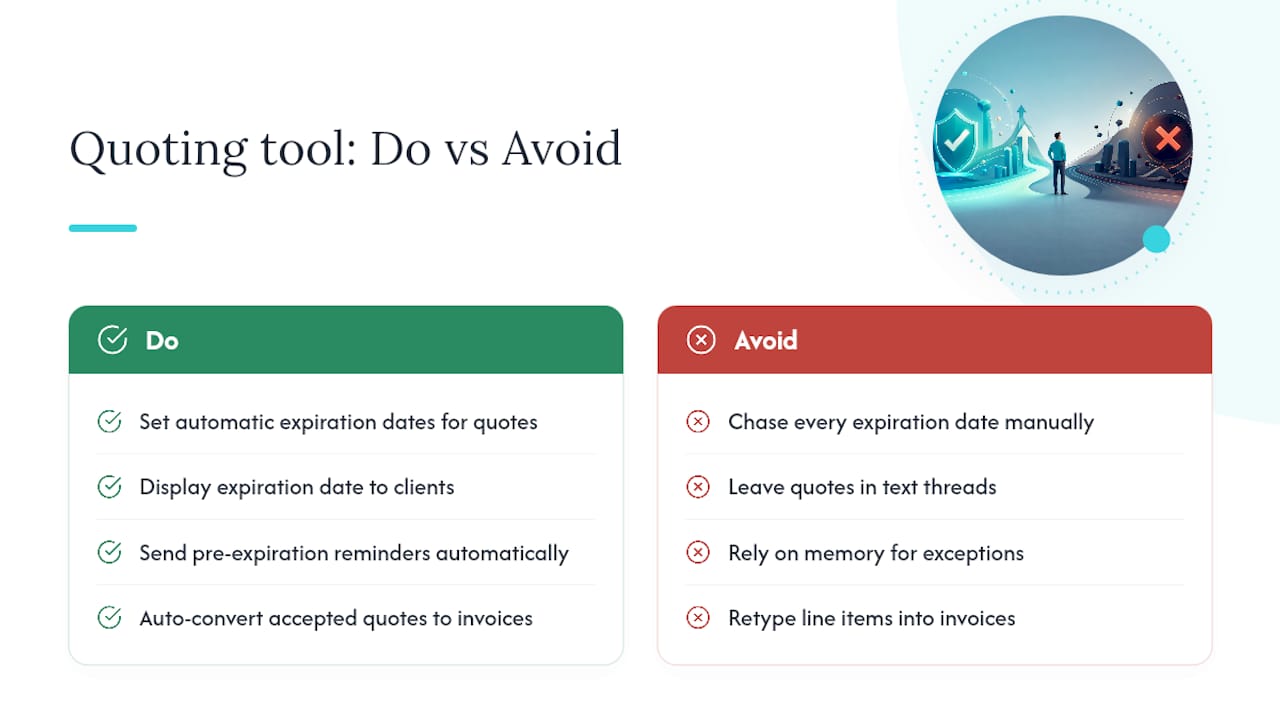
Chasing down every quote's expiration date by hand gets old fast, especially when you're also running jobs, ordering parts, and trying to get paid on time. A quoting tool can set a clear expiration date automatically on every quote you send, display it where the client can see it, and send a reminder before it lapses, so you're not the one keeping a mental calendar of who owes you an answer.

Once a client accepts, that same quote can flow straight into an invoice without retyping a single line item, which is where lots of solo operators lose time and, honestly, lose track of who's actually paid. If you've ever honored a one-time courtesy price and then forgotten you did it, some tools give you a place to log that exception right on the job record instead of relying on memory. Pair that with automated review requests that go out right after the job wraps, and you’re building the kind of Google presence that brings in the next client without extra legwork on your part.
If your quotes are still sitting in a text thread with no expiration date at all, that's the first thing worth fixing. Try Quotewren and set your first quote with a real "valid until" date in the next few minutes.
Where to Learn More
For the legal backbone behind "reasonable time" rules, Cornell Law School's WEX legal dictionary breaks down how courts have handled it historically. IBM's own quote expiration policy documentation shows how a real CPQ system handles 30-day defaults and manual overrides. For window-length guidance across different trades, Waco3's practitioner guide walks through how to match your expiration to project type, and their companion piece on handling expired quotes covers the exact scripts to use when a client comes back late.
Sources
- Reasonable time — Cornell Law School WEX
- Quote expiration policy — IBM Support
- How Long Is a Quote Valid? (Waco3)
- Quote expiration date — ORM Tech glossary
FAQ
How long is a quote legally valid for?
Without a stated date, U.S. common law holds a quote open only for a "reasonable time," which a court determines case by case after a dispute arises. Stating an exact expiration date removes that guesswork entirely.
Is a quote only valid for 30 days?
Thirty days is a common default, IBM's own quoting systems use it as the standard setting, but it's not a universal rule. Many trades use shorter windows (7 to 14 days) for jobs with volatile material costs.
How long does it take for a quote to expire?
A quote expires on whatever date you set on it, typically anywhere from 7 to 30 days from when you sent it, depending on the job type and how fast material prices move.
How long is a quote allowed to be?
There's no legal cap on how long you can make a quote valid; it's entirely your call as the business owner. Most tradespeople keep it short enough (under 30 days) that they're not stuck honoring outdated material costs.
What should I do if a client accepts my quote after it expires?
You have three honest options: send a fresh quote at current pricing, honor the old price as a documented one-time courtesy, or honor it with a specific adjustment for any material costs that changed. Whichever you pick, write it down so it doesn't become an unspoken expectation.