
An invoice asks for payment. A receipt proves payment happened. That's the whole difference, and mixing the two up is what leaves solo tradespeople chasing money they've already earned.
Here's the short version: invoices go out before you get paid and set a due date; receipts go out after the money lands and confirm the transaction is closed. In your books, an invoice becomes accounts receivable (money owed to you), while a receipt backs up income you've already recorded. For tax season, the IRS and SBA both expect you to keep both documents on file, and if a client disputes a charge card payment, having a clean receipt trail matters for fighting chargebacks.
Key Takeaways
An invoice requests payment before it's received, while a receipt confirms payment after it's collected, and treating them as separate steps keeps your books audit-ready.
| Point | Details |
|---|---|
| Invoice comes first | Send it before or during the job with an itemized list and a firm due date. |
| Receipt comes after | Issue it the moment payment clears, showing date, amount, and method. |
| Don't skip the receipt | A paid invoice alone doesn't hold up as well as a dedicated receipt for disputes or warranties. |
| Match documents to your books | File invoices under accounts receivable and receipts under recorded income. |
| Automate the paperwork | Quotewren generates branded invoices, payment links, and receipts automatically after each job. |
Table of Contents
- Invoice vs Receipt: The Key Differences
- What Is an Invoice and When Should You Send One?
- What Is a Receipt and When Should You Issue One?
- When Do You Issue an Invoice vs a Receipt?
- How Invoices and Receipts Work in Your Books
- Is an Invoice Proof of Purchase? Can a Receipt Replace It?
- How to Create an Invoice and Issue a Receipt
- Quote, Invoice, Receipt: The Full Payment Loop
- Let Software Handle the Paperwork for You
- A Solo Tradesperson's Perspective on Getting This Right
- Send Every Invoice and Receipt Automatically With Quotewren
- Sources
- FAQ
Invoice vs Receipt: The Key Differences
Both documents track money, but they do different jobs at different points in the transaction. Get these mixed up and you'll either confuse a client about what they owe or leave yourself with no paper trail if the IRS ever asks questions.
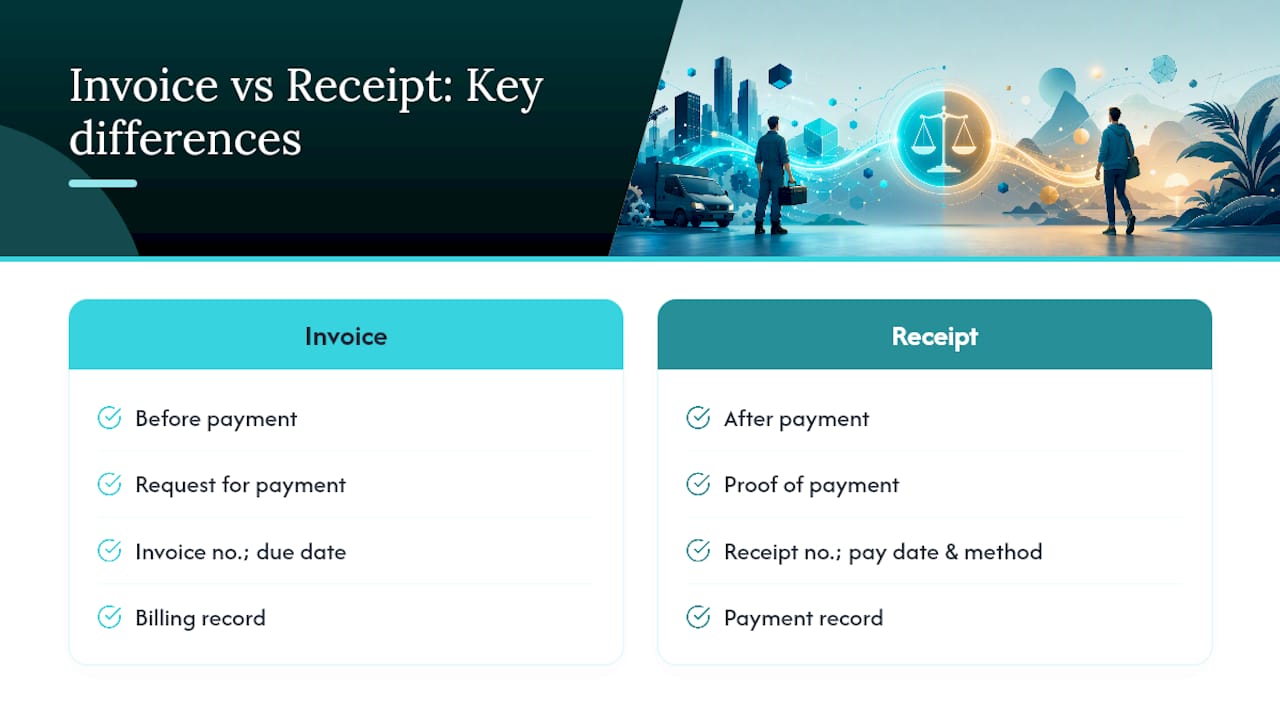
- Purpose: An invoice requests payment. A receipt confirms payment already happened.
- Timing: Invoices go out before or at the time of service. Receipts go out immediately after payment clears.
- What it proves: An invoice proves you billed for work. A receipt proves the client paid you.
- Accounting role: Invoices sit in accounts receivable until paid. Receipts get logged as income (or as a deductible expense on the buyer's side).
- Required detail: Invoices need payment terms and a due date. Receipts need the payment date and method used.
Pro Tip: Don't just stamp an old invoice "PAID" and call it a receipt. Adobe's guidance on the two documents recommends treating them as separate steps, because a dedicated receipt with its own date and payment method holds up better if you ever get audited or a client disputes the charge.
What Is an Invoice and When Should You Send One?
An invoice is a formal bill. You send it before you've been paid, spelling out exactly what you did and what the client owes you. Think of it as the paperwork that starts the clock on getting paid.
A solid invoice needs:
- Your business name, address, and contact info
- A unique invoice number
- The date of service and the invoice date
- An itemized list of labor, parts, and materials
- Sales tax, if it applies in your state
- Payment terms and a firm due date
- Accepted payment methods (card, ACH, check)
Here's what a basic electrical service call invoice looks like:
Invoice #1042 — Sparks Electric Service date: March 3, 2026 Panel repair labor: $180.00 | Breaker parts: $45.00 Tax: $11.25 | Total due: $236.25 Due: March 17, 2026 (Net 14)
A missing due date is a bigger problem than most solo operators realize. An invoice without one gives you nothing to point to when you follow up on a late payment. Stripe's guidance on invoicing makes the same point: a due date turns a vague request into an actionable deadline you can actually enforce. The invoice number matters too. It's how you match a payment to the right job when you're reconciling your books at the end of the month.
What Is a Receipt and When Should You Issue One?
A receipt is proof the money changed hands. It goes out right after payment, whether that's the second a client taps their card or the moment a check clears. Receipts can be paper, emailed as a PDF, or generated automatically by whatever payment processor you use.
A complete receipt includes:
- The date payment was received
- The exact amount paid
- The payment method (card, cash, check, ACH)
- A reference to the related invoice or order number
- Sales tax collected
- Your business name and contact info
For a landscaping job with a deposit, a receipt might read:
Receipt #R204 — Green Edge Landscaping Payment received: March 3, 2026 Deposit for spring cleanup: $150.00 Payment method: Visa ending 4471 Balance remaining: $400.00 (Invoice #1042)
Pro Tip: Attach every receipt to its matching invoice in your files, whether that's a folder on your phone or a bookkeeping app. Chase notes that receipts are often required for returns, warranty claims, and chargeback disputes, so a client asking "prove I paid you" six months later won't leave you scrambling.
When Do You Issue an Invoice vs a Receipt?
The rule is simple: invoice before payment, receipt after. But real jobs don't always run on a clean schedule, so here's how the common variations shake out.
- Deposit at booking: Issue a receipt for the deposit amount right away, then a final invoice for the balance when the job wraps.
- Milestone billing: Send an invoice at each milestone, and a receipt each time that invoice gets paid.
- Client pays before you invoice: Still write the invoice for your records, mark it paid, and send a receipt confirming the payment date and method.
- Card preauthorization: Wait until the charge actually settles before issuing the receipt. A hold isn't a completed payment.
How Invoices and Receipts Work in Your Books
Invoices and receipts aren't interchangeable in your accounting, even though they're both pieces of paper about money. An unpaid invoice sits in accounts receivable. It's money you're owed, not money you have. Once a client pays, that invoice clears and the payment gets logged as income, backed by a receipt.
At tax time, this pairing matters. Reconciling your books means matching every payment received to the invoice it settles, then filing the receipt alongside it. A quick checklist for solo operators:
- Match every deposit or payment to its invoice number.
- Note partial payments and remaining balances clearly.
- Store receipts with their matching invoice, not in a separate pile.
- Flag any credits or refunds issued against an invoice.
The IRS expects businesses to keep records that support both income and expense claims, and the SBA's guidance on tax ID setup is a good starting point if you haven't formalized your business registration yet. Clean invoice and receipt pairs make an audit a non-event instead of a scramble.
Is an Invoice Proof of Purchase? Can a Receipt Replace It?
An invoice is usually not proof of purchase. It's a request, not a confirmation. A receipt is the document that actually proves payment happened.
Can a receipt replace an invoice? Sometimes, but it depends on the details. A paid invoice can double as a receipt only if it clearly shows the payment date and method, not just a "PAID" stamp. Even then, most bookkeeping guidance recommends issuing a separate, clean receipt anyway.
Compare a marked-paid invoice ("Invoice #1042, PAID 3/3/26, Visa") to a proper receipt with its own number, date, and amount. The second one holds up better if a client disputes the charge or needs proof for a warranty claim, since a receipt alone doesn't stop a chargeback from being filed, so keeping service records on hand still matters.
How to Create an Invoice and Issue a Receipt
Here's the actual sequence to follow after every job:
- Write the invoice immediately after finishing the work, while the details are fresh.
- Include an itemized breakdown, a firm due date, and every payment option you accept.
- Send it to the client by email or text with a payment link attached.
- Once payment clears, mark the invoice paid in your records.
- Generate and send a receipt showing the payment date, amount, and method.
If you're taking card payments directly, follow basic PCI security standards for handling card data. That mostly means using a reputable payment processor instead of storing card numbers yourself.
Pro Tip: A payment link cuts a lot of friction out of getting paid. Clients pay faster when they can tap a link on their phone than when they have to write a check and find a stamp. RealClient's guide to asking for payment has good phrasing if you're uncomfortable bringing up money directly.
Quote, Invoice, Receipt: The Full Payment Loop
A clean job follows one path: quote, then invoice, then payment, then receipt. Each document has an owner and a home in your records.
- Quote/estimate: You create it, client approves it, you file it as the job's starting point.
- Invoice: You issue it, client owes it, you track it in accounts receivable until paid.
- Payment: Client sends it, you confirm it, you log it as income.
- Receipt: You issue it, client keeps it as their proof, you file your copy with the invoice.
A one-day service call might run this whole loop in under 24 hours. A multi-day remodel with a deposit could stretch it over weeks, with a receipt for the deposit and a final invoice and receipt at completion.
Let Software Handle the Paperwork for You
Chasing invoice numbers, due dates, and receipts by hand eats into the hours you'd rather spend on the job site. A tool like Quotewren turns a finished job into a branded invoice, sends the client a payment link, and automatically generates a receipt the moment they pay.
That means faster payment (clients pay links faster than paper bills) and consistent records you're not rebuilding from memory every tax season. Quotewren also fires off an automated review request right after the job closes, which helps solo tradespeople build the online reputation that larger crews already have. If you're tired of juggling invoice templates and forgetting to send receipts, that's worth a look.
A Solo Tradesperson's Perspective on Getting This Right
Every solo contractor learns this the hard way eventually: the electrician who invoices a service call, the landscaper who takes a deposit at booking, the handyman who gets a warranty claim six months later with no receipt to back it up. The paperwork feels like a hassle until the day it saves you.
The fix isn't complicated. Issue a receipt every single time you accept payment, no exceptions, even for cash jobs. That one habit closes more gaps than any bookkeeping software ever will.
Send Every Invoice and Receipt Automatically With Quotewren
Quotewren turns a finished job straight into a branded invoice, complete with an integrated payment link so clients can pay from their phone. Once that payment clears, Quotewren generates the receipt automatically and sends a review request right behind it, which means you're not just getting paid faster. You're building the Google reviews that win your next job. It's built specifically for solo trades, not fleets of trucks, so the pricing stays simple and the setup takes minutes, not weeks.
Try Quotewren free and send your next invoice before you even leave the job site. This article includes a promotional mention of Quotewren, a product built for solo tradespeople.
Sources
- What Kind of Records Should I Keep? | IRS
- Get federal and state tax ID numbers | SBA
- Invoice vs Receipt | Chase
- PCI Security Standards Council
- Invoice vs receipt: Understanding the differences | Adobe Acrobat
FAQ
Is an Invoice Proof of Purchase?
Not usually. An invoice is a request for payment, not confirmation that payment happened, so it doesn't function as proof of purchase on its own.
Can a Receipt Replace an Invoice?
Sometimes a paid invoice with a clear payment date and method can double as a receipt, but issuing a separate receipt is still the safer, more audit-ready practice.
What's the Difference Between an Invoice and a Bill?
An invoice and a bill are essentially the same thing: a formal request for payment. "Bill" is just the more casual term people use for the same document.
Do I Need to Keep Both Invoices and Receipts for Taxes?
Yes. The IRS recommends keeping records of both charges and payments received, so pairing every invoice with its matching receipt makes tax filing and audits far easier.
Can Quotewren Handle Both Invoices and Receipts Automatically?
Yes. Quotewren generates a branded invoice after a job, sends a payment link, and automatically creates a receipt once the client pays.