

Yes, you can charge invoice late fees, as long as you told the customer about them in writing before the work started. A safe default is a monthly rate commonly between 1% and 1.5%, which generally aligns with industry norms and is considered reasonable annualized. That range is the industry norm and usually stays clear of state usury limits, but enforceability always comes down to one thing: did the customer agree to the fee before the invoice showed up?
- Yes, you can charge them — but only if you disclosed the fee in writing beforehand.
- Safe starting rate: 1% to 1.5% monthly, or a flat fee for small jobs.
- The catch: even a fair fee is hard to collect if it wasn't in your estimate or contract first.
Quick fact: Late fee wording carries the most weight when the customer agreed to it before the transaction happened, not after the invoice went out, according to LegalClarity.
Table of Contents
- What Is an Invoice Late Fee and How Do You Charge One?
- Is a Late Fee on an Invoice Legally Enforceable?
- How Do You Write Late-Fee Terms That Actually Hold Up?
- How Do You Calculate a Late Fee on an Invoice?
- Do State Usury Laws Limit Your Late Fees?
- What Should Your Overdue Invoice Reminders Say?
- When Should You Skip the Late Fee Instead?
- Does Automating Invoices Actually Reduce Late Payments?
- How Do You Report Late Fees for Taxes and Bookkeeping?
- A Solo Tradesperson's Take on Making This Work
- Try Automated Invoicing Built for One-Person Crews
- Sources
- FAQ
What Is an Invoice Late Fee and How Do You Charge One?
A late fee is money you add to an unpaid invoice as a penalty for paying past the due date. It's not the same as interest on a loan, though the math can look similar. Most tradespeople use one of three structures.
- Flat fee. A set dollar amount, like $25 or $50, added once the invoice goes overdue. Works well for smaller jobs where a percentage wouldn't add up to much.
- Percentage. A monthly rate, typically 1% to 1.5%, charged on the unpaid balance. This scales naturally with bigger invoices.
- Mixed. A flat administrative fee plus a monthly percentage, like $25 plus 1% per month, which covers your paperwork time while still growing with the balance.
Stick with simple interest, not compound. Simple interest calculates the fee only on the original unpaid amount each month. Compounding, where you charge interest on the interest, gets messy fast and invites disputes. For a $4,000 electrical panel job, simple math is easier to defend and easier for the customer to understand.
Pro Tip: *If most of your invoices are under $1,000, a flat fee usually beats a percentage.
Is a Late Fee on an Invoice Legally Enforceable?
A late fee is enforceable only when the customer agreed to it before the invoice existed. An invoice by itself isn't a contract. It's a bill. If the late-fee language shows up for the first time at the bottom of the invoice after the job is finished, a court may treat it as something you added unilaterally, not something the customer accepted.
Courts generally look at whether a fee functions as liquidated damages (a reasonable estimate of the harm caused by late payment) or as a punitive penalty (designed to punish, not compensate). Fees in the 1% to 1.5% monthly range almost always read as reasonable.
Quick fact: Keeping fees near 1% to 1.5% monthly preserves enforceability across most U.S. states for commercial invoices and avoids usury exposure in many jurisdictions.
Before you charge a dime, run through this checklist:
- Signed estimate, work order, or contract that mentions the late-fee terms.
- The same fee language repeated on the invoice itself.
- A consistent policy applied to every late customer, not just the ones who annoy you.
- Copies of every signed document and every reminder you send, kept somewhere you can find them later.
Skip any of these, and you're relying on goodwill instead of a legal right.
How Do You Write Late-Fee Terms That Actually Hold Up?
Vague wording is the number one reason late fees get challenged. Your terms need five specific pieces: the due date format, the exact fee or rate, when the clock starts, whether it compounds, and how partial payments get applied. Leave one out, and a customer's lawyer (or a small claims judge) has an opening.
Here are three templates you can copy into your contract and invoice today.
- Percentage template: "Invoices are due within 15 days of the invoice date. Unpaid balances after that date will accrue a late fee of 1.5% simple interest per month, calculated on the outstanding balance. Partial payments are applied to the oldest outstanding balance first."
- Flat-fee template: "Invoices are due upon receipt. A flat late fee of $35 will be applied for any payment received more than 10 days after the invoice date."
- Combined template: "Payment is due within 30 days. A one-time $25 administrative fee applies to any invoice unpaid after 30 days, plus 1% simple interest per month on the remaining balance until paid in full."
A late fee clause added only to the invoice after the job is done rarely holds up. The clause needs to live in the estimate, the signed work order, or a terms confirmation the customer sees before you start the work.
Put this language in two places: your estimate or contract, and again on every invoice you send. Get a signature or a clear digital acceptance on the first document. If you're using a quoting tool, build the fee language into your standard quote template so it's never an afterthought.
Pro Tip: Don't bury the fee clause in fine print. Put it in bold near the payment terms so no customer can later claim they missed it.
How Do You Calculate a Late Fee on an Invoice?
The math is straightforward once you pick a structure. Here's how each one plays out on real trade invoices.
Flat-fee example: A $500 invoice for a plumbing repair goes 20 days past due. Your terms include a $50 flat late fee. The new total owed is $550, flat, no matter how many extra weeks pass (unless your terms also add a recurring flat fee per month, which some businesses do for chronic late payers).
Percentage example: A $5,000 HVAC installation invoice sits unpaid. Month one adds $75 ($5,000 x 0.015). Month two adds another $75, calculated on the original $5,000, not on the new balance. After two months, the customer owes $5,150 in principal plus fees.
- Month 1 fee: $75
- Month 2 fee: $75
- Total after 2 months: $5,150
Simple vs. compound: If you compounded instead, month two's fee would be based on $5,075, not $5,000, adding a few extra cents. It's not a huge difference at this scale, but compounding is harder to explain and easier to challenge. Simple interest is the standard most invoicing guides recommend, and it's what most collections software calculates by default.
Quick fact: Combined structures like a $25 flat fee plus 1% monthly interest are common because they make sure small invoices carry a fee that actually means something, not just a few cents.
Do State Usury Laws Limit Your Late Fees?
State law is not uniform, and that's the part most trade guides skip. Usury statutes cap the interest rate you can charge on certain transactions, and those caps differ state to state.
That range sits comfortably under most usury thresholds for commercial invoices, according to Stripe's guidance for businesses.
- Charging 1% to 1.5% monthly: generally safe across most states.
- Charging above 2% monthly: check your state's usury statute first.
- Doing interstate work: the applicable law can depend on where the contract was signed or performed, not just where your business sits.
A 30-minute consult costs far less than a fee that gets thrown out in court, or worse, triggers a usury counterclaim against you.
What Should Your Overdue Invoice Reminders Say?
Consistency beats aggression. A predictable, professional reminder sequence collects more money than a single angry email, and it protects the relationship while you're at it.
- Friendly reminder (5–15 days past due). Short and low-pressure: "Hi [Name], just a reminder that invoice #1042 for $500 was due on [date]. Let me know if you have questions or need to arrange payment."
- Second notice (15–30 days past due). Slightly firmer, mention the fee: "Invoice #1042 is now 20 days past due. Per our agreement, a late fee applies to balances unpaid after 15 days. Updated total: $550."
- Fee applied, invoice updated (per your terms). Send a revised invoice showing the new total, the fee amount, and the payment link.
- Formal demand (30–60+ days past due). A written, dated notice stating the full amount owed, the consequences of continued nonpayment, and a firm deadline.
Every message needs the invoice number, original amount, fee applied, new total, and a clear way to pay. Consistent, documented follow-up is what makes late fees collectible instead of theoretical. Keep copies of everything. If a customer hits 60 days with no response, that's usually the point to pause future work or consider a collections referral.
Pro Tip: Save your reminder templates once, then reuse them for every overdue invoice. Customizing from scratch each time is how follow-ups quietly stop happening.
When Should You Skip the Late Fee Instead?
Not every late payment deserves a penalty. Waive the fee when you sent the invoice late yourself, when there's a genuine billing dispute, or when a normally reliable customer slips up once. Charging a loyal customer a fee over a five-day delay can cost you more in goodwill than the fee is worth.
- Billing errors on your end: waive it.
- First-time late payment from a good customer: consider a one-time pass.
- Ongoing disputes over the work itself: resolve the dispute before touching fees.
Better alternatives exist for protecting cash flow without burning bridges: deposits before starting a job, milestone billing on larger projects, short payment plans for big invoices, and early-pay discounts that reward fast payers instead of punishing slow ones, or consider invoice financing options to improve your cash flow while waiting on payments. If you're introducing late fees for the first time, give existing customers 30 to 60 days' notice before you start enforcing the new policy on them.
Does Automating Invoices Actually Reduce Late Payments?
Late fees only work if you actually send reminders and apply them consistently, and that's the part solo tradespeople struggle with most. You're on a roof or under a sink, not sitting at a desk tracking due dates.

Automation closes that gap. Automating reminders removes the operational friction that stops most small businesses from enforcing late fees at all — no more forgetting who owes what, no more awkward phone calls three weeks later.
Quotewren was built around this exact workflow for solo trades: convert your finished quote into an invoice, attach a pay link, send automated reminders on schedule, and follow up with a review request once the job's paid. That's the full quote to invoice to paid to reviewed cycle handled without you touching a spreadsheet.
- Reminders go out on schedule, without you remembering to send them.
- Pay links let customers pay immediately instead of mailing a check.
- Review requests fire automatically right after payment, when the job's still fresh in the customer's mind.
Try it on a small scale first. Pick your next five overdue-prone invoices, turn on automated reminders, and compare how fast they get paid versus your usual manual follow-up.
| Point | Details |
|---|---|
| Manual follow-up leaks cash | Forgotten reminders are the biggest reason late fees never get collected. |
| Automation applies consistency | Scheduled reminders and pay links reduce the friction that stops enforcement. |
| Quotewren covers the full cycle | It connects quotes, invoices, pay links, reminders, and review requests in one flow. |
How Do You Report Late Fees for Taxes and Bookkeeping?
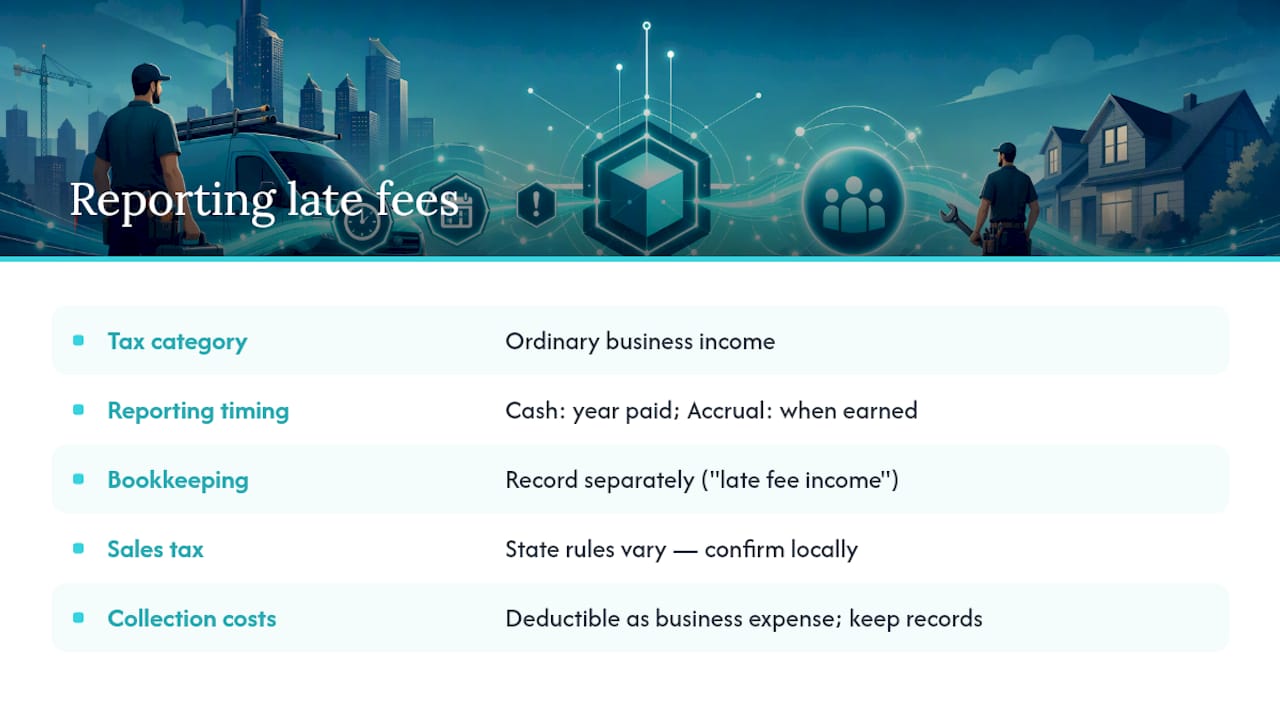
Late fees you collect from customers count as ordinary business income, not a separate category. Record them the same way you'd record any other revenue, typically under a line like "late fee income" or "interest income" in your bookkeeping software, separate from the invoice's original job total so you can track how much fee revenue you're actually collecting.
For most solo tradespeople using cash-basis accounting, you report the late fee income in the tax year you actually receive the payment, not the year you invoiced it. If you invoice in December but the customer pays the late fee in January, that income belongs on next year's return. Businesses using accrual accounting recognize it differently, generally when the fee is earned, so check with a bookkeeper if you're not sure which method you're on.
On your books, keep the late fee separate from the invoice subtotal and any sales tax you charged on the original job. Sales tax rules on late fees vary by state. Some states treat late fees as part of the taxable sale price; others don't tax them at all. Since this varies locally, confirm the rule with your state's department of revenue or your accountant rather than assuming one way or the other.
Deducting collection costs works the normal way: if you pay a collections agency or an attorney to chase an unpaid invoice, that expense is generally deductible as an ordinary business cost. Keep the invoice, the signed terms, and your reminder records together. If the IRS or a state auditor ever asks why your income doesn't match your invoiced totals, that paper trail is what backs you up.
A Solo Tradesperson's Take on Making This Work
Late fees don't fail because the math is wrong. They fail because nobody follows up. On a five-person crew or a one-truck operation, chasing invoices always loses to the next job on the schedule.
What actually protects your cash flow is boring and repeatable: modest, disclosed fees plus reminders that go out whether you remembered or not. Pick a rate you'll actually enforce every time, put it in writing before you swing the first hammer, and let automation handle the follow-up you'd otherwise forget. Start with your next five invoices and watch what changes.
Try Automated Invoicing Built for One-Person Crews
Most invoicing tools are built for companies with a fleet and an office manager. Quotewren isn't. It's built for the solo electrician, plumber, or landscaper who quotes a job on-site, needs the invoice out the same day, and doesn't have time to track down every late payment by hand.
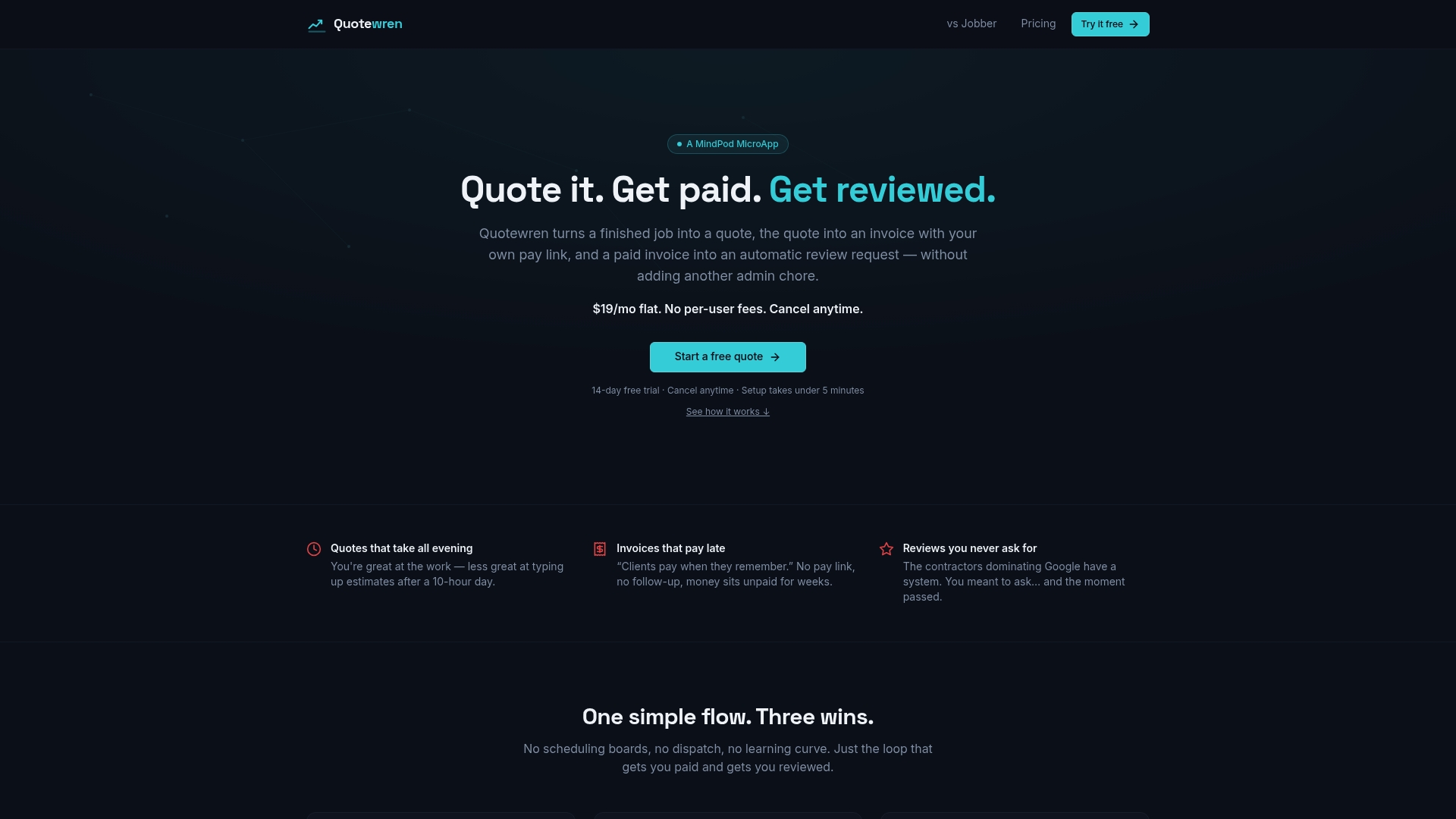
Quotewren turns your finished quote into an invoice automatically, attaches a pay link so customers can pay on the spot, and sends your reminder sequence without you lifting a finger. Once payment lands, it fires off a review request while the job's still fresh in the customer's mind, which helps you show up better on Google for the next search in your area. If chasing unpaid invoices is eating into your week, start a free trial with Quotewren and send your next invoice through it to see the difference.
| Point | Details |
|---|---|
| Get consent first | Put late-fee terms in the estimate or contract before work begins, not just on the invoice. |
| Default to 1%–1.5% monthly | This range covers most trades invoices and usually stays under state usury limits. |
| Use simple interest | Simple interest is easier to explain and defend than compounding. |
| Automate your reminders | Consistent, scheduled follow-up collects far more than sporadic manual emails. |
| Try Quotewren for the full cycle | Quotewren connects quoting, invoicing, pay links, reminders, and review requests for solo tradespeople. |
Sources
- Invoice late fee wording: What to include and avoid - LegalClarity
- What businesses should know | Stripe
- Late Payment Fees: How to Charge Them | ClearReceivables
- Late Payment Fees and Interest: How to Charge Them Legally | American Invoice Generator
FAQ
What Is a Typical Late Fee for Invoices?
Can I Charge Late Fees on an Invoice?
Yes, but only if you disclosed the fee in writing and the customer agreed to it before the work started; adding it to the invoice after the fact rarely holds up.
How Much Can I Charge for a Late Invoice?
What Happens If I Pay an Invoice Late?
The vendor may add the disclosed late fee to your balance, and continued nonpayment can lead to formal demands, paused future work, or collections referral.
Can automation like Quotewren help reduce late payments?
Yes. Automated reminders and pay links, like the ones built into Quotewren's quote-to-invoice workflow, remove the manual follow-up that most solo tradespeople struggle to keep up with.