

Yes, every solo tradesperson should use a written travel charge policy that names the billing method, the free-service radius, and how the charge shows up on the invoice. Pick one method (mileage, travel time, flat fee, or a hybrid), put the rate in your contract or service agreement, and disclose it before you book the job, not after you finish it.
TL;DR:
- A written travel charge policy must specify the billing method, free radius, exact rate, and invoice appearance to be enforceable in case of disputes.
- The four common billing methods are per-mile, travel time, flat fee, and hybrid, each suited to different drive patterns and local market conditions.
- Most solo tradespeople set a free radius between 10 and 25 miles based on their last 20 jobs, adjusting rates and zones accordingly for rural or suburban work.
- Travel charges should be itemized as separate line items on invoices with clear details, including date, destination, method, tolls, and total, to prevent disputes.
- Disclose travel fees early during the estimate or booking stage, and consider offering flexibility to avoid conflicts or negative reviews.
Table of Contents
- What Is a Travel Charge Policy?
- Copy This Travel Charge Policy Template
- Which Travel Billing Method Fits Your Trade?
- How Do You Set Your Free Radius and Rates?
- How Should Travel Charges Appear on Invoices?
- How Do You Tell Clients About Travel Fees Without Losing the Job?
- What Do You Do When a Client Disputes a Travel Charge?
- What Tradespeople Get Wrong About Travel Charges
- Let Quotewren Handle the Travel Line for You
- Sources
- FAQ
What Is a Travel Charge Policy?
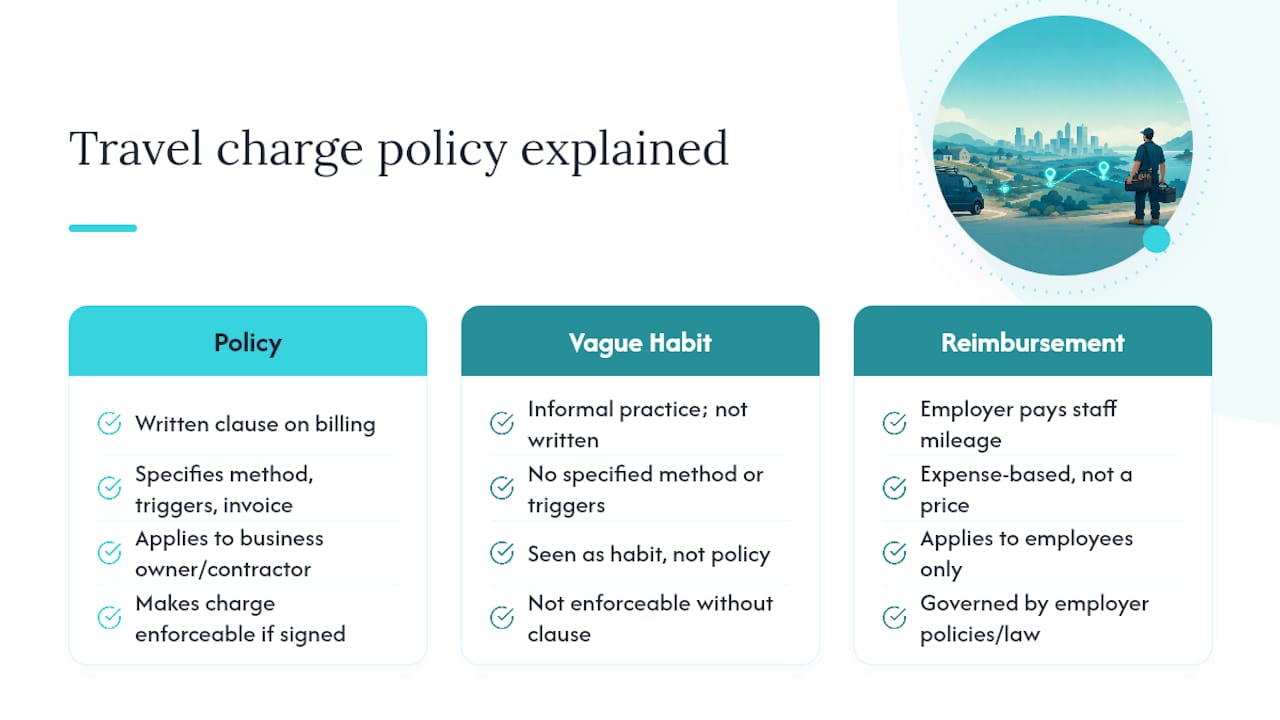
A travel charge policy is the written rule you use to bill clients for the time and cost of getting to a job. It is not a vague habit of "sometimes charging extra for far jobs." It is a specific clause that says what method you use, what triggers the fee, and where it shows up on paper.
Solo tradespeople often confuse this with a general "travel reimbursement" idea borrowed from office jobs, where an employer pays staff back for mileage. That is a different animal entirely. You are not an employee filing an expense report. You are a business owner setting a price. No federal law requires a client to pay you for travel time. The Department of Labor's guidance on contractor pay applies to employees, not independent contractors, which means your right to charge for travel comes entirely from what you put in writing.
That last point matters more than most tradespeople realize. If your contract says nothing about travel, and a client refuses to pay a travel fee you tack on at the end, you have almost no ground to stand on. A written clause is what turns "I usually charge for driving" into an enforceable term.
Copy This Travel Charge Policy Template
You do not need a lawyer to write this. You need one paragraph and a few consistent numbers. Here is a base template you can drop into any estimate, contract, or booking confirmation:
"Travel within [X] miles of [your base location] is included in the service call. Beyond that radius, travel is billed at [method and rate]. Travel charges are calculated round-trip from [starting point] and appear as a separate line item on your invoice."
Fill in the brackets with one of these four variants depending on how you want to bill:
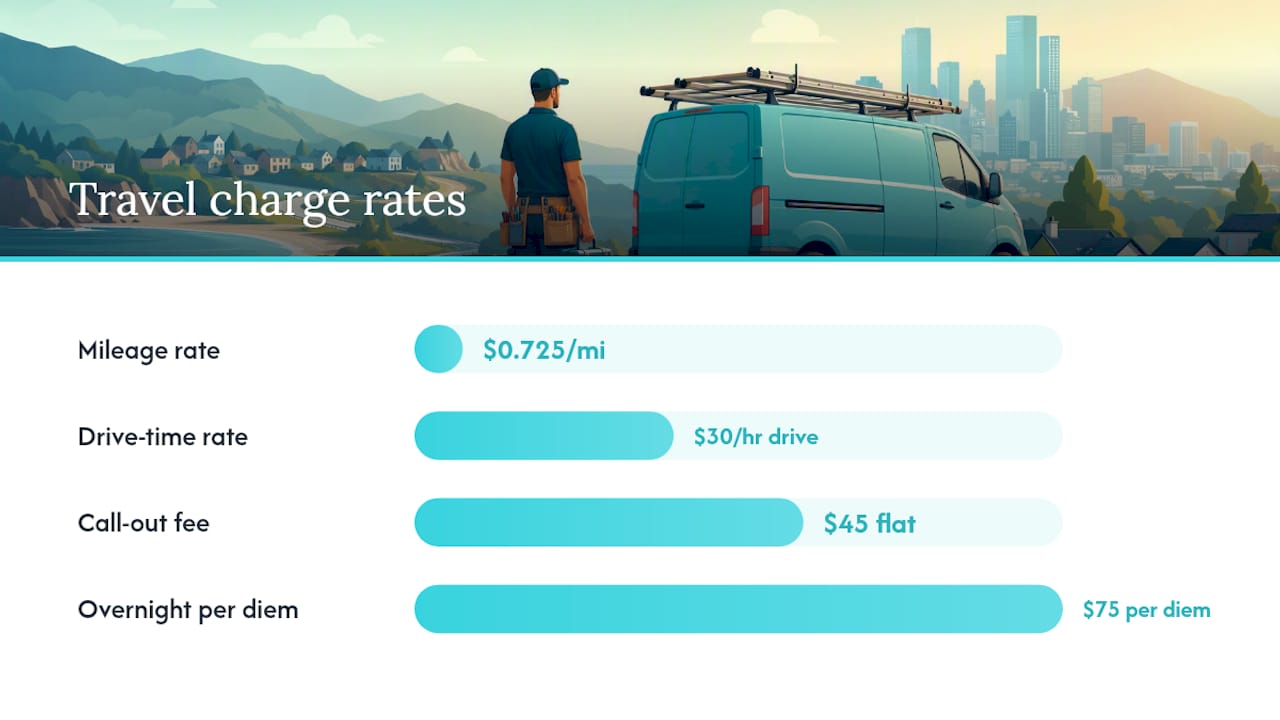
- Mileage-only: "Travel beyond 15 miles is billed at $0.725 per mile round-trip," using the IRS standard mileage rate as your benchmark.
- Mileage plus reduced travel time: "Travel beyond 15 miles is billed at $0.725 per mile plus $30 per hour of drive time" (roughly half your normal labor rate).
- Flat call-out fee: "A $45 call-out fee applies to all jobs outside the free service zone."
- Per diem for overnight work: "Jobs requiring overnight stays include a $75 per diem plus mileage."
Add the clause in three places: the estimate (so the client sees it before agreeing), the booking confirmation (so there is a paper trail), and the final invoice (so it is itemized, not buried).
- Draft the clause once using the template above.
- Paste it into your standard contract or scope-of-work document.
- Add the same wording to your quote template so every estimate shows it automatically.
- Reuse the exact line on every invoice, adjusting only the numbers.
Pro Tip: Save your travel clause as a reusable snippet in whatever quoting tool you use. Typing it freshen every time is how inconsistent wording, and inconsistent client expectations, creep in.
Which Travel Billing Method Fits Your Trade?
Four billing methods cover almost every situation a solo tradesperson runs into. LegalClarity's breakdown of contractor travel billing lays out the same four models most experienced contractors already use informally.
- Per-mile: Bill using the IRS standard mileage rate, which is set at 72.5 cents per mile for 2026. This works best for rural electricians, HVAC techs, or landscapers who regularly drive long distances between jobs, since it directly covers fuel, wear, and depreciation.
- Travel time: Charge a percentage of your hourly labor rate, commonly around 50%, for the time driving displaces from billable work. This suits plumbers and handymen whose drive time eats into a day that would otherwise be full of paid jobs.
- Flat fee or zone pricing: Set one number, like $45, for anything outside your free radius. This is the simplest option for cleaning businesses and small-repair handymen working in dense suburban markets where drive times barely vary.
- Hybrid: Combine mileage for vehicle cost with a reduced travel-time rate for labor. This is widely considered the fairest model because it accounts for both what your truck costs and what your time is worth.
None of these methods is universally "correct." A landscaper doing three jobs a day in one zip code has a different math problem than an electrician who drives 40 miles to a rural farmhouse. Match the method to your actual drive patterns, not to what a competitor down the street uses.
How Do You Set Your Free Radius and Rates?
Most solo tradespeople set a free-service radius somewhere between 10 and 25 miles from their home base or shop. A tighter radius, closer to 10 miles, makes sense in dense cities where most calls are close together. A wider radius, closer to 25 miles, fits rural HVAC or electrical work where clients are spread thin and a 10-mile limit would trigger fees on nearly every job.
- Map your last 20 jobs and note the average distance. That is your real service pattern, not a guess.
- Set your free radius just above that average so routine local work stays free.
- Calculate mileage cost using the IRS rate, then add a travel-time charge if the drive regularly eats more than 20 minutes each way.
- Decide round-trip versus one-way. Round-trip is standard and easier to defend, since you are driving back regardless of the job.
- For multi-stop days, prorate travel across jobs rather than billing each client for the full trip.
Pro Tip: If you serve two or three towns regularly, consider a zone map instead of a single radius. A $0 zone for your home area, a $35 zone for the next town over, and a $60 zone for anything further keeps pricing predictable for both you and the client.
How Should Travel Charges Appear on Invoices?
Travel needs its own line item. Never fold it into "labor" or "materials," because a bundled number is the fastest way to trigger a dispute when a client asks what they are paying for.
- Date of service
- Destination or job address
- Method used (miles times rate, or hours times travel rate)
- Tolls or parking, listed separately
- Total travel charge, shown to the penny
A simple example: "Travel: 22 miles round-trip at $0.725/mile = $15.95." For a time-based charge: "Travel: 0.75 hours at $30/hour = $22.50." Attach a mileage log or a photo of a toll receipt when the amount is unusual. This is the same discipline behind clean invoice line items generally, travel is just one more line that needs its own detail.
| Method | Sample Calculation | Invoice Line |
|---|---|---|
| Per-mile | 22 miles round-trip × $0.725 | Travel: $15.95 |
| Travel time | 0.75 hours × $30/hour | Travel: $22.50 |
| Flat fee | Zone 2 call-out | Travel: $45 |
| Hybrid | 22 miles × $0.725 + 0.5 hr × $30 | Travel: $22.50 |
Keep your payment terms consistent between labor and travel. If your invoice terms are net-15 or net-30, that applies to the whole invoice, travel included, not a separate deadline. If you charge late fees, spell that out in your contractor invoice terms up front so it is never a surprise.
How Do You Tell Clients About Travel Fees Without Losing the Job?
Timing is everything here. Bring up travel charges when you first discuss the job, during the estimate or the booking call, never after you have already driven out and finished the work. A fee that shows up for the first time on the final invoice reads as a bait-and-switch, even when your math is fair.
- Frame it around fairness: explain that your free radius keeps prices low for nearby clients, and the fee simply covers what it costs to reach jobs further out.
- State the number plainly in the estimate: "This quote includes a $45 travel fee for your location."
- Offer flexibility where it makes sense. Waive the fee for repeat clients on recurring maintenance, roll it into a larger project quote, or credit it back if the client books additional work that same visit.
Pro Tip: If a client balks at a travel fee, offer to apply it as a credit toward the job total instead of removing it. You keep the fee's function, covering your cost, while making the client feel like they are getting something back.
What Do You Do When a Client Disputes a Travel Charge?
Most disputes come from surprise, not unfairness. FieldCamp's research on travel billing points to undisclosed fees on final invoices as the leading cause of pushback, which is exactly why disclosure at booking matters so much.
- Pull the paper trail: the original estimate showing the travel line, the booking confirmation, and your mileage log or receipts.
- Walk the client through the math calmly. Most disputes resolve once someone actually sees the calculation instead of just a total.
- If the client still objects, offer a partial credit or apply the fee toward a future job rather than digging in on principle.
- For unpaid invoices past your stated terms, cite the late-fee clause in your contract before escalating, and reserve small-claims court for amounts that justify the time.
What Tradespeople Get Wrong About Travel Charges
The most common mistake is vague language. "I might charge extra for far jobs" is not a policy. It is a maybe, and clients push back on maybes. The second mistake is inconsistency: charging one neighbor $30 and another $60 for the same distance because you never wrote the rule down. The fix is boring but effective: one clause, one rate, applied the same way every time. Disclose early, itemize clearly, and stop treating travel charges like an afterthought instead of a real cost you are entitled to recover.
— jaras
Let Quotewren Handle the Travel Line for You
Quotewren turns your travel charge policy into something you set up once and never rebuild by hand. Instead of retyping the same clause and recalculating mileage on every job, you create a reusable travel item, per-mile, flat fee, or time-based, and it drops into every quote automatically with consistent wording and math.

When the job wraps, that same line item flows straight into an itemized invoice with a pay link attached, so the client sees exactly what they owe and can pay on the spot. Quotewren also sends automated review requests after the job closes, which matters more than most solo tradespeople think: a client who just watched you charge a fair, clearly explained travel fee is far more likely to leave a good review than one who got blindsided by it. For payment terms and communication around fees more broadly, RealClient's guide to client payment terms covers ground worth reading too. Quotewren's plans start with a free tier, and the paid Quotewren plan runs $19 a month if you want the full quote-to-invoice-to-review workflow. Set up your first reusable travel item at App and see it show up on your next quote.
Sources
- Internal Revenue Service — Notice 2026-10 Standard Mileage Rates
- LegalClarity — How to bill for travel time as a contractor
FAQ
What Should Be in a Travel Charge Policy?
A travel charge policy should name the billing method (mileage, travel time, flat fee, or hybrid), the free-service radius, the exact rate, and how the charge appears on invoices. Put it in writing in your contract or service agreement, since no federal law guarantees payment for travel without one.
Can I Charge for Travel Time as an Independent Contractor?
Yes, but only if your contract or service agreement says so. The Department of Labor's guidance confirms that FLSA travel-pay rules apply to employees, not independent contractors, so your right to bill for travel comes entirely from your written terms.
What Is a Fair Travel Fee for a Solo Tradesperson?
There is no single fair number since it depends on your market and drive patterns, but many solo tradespeople set a flat call-out fee in the $25 to $75 range for local jobs outside their free radius, according to industry fee calculators. Rural or long-distance work often shifts to per-mile or hybrid billing instead.
Does Quotewren Handle Travel Charges on Invoices?
Yes. Quotewren lets you build a reusable travel item, whether mileage, flat fee, or time-based, that drops into quotes and invoices automatically with a pay link attached. Pricing starts free, with the full-featured Quotewren plan at $19 a month, listed at App.
Should I Charge Round-Trip or One-Way for Travel?
Round-trip is the standard approach since you are driving back to your base regardless of the job's outcome. One-way billing is harder to defend to clients and can look inconsistent if you use round-trip pricing for other jobs the same week.