

Payment terms are the rules that say when, how, and by what method your customer must pay you. If you run a one-person plumbing, electrical, or landscaping business, the single most useful thing you can do this week is pick explicit due dates and require deposits on any job with real material costs. The Uniform Commercial Code backs the default rule that payment is due when goods change hands, DSO (days sales outstanding) measures how long you wait to get paid, and a tool like Quotewren can turn those rules into an automatic invoicing habit.
TL;DR:
- Clearly define the trigger event on every invoice to prevent delays caused by ambiguous start dates, especially for net terms.
- Require deposits for jobs with material costs exceeding a few days of labor to minimize cash flow risks and upfront expenses.
- Use exact language like "Net 30 from invoice date" and specify exact due dates in writing to avoid disputes and payment delays.
- Implement staged payments or milestone billing for large or long-term projects to protect against upfront costs and extend cash flow.
- Match your payment terms to industry standards, with small, quick jobs often paid on delivery, and bigger projects requiring staged or advance payments.
Table of Contents
- What Payment Terms Are and Why They Control Your Cash Flow
- Common Payment Terms Explained, With When to Use Each
- How Payment Terms Change Your Cash Flow: DSO and DPO Explained
- How to Choose, Set, and Negotiate Payment Terms
- What to Put on an Invoice: Wording, Clauses, and a Quick Comparison
- The Workflow: Quote to Invoice to Paid, Automatically
- Legal Implications and Enforceability of Payment Terms
- How Payment Terms Affect Trust Between You and Your Customers
- Recording Payment Terms in Your Bookkeeping
- Payment Terms Vary a Lot by Industry
- Why Most Payment Terms Advice Misses the Point
- Sources
- FAQ
What Payment Terms Are and Why They Control Your Cash Flow
A payment term is really five smaller decisions bundled into one line on your invoice. It sets the due date, the trigger that starts the clock, the accepted payment methods, whether there's a discount for paying early, and what happens if the customer pays late. Get any one of those wrong and you're stuck waiting, guessing, or arguing.
Here's where most solo contractors get tripped up: the difference between the invoice date and the receipt date. If you write "Net 30" without specifying the start event, your customer might interpret the start of the payment window differently, not when you sent it. That gap of a few days doesn't sound like much, but stack it across a dozen invoices a month and it turns into weeks of delayed cash. Ambiguity about the trigger date is one of the most common causes of payment delays, and it's entirely avoidable with a single extra phrase.
The parts of a real payment term look like this:
- The trigger event — what starts the countdown (invoice sent, job finished, materials delivered)
- The due date or window — how many days the customer has, or whether payment is due immediately
- Accepted methods — check, ACH, card, cash, or a pay link
- Early-pay incentives — a discount for paying faster than the standard term
- Late fees or interest — the cost of missing the deadline
The stakes here aren't abstract. A survey cited by Stripe found that 65% of businesses reported wasting an average of 14 hours a week chasing overdue payments. For a solo tradesperson, 14 hours is almost two full workdays every single week spent on phone calls and follow-up texts instead of billable work.
Pro Tip: Write your trigger date on the invoice itself, not just in your head. "Due 30 days from invoice date" closes the loophole before it opens.
Clear terms don't just get you paid faster. They also cut down on the awkward conversations where a customer says "I didn't realize it was due already" and you're stuck deciding whether to push back or let it slide. Spell it out once, on paper, and that argument never happens.
Common Payment Terms Explained, With When to Use Each
Every industry has its own shorthand for payment terms, and most of it looks like code until someone explains it plainly. Here's what the common ones actually mean and when they make sense for trades work.
-
Net 30 / Net 15 / Net 60 / Net 90 — Payment is due within that many days of the trigger date. Net 30 is the standard default in US B2B transactions, and it works fine for repeat commercial clients with steady cash. Net 60 and Net 90 extend the payment window, increasing the time your money may be outstanding. The confusion almost always comes from an unclear start date, so always write "from invoice date" or "from completion" right next to the number.
-
2/10 Net 30 — This means the customer gets a 2% discount if they pay within 10 days, otherwise the full amount is due in 30. JPMorgan notes that incentive terms like this speed up payment when you need cash for materials fast. The math matters here: giving up 2% to get paid three weeks earlier is often a better deal than it looks, since that discount works out to a high effective annual return compared to what you'd pay to borrow the same money short-term.
-
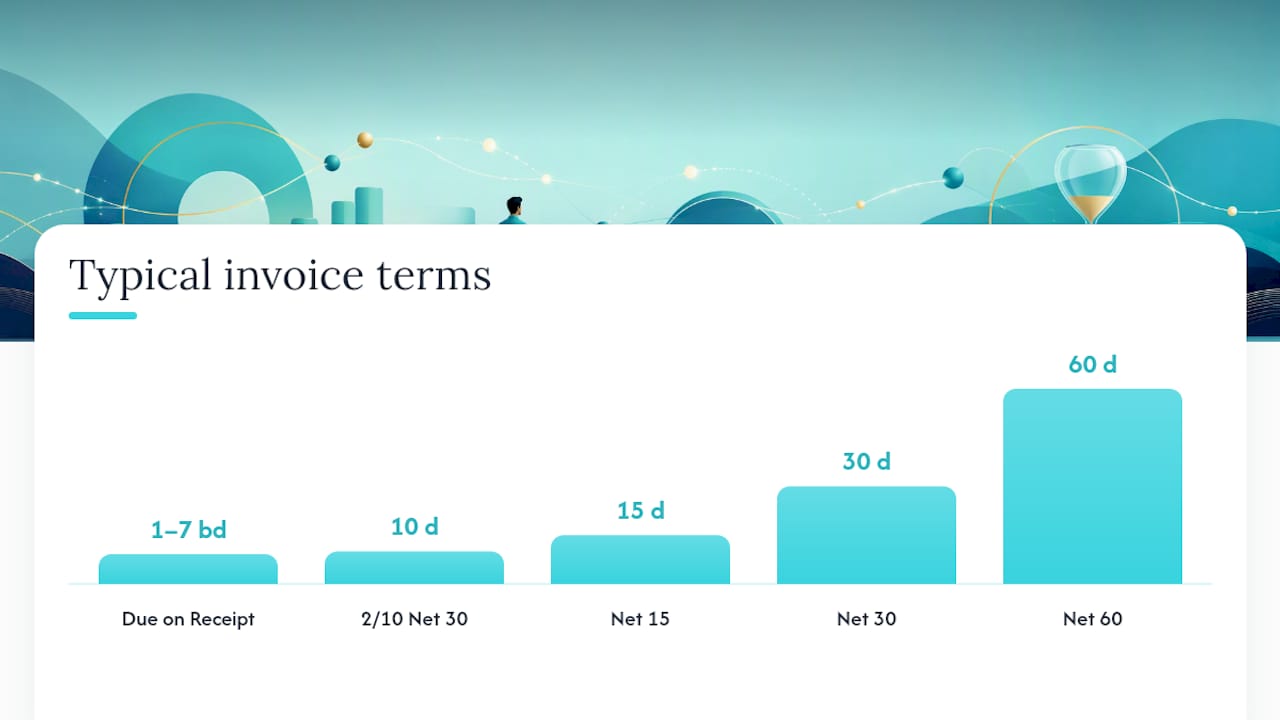
Due on Receipt — This is the one that causes the most arguments. Legally, "due on receipt" restates the UCC default: payment is owed when and where the buyer receives the goods or service. In practice, most accounts payable departments and homeowners treat it as a window of one to seven business days, not "this second." If you actually want same-day payment, don't rely on the phrase. Write "Due within 3 business days of invoice date" instead. It's clearer, and it holds up better if you ever need to chase the money.
-
EOM (End of Month) — Payment is due by the last day of the month the invoice was issued in, sometimes written as "Net 30 EOM" meaning 30 days after month's end. This shows up more in supply and wholesale relationships than typical trades work, but you'll see it if you bill larger property management companies.
-
MFI (Monthly Fixed Invoicing) — Invoices are batched and paid on a fixed monthly schedule rather than per job. Useful if you do recurring maintenance work for the same commercial account.
-
COD (Cash on Delivery) — Payment happens at the moment the job or delivery is finished, before you leave the site. This is common for small handyman jobs, emergency service calls, or any one-off job where you don't know the customer.
-
Cash in Advance / CWO (Cash With Order) — The customer pays in full before you start. Reasonable for small material-only orders or first-time customers where you have no track record with them yet.
-
Staged or progress payments — You bill in installments tied to job milestones. A common payment structure for larger jobs divides payment into initial and completion installments, which protects you from fronting material costs out of your own pocket. A kitchen remodel or a full HVAC system swap is exactly the kind of job where this matters.
-
Installment plans — The total is split into several payments over time, often used for large residential jobs like a full re-roof or a whole-home electrical panel upgrade, where the homeowner needs to spread out the cost.
For quick one-off jobs, a small unclogging job, a light fixture swap, a same-day AC filter service, Due on Receipt or COD keeps things simple. For anything with real material spend, like a bathroom remodel or a landscaping install with pavers and irrigation lines, staged payments protect you. Save Net 30 for commercial accounts you already trust and plan to bill repeatedly.
How Payment Terms Change Your Cash Flow: DSO and DPO Explained
Two numbers decide whether your bank account feels healthy or scary: DSO and DPO. DSO, days sales outstanding, measures how long it takes you to collect money after you've done the work. DPO, days payable outstanding, measures how long you take to pay your own suppliers. For a one-person shop, the gap between these two numbers is basically your cash cushion.
Here's a real-world version of the math. Say you take on an HVAC repair job that requires $2,000 in materials, plus your labor. If you bill Net 30 with no deposit, you're covering that $2,000 supply house bill out of your own pocket for up to a month before the customer's check clears. If instead you require 50% upfront ($1,000) before you order parts, and bill the remaining balance on completion, you've cut your exposure in half and shortened the time your own cash is tied up.
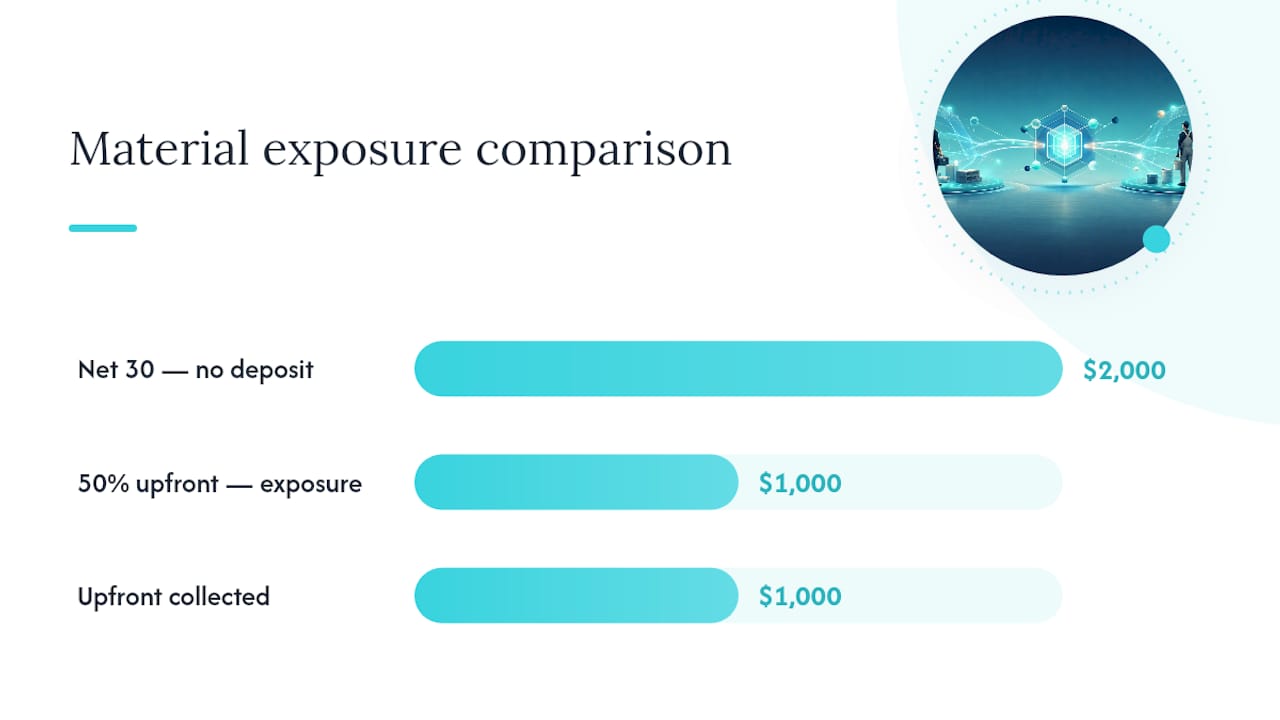
JPMorgan's research frames this simply: extending your customers' terms directly increases your own DSO, and that gap has to get funded somehow, either from savings, a credit line, or a stretched relationship with your supply house. Extending terms from Net 30 to Net 60 approximately doubles your DSO, potentially straining cash flow.
A few rules of thumb keep this from becoming a crisis:
- Require a deposit on any job where materials cost more than a day or two of labor.
- Use staged billing on jobs longer than one week, tied to clear milestones (rough-in complete, final inspection passed).
- Offer a small early-pay discount like 2/10 Net 30 on jobs where you'd rather have cash now than wait the full term.
- Never let a Net 60 or Net 90 request from a client become your standard, even if one commercial account insists on it.
The tradespeople who stay cash-healthy aren't the ones who never offer credit. They're the ones who match the credit they extend to how much cash they can actually afford to have sitting out at any given time.
How to Choose, Set, and Negotiate Payment Terms
Setting your terms isn't a one-size-fits-all decision. It depends on who you're billing, how big the job is, and how well you know the client. Here's a workable process.
-
Sort the client into a risk category before you quote. A homeowner you've never met, a repeat commercial account, and a friend-of-a-friend referral all deserve different terms. New residential clients: require a deposit. Repeat commercial clients with a track record of paying: Net 30 is fine. Anyone asking for Net 60 or longer on their first job with you: that's a red flag, not a compromise.
-
Set your default policy and stick to it. Decide now, not mid-negotiation, what your standard terms are. A common structure for trades: 30% to 50% deposit on jobs over a set dollar threshold (say, $500), balance due on completion, with a 2/10 Net 30 option for clients who want a small discount for paying fast.
-
Use a script when a client pushes back. For a residential homeowner asking to skip the deposit: "I get it, nobody likes putting money down before the work's done. Here's why I ask: once I order your materials, that cost comes out of my pocket until you pay. A 30% deposit covers the parts so I can get started right away instead of waiting on a supply order."
-
For a repeat commercial client asking for longer terms: "I can do Net 30 on this one since we've worked together before. If you'd rather pay within 10 days, I'll knock 2% off the invoice, that's basically free money on your end for paying a little faster."
-
Document every agreed term in writing before the job starts. A verbal "sure, 30 days is fine" means nothing when the invoice is 45 days overdue. Put the agreed term on the quote, repeat it on the invoice, and keep a copy of any email or text where the client confirmed it.
-
Set your reminder cadence in advance. A friendly nudge a few days before the due date, a firmer one the day it's late, and a phone call if it hits 15 days past due. Waiting silently for 60 days before saying anything only trains customers to think you don't mind.
-
Know your escalation line. Decide ahead of time what happens at 30, 60, and 90 days overdue, whether that's pausing future work, adding a late fee, or involving a collections service. Deciding this in the moment, out of frustration, usually leads to worse outcomes than deciding it calmly in advance.
Pro Tip: Never negotiate terms in a text message you'll forget about. Put the final agreed number in writing, on the quote or the invoice, where you can point to it later if needed.
What to Put on an Invoice: Wording, Clauses, and a Quick Comparison
The words on your invoice matter as much as the number. Vague language is where most payment delays start, and it's the easiest thing on this whole list to fix.
Here's what a solid invoice needs, spelled out:
- A clear trigger date. Instead of "Net 30," write "Net 30 from invoice date" or "Payment due within 30 days of job completion." Naming the trigger removes the argument entirely.
- An exact due date, not just a term. Many invoicing tools, including Quotewren, will calculate and print the actual calendar date, which is far less arguable than a floating "30 days."
- Accepted payment methods, listed plainly: "We accept ACH transfer, credit card, and check." If you take online payments through a pay link, say so and include it.
- An early-pay discount clause, if you offer one: "2% discount if paid within 10 days of invoice date."
- A late fee clause, stated in advance, not added after the fact: "A 1.5% monthly late fee applies to balances unpaid after the due date." Check your state's rules on maximum allowed late fee rates before setting this number, since it isn't unlimited everywhere.
- A staged payment schedule, if the job calls for it: "Deposit: $1,000 due at signing. Balance: $1,000 due upon completion."
Here's how the common terms stack up side by side:
| Term | Meaning / timing | Best for | Cash-flow effect |
|---|---|---|---|
| Due on Receipt | Payment expected within 1 to 7 business days of invoice, per typical AP practice | Small one-off jobs, first-time customers | Fast for you, but vague wording can still cause delay |
| Net 15 | Payment due 15 days from invoice or completion date | Smaller commercial clients, quick-turn service work | Moderate wait, easier to plan around than Net 30 |
| Net 30 | Payment due 30 days from invoice or completion date | Established commercial accounts, repeat clients | Standard delay; fine if you have cash reserves |
| Net 60/90 | Payment due 60 or 90 days out | Large commercial or institutional clients with strict AP cycles | High risk for solo operators; doubles or triples your DSO |
| 2/10 Net 30 | 2% discount if paid in 10 days, else full amount in 30 | Clients who want a deal, jobs where you need cash fast | Speeds up payment without a hard deadline |
| COD | Paid at time of job completion or delivery | Emergency calls, small handyman jobs | Immediate cash, zero collection risk |
| Staged/progress | Split into deposit plus milestone payments | Remodels, installs, jobs with heavy material costs | Protects you from funding materials yourself |
Good invoice wording, careful trigger dates, exact accepted methods, spelled-out discounts and fees, does more to speed up collections than any amount of chasing after the fact. It's the cheapest fix available to you, and it costs nothing but a few extra words.
The Workflow: Quote to Invoice to Paid, Automatically
Here's the actual sequence that keeps a solo trades business from bleeding cash while waiting on customers:
- Send the quote with your standard deposit terms already built in, so there's no surprise later.
- Collect a deposit before ordering materials on any job over your set dollar threshold, especially plumbing, electrical, and HVAC jobs where parts cost real money upfront.
- Convert the quote to an invoice the moment the job wraps, with the due date spelled out in exact terms, not vague shorthand.
- Attach a pay link so the customer can pay by card or ACH on the spot instead of mailing a check that sits on a kitchen counter for two weeks.
- Schedule two automated reminders, one a few days before the due date and one the day after, so you're not the one remembering to follow up at 11 PM.
- Trigger a review request once payment clears, while the job is still fresh in the customer's mind.
This is the exact gap Quotewren was built to close for solo tradespeople. It turns a finished job into a quote, then an invoice, adds a pay link so customers can pay immediately, and automatically sends a short SMS review request after the invoice is paid, which means you're not manually chasing money or asking for reviews between jobs. Shorter payment cycles and a steady stream of fresh Google reviews both come from the same habit: making it easy and automatic for a customer to pay you and then say something nice about it.
Legal Implications and Enforceability of Payment Terms
Payment terms are enforceable as long as both parties agreed to them, which is why writing them down matters more than most contractors realize. A verbal agreement can hold up in small claims court, but a written quote or invoice with the terms spelled out is far easier to prove.
The Uniform Commercial Code sets the baseline default for goods: payment is due when and where the buyer receives them, unless the parties agree to something different in writing. That's the legal backbone behind "Due on Receipt," and it's also why specifying your own explicit window protects you better than relying on the default.
Late fees and interest charges on overdue invoices are legal in most states, but the maximum allowed rate varies. Some states cap late fees or treat excessive rates as usury, so check your state's specific limit before writing a number into your clause. Jurisdiction also matters if you ever need to collect through small claims court. File in the county where the job was performed or where your business is registered, not wherever the customer happens to live, and keep every signed quote, invoice, and payment record as your evidence trail.
How Payment Terms Affect Trust Between You and Your Customers
Clear terms build trust; vague ones create suspicion. A customer who sees an exact due date, listed payment methods, and a spelled-out late fee up front tends to trust that you run things professionally. That same customer, handed a vague "pay when you can" invoice, might actually pay slower, not because they're dishonest, but because nothing on the page told them it was urgent.
The flip side matters too. If you're the one buying materials from a supply house, your own payment habits affect how that supplier treats you. Pay on time consistently and you'll often get better terms, faster order fulfillment, or a higher credit line down the road. Pay late repeatedly and you may find yourself required to pay cash in advance on every order, which kills your own cash-flow flexibility.
For customer-facing terms, the risk runs the other direction: pushing too hard on deposits or late fees with a first-time residential customer can feel aggressive if you don't explain the reasoning. A short line like "I ask for a deposit because it covers materials I order specifically for your job" turns a demand into a reasonable business practice the customer can respect. Trust, in both directions, comes down to whether your terms feel fair and are explained plainly rather than sprung on someone at the worst moment.
Recording Payment Terms in Your Bookkeeping
Payment terms don't just affect when money lands in your account, they affect how you track it. Every invoice you send should get logged as accounts receivable the moment it goes out, not the moment it gets paid. That's what lets you see, at a glance, how much money is owed to you right now and for how long it's been outstanding.
A simple aging report, sorted into buckets like current, 1 to 30 days overdue, 31 to 60 days overdue, and beyond, tells you exactly where your cash is stuck. If you're using basic spreadsheets, add a due date column and a paid status column so nothing slips through unnoticed. If you're using invoicing software, most tools calculate this automatically and flag overdue invoices for you.
Deposits need their own line too. A deposit isn't revenue the moment it lands, it's often treated as a liability or unearned income until the job is actually finished, depending on how your bookkeeping is set up. Talk to a bookkeeper or accountant about how to classify deposits correctly for your specific setup, since mishandling this can distort your actual profit picture at tax time.
Match every payment received against the correct invoice number, not just a lump total, so you always know which jobs are actually settled and which are still open. A clean invoice numbering system makes this dramatically easier to reconcile at month's end.
Payment Terms Vary a Lot by Industry
What counts as normal in one trade would raise eyebrows in another. Construction and remodeling jobs almost always use staged or progress billing, because material costs are large and the work stretches over weeks, sometimes with a lien waiver required at each payment stage. A general contractor pouring a new foundation isn't going to bill Net 30 on the whole project, they'll bill in phases tied to inspections passed.
Retail transactions, by contrast, are almost always Due on Receipt or Cash on Delivery, since the goods and payment change hands in the same moment. There's no credit extension involved at all.
Service-based trades sit in the middle. A plumber doing a same-day drain cleaning might collect payment on the spot, essentially COD, while an electrician doing a multi-day panel upgrade for a property management company might bill Net 30 because that's the client's standard AP cycle. Even outside the trades, event-based service businesses use a similar staged approach. Wedding and event planners, for instance, commonly structure payments around deposits and milestone billing tied to planning stages rather than a single invoice at the end.
The pattern across all of them: the bigger and longer the job, the more staged the payment structure needs to be. Small, fast jobs can stay simple. Big jobs need milestones.
Why Most Payment Terms Advice Misses the Point
Most advice on payment terms focuses on picking the right shorthand, Net 30 versus Net 60, Due on Receipt versus COD, as if the label itself solves the problem. It doesn't. The label is just a starting point. What actually determines whether you get paid on time is whether the trigger date is unambiguous and whether the term matches the size of your material risk.
Generosity with terms isn't the same as good customer service. It's often just deferred risk you didn't need to take on.
If there's one thing to prioritize first, it's this: write your trigger date and due date in plain, exact language on every invoice, and require a deposit on any job where materials cost more than you're comfortable floating for a month. Everything else, discounts, late fees, staged schedules, is a refinement on top of that foundation. Skip the foundation and no clever term shorthand will save your cash flow.
— jaras
Sources
- What are net payment terms? A guide for small businesses | Stripe
- Net payment terms: benefits of net 30/60/90 terms | JPMorgan
- Business payment terms: The complete guide (Net 30, Net 60, 2/10 Net 30 & More) | Corpay
FAQ
What are the different types of payment terms?
The main types are Net terms (Net 15, 30, 60, 90), Due on Receipt, COD (Cash on Delivery), Cash in Advance, early-pay discounts like 2/10 Net 30, and staged or progress payments split across job milestones.
What should I put on my payment terms?
Include the exact trigger date (invoice date or completion date), the due date or number of days, accepted payment methods, any early-pay discount, and your late fee policy stated clearly in advance.
What is the most common payment term?
Net 30 is the most common payment term in US B2B transactions, though small trades jobs and one-off service calls often use Due on Receipt or COD instead.
What does "net 21" mean in payment terms?
Payment terms like Net 15 or Net 30 mean payment is due after that many days following the invoice date or the trigger event; similar terms with different day counts work the same way.