

Yes, adding a QR code to your invoice is worth it for most solo tradespeople who want faster payments. The simplest and most reliable setup is a merchant-presented QR that points to a secure, hosted payment page rather than a bank-formatted code. Your client scans it, lands on a payment screen, and pays with a card or digital wallet in seconds. Less typing for them, faster money in your account for you.
TL;DR:
- Most solo tradespeople will benefit from adding merchant-presented QR codes that link to hosted payment pages for faster, error-free payments.
- Generating and placing a QR code takes about an hour initially, with testing recommended on multiple devices before sending to clients.
- Securely placing the code near the invoice total and including clear instructions and trust signals can significantly boost payment completion rates.
- Scammers often swap QR codes or send malicious links, so adding your business name and encouraging clients to preview links enhances safety.
- Processors like Square and PayPal offer free QR code generation, but processing fees still apply when clients make payments through the codes.
Table of Contents
- What invoice QR codes actually are
- Benefits that matter to a solo tradesperson
- Step-by-step: add a QR code to an invoice
- Security: common QR scams and how to stay safe
- Placement, wording, and layout tips that boost completed payments
- How to pick a payment flow and what to ask a processor
- A quick tradesperson example
- Quotewren: simple invoices with pay links you can turn into QR codes
- FAQ
- Sources
What invoice QR codes actually are
There are two basic patterns, and EMVCo defines them clearly: merchant-presented and consumer-presented. On an invoice, you almost always want merchant-presented, meaning you (the business) display the code and your client scans it to pay. Consumer-presented works the other way, where the customer shows their own code at checkout, which fits retail counters more than invoicing.

Some countries use structured bank-format codes instead of a simple web link. Europe uses EPC codes, Switzerland uses Swiss QR-Bill, and India uses UPI. These embed account and payment details directly in the code and route through banking rails. In the US, that format barely exists. Instead, invoice QR codes almost always point to a hosted pay page run by your processor, such as Stripe, PayPal, or QuickBooks, as the EZ-QR industry guide explains. That matters for reconciliation: bank-format codes settle through bank systems automatically, while URL-based codes need a processor webhook or manual matching to mark the invoice paid.
Benefits that matter to a solo tradesperson
A QR code does not change what you charge. It changes how fast you get paid and how much friction your client faces before they pay.
- Faster payments: clients pay on the spot from their phone instead of saving the invoice to deal with later.
- Fewer errors: no typos from manually entering a long payment link or account number.
- More payment options: depending on your processor, clients can use a card, Apple Pay, or Google Pay from the same code.
- Works on paper or PDF: a client who got a printed invoice at the job site can still pay instantly, no laptop required.
For a plumber leaving a paper invoice on the counter after a water heater repair, that last point alone can turn a "mail me a check" into a payment before you're back in the truck.
Step-by-step: add a QR code to an invoice
This takes about an hour the first time, and a few minutes after that.
- Pick your pay-flow type. For nearly every US solo pro, that means a hosted pay link (Stripe, PayPal, Square, or your invoicing tool), not a bank-format QR.
- Create the invoice and the pay link in your processor or invoicing software, with the total and due date set.
- Generate the QR code from your processor's built-in tool or a free generator. PayPal's developer docs show how to generate a code that opens a PayPal pay flow directly, including image size settings.
- Drop the code into your invoice template, near the total, with a short caption and your business name and phone number.
- Test it on both an iPhone and an Android phone before sending it to a real client.
- Confirm reconciliation works, either through a processor webhook that marks the invoice paid automatically or a manual check against your bank deposit.
For step one and two, our guide on generating and placing an invoice payment link walks through the setup in more detail.
Pro Tip: Run a real $1 test payment through your own QR code, then refund or void it. That one test catches broken links, wrong amounts, and expired codes before a client ever sees them.
Security: common QR scams and how to stay safe
QR codes are convenient, but they are also an easy target for scammers. The FTC warns that scammers swap legitimate codes for fake ones or send malicious codes by text and email, counting on people to scan first and think later.
For you as the seller:
- Put your logo and business name right next to the code.
- Use a short caption that names the invoice number.
- Send clients to a recognizable domain or a trusted processor's page, always over HTTPS.
- Keep a log of which invoices had a QR code and when they were paid.
For your clients: encourage them to preview the link before tapping it, check the spelling of the domain, and keep their phone's software updated. A quick note on the invoice like "If the link looks off, call us before paying" costs you nothing and builds trust.
Placement, wording, and layout tips that boost completed payments
Where and how you show the code matters almost as much as having one.
- Placement: put the QR code near the total and payment instructions, on the first page, not buried at the bottom.
- Caption: something like "Scan to pay invoice #12345: card, Apple Pay, Google Pay" plus your business name and phone number.
- Size: for print, aim for at least one inch square with high contrast and a plain background so phone cameras can read it easily; for PDFs, a slightly larger code helps on smaller screens.
- Trust signals: a small logo, a recognizable domain name, and a short line about your receipt or refund policy next to the code.
A landscaper who adds "Scan to pay, receipt emailed automatically" next to the code gives the client one less reason to hesitate.
How to pick a payment flow and what to ask a processor
Before you commit to a tool, check that it actually supports what you need for QR invoicing.
Look for a hosted pay link that renders well on a phone screen, automatic reconciliation through a webhook (so paid invoices update themselves), and support for the payment methods your clients actually use. Square notes that its QR payment pages accept cards and digital wallets, and that generating the code itself is free, though normal processing fees still apply when a sale goes through.
Ask any processor or invoicing tool:
- What are the processing fees, and are they the same for QR-driven payments?
- Is there a sandbox or test mode so you can try it before going live?
- Can you customize the pay page with your business name and logo?
- How are refunds and chargebacks handled if a client disputes a charge?
Once you've got answers, test the whole flow end to end: create the link, generate the code, and run one small live payment on both an iPhone and an Android phone before you trust it with real client invoices. Our breakdown of online invoice payments for trades covers how these pay links fit into a broader invoicing setup, and our ACH invoice payments guide explains why many solo pros prefer links that support both cards and bank transfers.
A quick tradesperson example
Picture an electrician who finishes a panel upgrade, hands over a printed invoice with a QR code, and gets paid before pulling out of the driveway. The tradeoff is real: unless your tool supports webhooks, you'll check your bank app to confirm the deposit landed. Still worth the one-time setup.
— jaras
Quotewren: simple invoices with pay links you can turn into QR codes
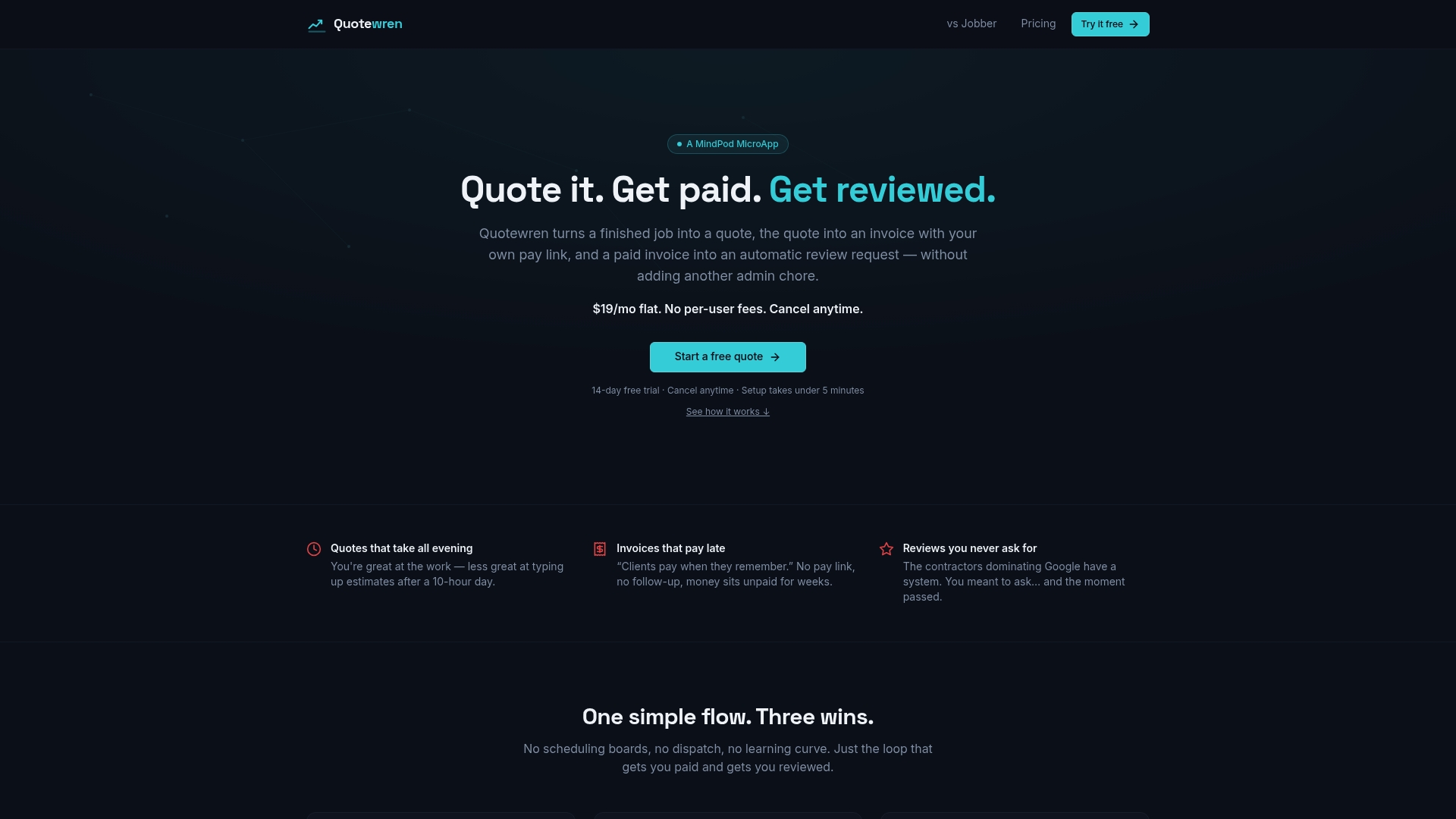
We built our software for solo tradespeople who want one simple tool instead of a bloated platform built for crews and fleets. Our software turns a finished job into a branded quote, then an invoice, with a payment link you can convert into a QR code for printed or emailed invoices.
- Create branded quotes and invoices in minutes, no design work needed.
- Add a payment link to any invoice and generate a scannable QR code for it.
- Automated review request follow-ups go out by text after the job is marked paid, so you're not chasing Google reviews on top of everything else.
If you want to see how it fits your workflow, start a free account at Quotewren and build a test invoice with a pay link today.
FAQ
How do I add a QR code to an invoice?
Create a payment link through your processor or invoicing tool, then generate a QR code from that link using the processor's built-in generator or a free tool like the PremiumWebTools QR generator. Paste the code onto your invoice template near the total, with a short caption and your business name.
How do I show a QR code for payment?
Place the code on the printed or PDF invoice near your total and payment instructions, with a caption like "Scan to pay invoice #12345." Keep it high contrast against a plain background so phone cameras can read it without trouble.
How do I scan a QR code on a receipt?
Open your phone's camera app and point it at the code; most modern iPhones and Android phones recognize QR codes automatically without a separate app. If nothing happens, check that your camera app has QR scanning enabled in settings, since older phones sometimes need it turned on.
Can I create a QR code for free?
Yes, most payment processors generate QR codes for free as part of their invoicing or checkout tools, including Square's QR payment feature. Standard processing fees still apply once a client actually pays through the code, even though generating it costs nothing.
Sources
For the technical details behind this guide, EMVCo's QR code resources explain merchant-presented and consumer-presented standards, and PayPal's developer documentation walks through generating invoice QR codes through its API. For consumer safety, read the FTC's alert on QR code scams, and for a broader industry overview, see the EZ-QR guide to invoice QR codes. If you want QR ideas for tip collection, Tipper's small business guide is worth a look.
- EMVCo – QR codes
- Generate QR code | PayPal Developer
- QR codes for contactless | Square
- See a QR code parked somewhere? Don’t scan it…yet. | FTC
- QR codes for invoices: complete 2026 guide | EZ-QR