

You get more quotes accepted by sending them fast, writing them so the customer understands every line, giving two or three clear options, and following up on a set schedule. Price matters, but it is rarely the only thing standing between you and a yes. Most lost quotes are lost to confusion, silence or slow timing.
This guide is for solo plumbers, electricians, HVAC techs, handymen, landscapers and cleaners. Every step below is something you can do this week with a phone and a simple template.
TL;DR
- Send the quote the same day you see the job. Homeowners decide quickly, and a fast, clear quote beats a slightly cheaper one that shows up late.
- Write the scope in plain words: what you will do, what is included, what is not, and the total price.
- Offer two or three options (good, better, best) so the customer picks which one instead of whether.
- Follow up on a set schedule, then mark the quote closed and ask why you lost it.
- Track your acceptance rate. Quotes accepted divided by quotes sent is the one number that tells you what to fix.
Table of Contents
- Why customers say no to a quote
- Send the quote fast
- Write the quote so nobody has to guess
- Give choices instead of one big number
- Follow up on a schedule
- Handle questions and "it's too high"
- Measure your acceptance rate
- Before you send: a 60-second check
- What happens after a yes
- Our perspective
- Put it into practice with Quotewren
- FAQ
- Sources
Why customers say no to a quote
Start with the problem. When a customer goes quiet, you assume your price was too high. The research points to other causes.
In a 2025 survey of more than 150,000 homeowners, 37.93% said pushy sales tactics make them least likely to hire a contractor, 32.6% said unclear quotes, and 31.42% cited poor listening or communication. Price is not even on that list. Unclear quotes and poor communication are.

An older survey of over 10,000 homeowners reported by an insurance firm found similar things. 63% ranked a poor attitude as a reason to decline a bid, 49% cited poor communication, and 45% cited a confusing bid. Tardiness came in at 44%.
Put those together and you get a short list of fixable problems:
- The quote was hard to read.
- The customer did not feel heard.
- The quote came too late.
- Nobody followed up.
None of those need a discount. They need a better process.
The first conversation matters more than the paperwork
A sales trainer who works with contractors makes a useful point: jobs are often lost because of how the job was understood before the quote was written, not because of how the quote looks. If you never learn why the customer is doing the work now, what went wrong last time, and what a good result looks like to them, price becomes the only thing they can compare.
So before you write a number, ask three things on site or on the phone:
- Why now? (A leak that got worse, a house sale, a broken AC in July.)
- Has anyone looked at this before, and what happened?
- What would make you feel this job went well?
Then put the answers in the quote. If the customer said "I need the water back on before my in-laws visit Friday," write "Complete by Thursday" on the quote. It shows you listened.
Send the quote fast
Speed is the cheapest way to look professional. A survey cited by a home-improvement lender found that about 60% of homeowners make their hiring decision within 72 hours, and nearly 40% refuse to hire someone who does not respond. Read that as a deadline. If your quote lands on day five, many customers have already chosen.
Some habits that make same-day quoting realistic when you work alone:
- Use a saved template. Your terms, payment info and logo should already be in place. You only fill in the job.
- Quote from the truck. Take photos, write the line items, and send before you drive off. A quick shot list for photos in quotes helps you do it in ten minutes.
- Build price lists for repeat work. A water heater swap, a panel inspection, a lawn cleanup, a deep clean. If you do it often, you already know the numbers.
- Use the evening block. If the job is too big to price on site, block 30 minutes after dinner and send it that night. Tell the customer when to expect it.
If you want a ready-made layout, the contractor quote template walks through one you can copy and send today.
Write the quote so nobody has to guess
A confusing quote makes a customer nervous, and a nervous customer waits, asks a competitor, or says nothing. Your quote has one job: let a stranger read it in two minutes and know exactly what they are buying.
What to put in every quote
| Part | What to write | Example |
|---|---|---|
| Customer and job address | Name, address, phone | Maria L., 214 Oak St. |
| Scope of work | Plain description of what you will do | Replace kitchen faucet and both supply lines |
| What is included | Materials, labor, permits, cleanup, haul-away | Faucet supplied by you, new supply lines, cleanup |
| What is not included | Anything a customer might assume | Drywall repair if the wall behind the sink is damaged |
| Price | One clear total, or line items that add up | $385 total |
| Timing | Start date and how long it takes | Thursday, about 2 hours |
| Payment terms | Deposit, due date, how to pay | 50% deposit to schedule, balance on completion |
| How long the price holds | A fair window for your costs | Good for 14 days |
| Next step | One clear action | Tap Accept or reply YES |
That "not included" line is the one most solo pros skip, and it prevents the most arguments. If you want to see how the paperwork fits together, read quote vs estimate and estimate vs proposal so you use each word the right way. A quote is a fixed price you stand behind. An estimate is your best guess that can change. Customers do not always know the difference, so say which one you are sending.
Use words your customer uses
The same lender's article says 41% of homeowners rank clear, respectful communication as most important during service appointments, and it suggests handing out a one-page explainer of common terms in your trade before sending estimates. You can do the same on a small scale:
- Plumber: write "shut-off valve (the knob that turns off water to one fixture)" the first time.
- Electrician: say "GFCI outlet (the kind with test and reset buttons, required near water)" instead of only the code name.
- HVAC: explain "capacitor (a small part that helps the motor start)" in one short line.
- Landscaper: describe "edging" and "mulch depth" so the customer knows what two inches looks like.
If a term needs a paragraph, cut it. If your customer would not say it, do not write it.
Add photos and a short note
Two or three photos of the problem make a quote real. A cracked capacitor, a scorched breaker, a rotted fence post. Under each, add one sentence about what you saw. Then end with a short personal note: "Maria, I can fit you in Thursday morning. Call or text me with any questions." That is how you sound like a person, not a form letter.
Give choices instead of one big number
A single price invites one question: "Do I do this or not?" Two or three options change it to "Which one?" This good-better-best approach is a common recommendation for winning jobs without lowering your price, and it works well for small trade jobs.
Here are examples a solo pro could write today.
HVAC tune-up and repair
- Good: Fix the failed capacitor today.
- Better: Fix the capacitor and clean the coil.
- Best: Fix the capacitor, clean the coil, and add a yearly maintenance visit.
Landscaping
- Good: Spring cleanup only.
- Better: Cleanup plus fresh mulch in front beds.
- Best: Cleanup, mulch, and a monthly mowing plan through the season.
Cleaning
- Good: Standard clean.
- Better: Standard clean plus inside the oven and fridge.
- Best: Deep clean now and a recurring every-two-weeks plan.
A few rules keep options honest:
- Never offer an option you would not want to do.
- Keep the middle option the one you would recommend, and say so.
- Show what each step adds, not just a bigger number.
- Three is the limit. More than that and people freeze.
For larger jobs, a customer may want to spread out payments. Financing is one way some contractors handle that, so mention it if you offer it.
Follow up on a schedule
Most solo pros send a quote and wait. That is where jobs quietly die. One marketing agency describes businesses that changed nothing except consistent follow-up within 24 hours and again three to five days later, and more estimates closed. That is one agency's account, not a guarantee, but it matches what many trades report: the follow-up is where the money is.
Here is a simple cadence you can run by hand:
- Same day: Text the customer: "Quote sent. Let me know if anything looks unclear."
- Day 3 to 5: Check in. Ask if they had a chance to look and offer to talk it through.
- Day 10 to 14: Send a short reminder. Mention anything time-sensitive, like your schedule filling up or a material price that will not hold.
- Day 30: Send a final note. Say you will close out the quote, and that they can reach you any time.
The 3-5 day, 10-14 day and 30-day pattern comes from a bid follow-up guide that also suggests marking a bid inactive after three touches with no reply. We would add one thing: keep each message short and useful, not pushy. Remember that pushy tactics were the top complaint in that homeowner survey.
Example texts you can steal:
- "Hi Maria, it's Dave. Just checking you got the faucet quote. Happy to answer any questions."
- "Hi Maria, Thursday morning is still open if you want to move ahead. No pressure either way."
- "Hi Maria, I'll close out this quote on my end. If anything changes, just reply and I'll reopen it."
For more wording and timing, see our quote follow-up templates and cadence. For a local view of how busy HVAC and plumbing shops keep this going every week, these lead follow-up habits are worth a skim.
Handle questions and "it's too high"
When a customer pushes back, do not defend and do not drop your price on the spot. A simple four-step approach works:
- Listen. "I get it, this is a lot of money."
- Find the real issue. "Is it the total that worries you, or is there something in the quote you want to look at?"
- Learn the gap. "What number did you have in mind? Which parts should we compare?"
- Walk through the scope. Compare line by line what is included, what is left out, and what the terms are.
This follows a price-objection framework that also reminds contractors that not every job is worth winning. If the customer wants work you cannot do profitably, offer a smaller version of the job instead of a lower price on the full one. A customer who wants the "best" job at the "good" price can often be happy with Good.
Depending on the job, your answer might be:
- Plumber: "I can use the standard fixture instead of the one you picked. That saves $140 and the install is the same."
- Electrician: "We can do the two bedrooms now and the garage circuit next month."
- Landscaper: "Let's do the front yard now and add the back in fall."
That protects your margin. Cutting the price the moment someone hesitates teaches customers to hesitate.
When they say no
Sometimes the answer is no. Ask one question and listen: what made you choose someone else, or hold off? Our post on what to ask when a customer declines an estimate covers it. Write the answer down. After ten of them, you will see a pattern, and the pattern tells you what to change.
Measure your acceptance rate
You cannot fix a number you never look at. The formula is simple:
Quotes accepted ÷ quotes sent × 100 = acceptance rate

If you sent 20 quotes last month and 9 were accepted, your rate is 45%.
What counts as good? Benchmarks vary by trade, job size and how many leads are tire-kickers, so use these as loose reference points, not targets:
- A study of North American green-industry companies found that proposals from landscaping and tree care companies were accepted 63 percent of the time on average, based on 2018 and 2019 data.
- Research on 794 contractors found a median conversion of 73.9% when only decided quotes are counted, and 38.1% when all quotes sent are counted.
The gap between those two numbers is the lesson. Many quotes never get a yes or a no. They just sit. The same research shows converted quotes were accepted in a median of 2 days, while lost quotes were marked lost a median of 29 days after sending. A quote that has been quiet for two weeks is probably not a yes. Follow up, then close it out.
A quick example of what it is worth
One agency gives this math: if you send 80 estimates and book 28 jobs, your close rate is 35%. With an average estimate of $6,000, the 52 that did not close represent $312,000 in possible work. Lifting the rate from 35% to 45% would bring in eight more jobs.
Your numbers will be smaller. Say you send 30 quotes a month averaging $900. At 40% you book 12 jobs. At 50% you book 15. That is three more jobs, or $2,700 a month, without a single new lead. For a longer walk-through, see how to calculate and raise your quote conversion rate.
Keep a simple log with these columns:
- Date sent
- Customer and job type
- Quote amount
- Status: accepted, declined, no reply
- Reason, if you know it
Review it once a month. Look at which job types close best, which size jobs stall, and how quickly you sent the quote.
Before you send: a 60-second check
Run through this list every time:
- Does the scope say what is included and what is not?
- Is there one clear total, or options?
- Are the start date and timeline there?
- Are deposit and payment terms clear?
- Is there a deadline for the price?
- Did you spell the customer's name right and use the right address?
- Is there one easy way to say yes?
Mistakes in the numbers also cost you jobs and money. Our 15-minute checklist for common estimate mistakes helps you catch them first.
What happens after a yes
A yes is not the finish line. Quote acceptance feeds the rest of your cash flow, so treat the next steps as part of the same process.
- Deposit: Ask for it when the customer accepts, especially when you must buy materials. Keep the amount and timing in the quote.
- Invoice: Turn the approved quote into an invoice when the work is done, with no retyping. See how contractors get paid faster with quote to invoice and the invoice terms solo contractors use.
- Review request: Ask for a Google review right after the job, while the customer is happy. More reviews make your next quote easier to accept, because the customer has already seen proof that you do good work.
That last step closes the loop. Reviews bring in better leads, and better leads accept more quotes.
Our perspective
Most solo pros we talk to think they have a pricing problem. Often they have a paperwork problem. The quote is late, it is hard to read, or nobody follows up.
We built Quotewren for one person running a whole business from a truck. Big field-service platforms are made for teams with dispatchers and fleets. A solo plumber does not need all that. You need a quote that looks clean, goes out the same day, turns into an invoice with a tap, and leads to a review request after the job.
That is why flat pricing and a simple layout matter to us. If the tool takes an hour to learn, you will not use it between jobs. And if the review request depends on you remembering, it will not happen. We designed the three-touch SMS review request to run after job completion, so a good job turns into a good Google profile without extra work from you.
Acceptance is about trust. Quotes that look professional, arrive quickly and are easy to say yes to build trust before you ever show up.
jaras
Put it into practice with Quotewren
If you want a quote that looks professional and is easy to approve, Quotewren gives you branded quotes and invoices with pay links, plus automated review requests by text after the job is done.
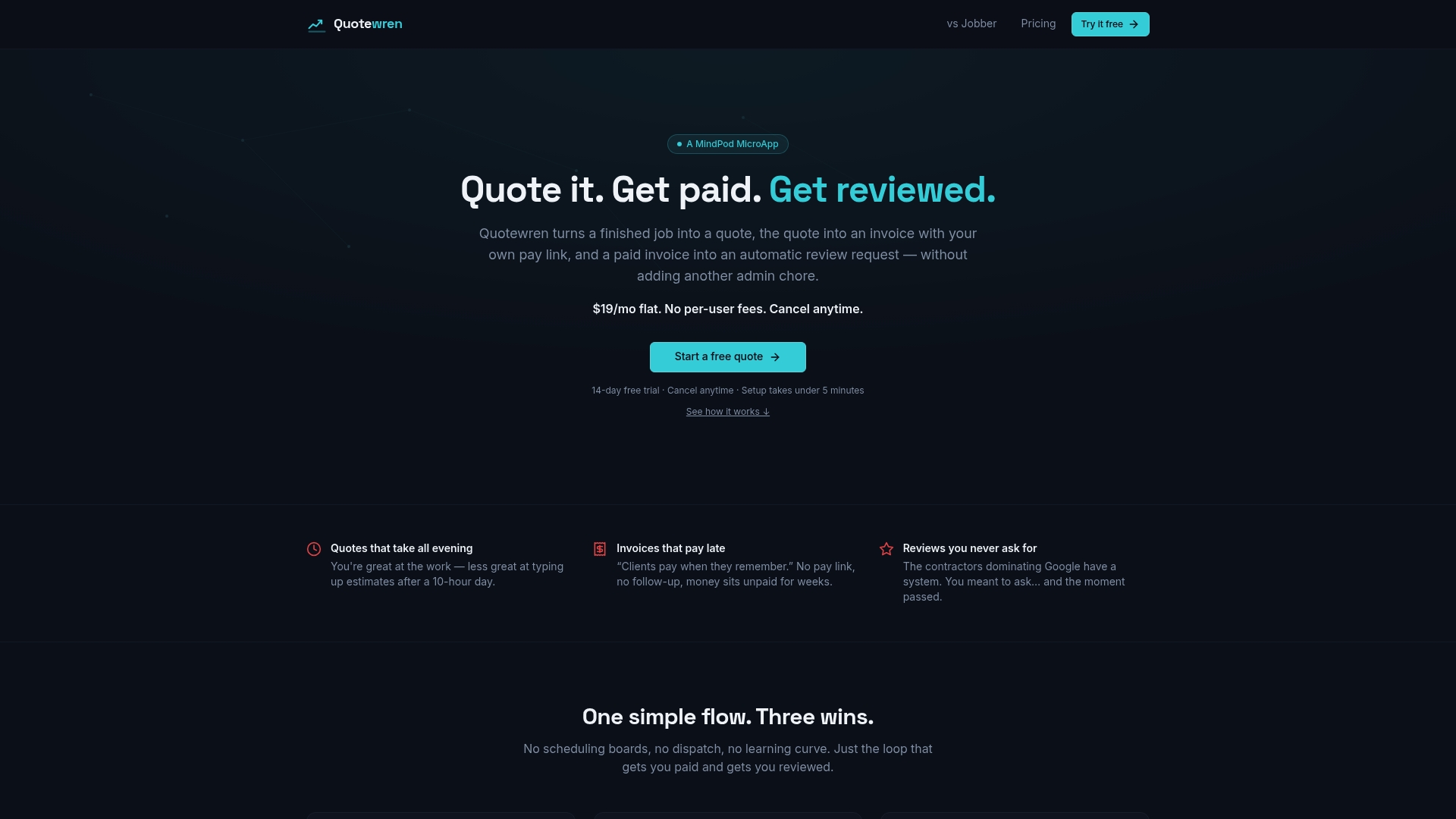
There is a Free plan to start. The Quotewren plan is $19 per month, and Quotewren Crew is $39 per month. Automated review requests are built into every paid plan. Try it on your next quote and see how it feels from the customer's side.
FAQ
What is a good quote acceptance rate for a small trade business?
It depends on your trade, job size and lead quality. Published figures range widely: one study of landscaping and tree care firms found an average of 63%, while another dataset showed a median near 38% when all quotes sent were counted. Compare yourself to your own past months first, and aim to move up from there.
How long should I wait before following up on a quote?
Text the same day to confirm it arrived. Then check in around days 3 to 5, send a reminder around days 10 to 14, and close it out near day 30. Keep each message short and friendly. If the customer says they are not ready, ask when it makes sense to check back.
Should I lower my price to win a job?
Try other levers first: offer a smaller scope, a phased plan or a Good option, and make sure the customer understands what is included. A discount can bring in customers who leave for the next lower bid. If you do change a price, change the scope with it so the numbers still make sense.
What is the difference between a quote and an estimate?
A quote is a fixed price for a defined job. An estimate is your best guess, and the final cost can change. Tell customers which one you are sending, and state any conditions, like a price that may change if you find hidden damage.
Sources
- Modernize Homeowner Insights 2025: Contractor Selection
- Hiring a Contractor Homeowner Survey Report
- Why You're Losing Jobs After the Quote
- How to Win Construction Bids When You're Not the Cheapest
- How to Quote and Close More Jobs Without Lowering Your Price
- Contractor Bid Follow-Up Reminder
- The Number Sitting in Your Estimates Report
- How to Handle Price Objections as a Contractor
- SingleOps report reveals economic benchmarks for green industry
- Contractor Quote Conversion Rate
- 9 lead follow-up habits for HVAC and plumbing shops