
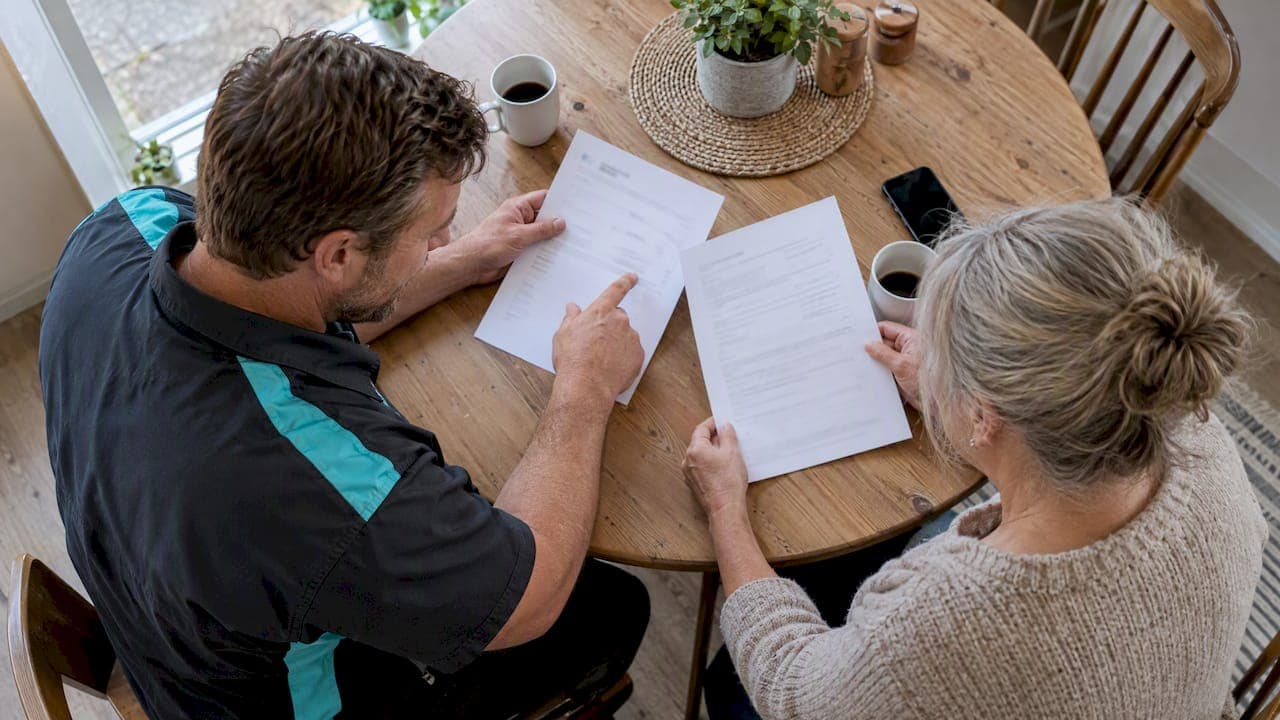
An estimate is your best guess at the price. A proposal is a formal offer that spells out the work, the price and the terms, and asks the customer to say yes. For most small jobs, like a leaky faucet or a dead outlet, a clear estimate is enough. For bigger jobs, like a furnace swap or a backyard drainage project, a proposal protects you and the customer.
The words get mixed up all the time, and that is where the trouble starts. This guide explains the difference in plain terms, shows when to use each one, and gives you steps you can use on your next job.
TL;DR
- An estimate is a good-faith guess at cost. It can change if you find surprises like rot or hidden wiring.
- A proposal is a formal offer with scope, price, terms and a place to sign. Once signed, it works like a contract.
- Use an estimate for small, simple jobs and early ballpark talks. Use a proposal when the job is big, the scope is detailed, or the customer is comparing bids.
- Label every document clearly. If it says "estimate," say it can change and say why.
- After the work is done, the invoice asks for payment, and a review request comes right after.
Table of Contents
- What is an estimate?
- What is a proposal?
- Estimate vs proposal side by side
- Where quotes, bids and work orders fit
- Why mixing them up costs you money
- How to decide: a simple test
- Should you charge for an estimate?
- How to write a clear estimate in five steps
- How to turn an estimate into a proposal
- What happens after the customer says yes
- Our view: keep it simple, but keep it clear
- Send clean quotes and invoices without the busywork
- FAQ
- Sources
What is an estimate?
An estimate is an approximation. You look at the job, think about labor and materials, and tell the customer what you expect it to cost. It is built on what you can see today, and it is not a promise.

One contractor guide describes an estimate as a good-faith approximation, usually non-binding, based on incomplete information and site conditions. That fits how trades work. You can't see inside a wall.
Here are some real examples:
- Plumber: "Replacing the water heater will run about $1,800 to $2,200, depending on what we find with the venting."
- Electrician: "Adding two outlets in the garage is about $450, assuming the panel has room."
- Landscaper: "Mulching the front beds is around $600, based on about 8 yards."
- Cleaner: "A deep clean of a three-bedroom is about $320, assuming standard buildup."
Notice the words "about" and "assuming." Those words are doing real work. They tell the customer the number depends on something.
When an estimate is the right tool
- The job is small and the scope is simple.
- The customer wants a ballpark before deciding to go further.
- You can't know the full scope until you open something up.
- You do repair work where the cause isn't clear yet.
What is a proposal?
A proposal is a formal, customer-facing offer. It goes beyond a price. It describes what you will do, what you will use, how long it will take, what is not included, how you want to be paid, and how the customer says yes.
One Reddit thread of contractors is often cited on this topic, and the common view is that a proposal and a contract overlap. In practice, when a customer signs your proposal, it often becomes the agreement for the job. That is why the details matter.
A good proposal for a trades job usually includes:
- Your business name, address, phone and license number (if your state requires one)
- The customer's name and the job address
- A plain description of the work, step by step
- Materials and brands, if they matter
- The total price, or a price per phase
- What is not included (permits, drywall repair, disposal, and so on)
- A deposit and payment schedule
- Estimated start and finish dates
- How changes will be handled
- A signature line and date
The FTC's advice on home improvement tells customers to get a written agreement even if their state doesn't require one. It lists the contractor's name, address and license number, estimated start and finish dates, a payment schedule, and a clear scope of work and costs. A solid proposal covers all of that, so a customer who has read the FTC page will feel at ease with yours.
When a proposal is the right tool
- The job is large, like a full panel upgrade, a new HVAC system or a bathroom remodel.
- The customer is comparing several contractors.
- You are taking a deposit and want terms in writing.
- Several people need to approve it, like a couple, a landlord or a property manager.
- The scope has many parts and you want to avoid "I thought that was included."
Estimate vs proposal side by side
| Estimate | Proposal | |
|---|---|---|
| What it is | Approximate price | Formal offer with scope, price and terms |
| Can the price change? | Yes, if conditions change | Only through an agreed change |
| Detail level | Short and simple | Detailed |
| Signature | Usually not needed | Usually yes |
| Best for | Small jobs, ballparks, repairs | Larger jobs, competitive bids |
| Risk to you | Customer may treat it as fixed | Lower, if the terms are clear |
The real difference is how much both sides can count on the number. An estimate says, "Here is what I expect." A proposal says, "Here is exactly what I will do for this price, if you agree."
Where quotes, bids and work orders fit
People search for these terms together, so here is a quick map.
- Quote: A fixed price for clearly defined work. If you quote $950 to replace a garbage disposal and install a new shutoff valve, $950 is the price. We cover this more in our guide to quote vs estimate for trade pros.
- Bid: A formal, binding offer to do a defined scope for a stated price, often when several contractors compete. A bid is close to a proposal that is built around price.
- Work order: An internal or customer-approved instruction to do specific work. It says what to do and when. It is not a price offer. Many pros create one after the customer approves the estimate or proposal, so the job is clear to whoever is on site.
- Invoice: A request for payment after the work is done. It lists final costs, taxes if they apply, and payment terms. Our guide on invoice terms solo contractors use goes deeper.
So the usual flow is: estimate or proposal, customer approval, work order, the job, then the invoice.
Why mixing them up costs you money
Here is a common story. A plumber tells a homeowner it will be "about $2,000" to replace a section of old pipe under the sink. He opens the wall and finds rot. The repair now takes twice as long. The homeowner says, "You told me $2,000."
If that number was a loosely worded estimate, the plumber has a hard conversation. If it was never labeled as an estimate, he may have to eat the cost.
That is exactly the risk Home Contractor Authority points to. Treating an estimate like a binding fixed-price bid puts the cost overrun on you. A properly labeled estimate lets you adjust when you find something unexpected.
The fix is simple:
- Put the word "Estimate" at the top of the document.
- Add one sentence: "This is an estimate and the final price may change if conditions differ from what we can see today."
- List your assumptions, such as "assumes existing shutoff valve works" or "assumes no code upgrades needed."
- Say how you will handle surprises: "I will call you before doing any extra work."
Our 15 minute checklist for common estimate mistakes walks through more of these fixes.
How to decide: a simple test
Ask yourself four questions before you write anything.
- Can I see the whole job? If yes, a quote or proposal makes sense. If no, send an estimate.
- Is this more than a day or two of work? If yes, lean toward a proposal.
- Am I asking for a deposit? If yes, get it in writing in a proposal.
- Is the customer comparing bids? If yes, a proposal helps you look organized and trustworthy.
Here is how that plays out across the trades:
- HVAC technician: A tune-up or a capacitor swap gets a quick estimate or quote. A full system replacement gets a proposal with equipment model, warranty, and install schedule. See our free HVAC quote template for a starting layout.
- Handyman: Hanging a door and patching drywall is an estimate. A deck repair with new boards, posts and railing is a proposal. Our handyman quote template is a good place to start.
- Cleaner: A recurring weekly clean can be a simple written estimate with a per-visit price. A move-out clean with extras (inside oven, windows, fridge) is better as a proposal. Try the cleaning quote template.
- Electrician: A single outlet repair is an estimate. A service upgrade or a rewire of a room is a proposal, since permits and inspections add steps.
- Landscaper: Spring cleanup is an estimate. A new patio with grading and drainage is a proposal.
Should you charge for an estimate?
Many pros give free estimates on small jobs and charge for the ones that take real time, like a design plan or a detailed site assessment. There is no single rule. Decide on a policy, state it on your website or when the customer calls, and stick to it. If you do charge, many contractors credit the fee toward the job if the customer hires them. That keeps the conversation friendly.
How to write a clear estimate in five steps
- Look at the job and take notes. Photos help. Write down what you see and what you can't see.
- Break out the pieces. List labor, materials and any fees (permit, disposal) as separate lines.
- State your assumptions. What are you counting on to be true?
- Label it. Write "Estimate," the date, and how long the number is good for, like 30 days.
- Say what happens next. "Reply to approve and I will book a start date."
We also have a contractor quote template for solo pros you can copy and fill in today.
How to turn an estimate into a proposal
When the customer says "sounds good, what's next?" on a bigger job, upgrade the document. You already have the numbers. Now add:
- A written scope, step by step
- Exclusions
- A start window and a finish estimate
- A deposit and payment schedule
- A change policy: any change in scope gets written down and priced before work starts
- A signature line
About deposits
Asking for a deposit is normal in the trades. The FTC advises against paying the full amount upfront and says never to make the final payment until the job is done to your satisfaction. A one-third deposit is often mentioned as a common practice. But some states limit how much you can ask for ahead of time, so check your state or county consumer agency rules before you set your number. The FTC's page on avoiding scams after weather emergencies is a useful reminder of how closely customers watch upfront payments.
If your job is paid in stages, our guide on progress invoicing fields shows what to put on each invoice.
What happens after the customer says yes
A clean paper trail makes the rest of the job easier.
- Approval. Get a written yes. A signed proposal or a reply to your estimate works.
- Work order. Write down what is being done, where, and when, especially if a helper is going to be on site.
- Change notes. If the scope shifts, write it down and get a text or email approval.
- Invoice. Send it the same day you finish. Our piece on going from quote to invoice shows how to do it fast.
- Review request. Ask while the customer is happy and the work is fresh.
Keeping records matters for taxes too. The IRS says businesses need organized records like invoices, receipts and canceled checks to support what they report. Tracking each job from estimate to final invoice makes that much easier at tax time.
If you wonder what to do when a customer says no, read what to ask when customers decline an estimate.
Our view: keep it simple, but keep it clear
We built Quotewren for solo operators, so we see the same pattern again and again. Most disputes don't come from bad work. They come from a document that meant one thing to the pro and another thing to the customer.
Here is what we tell solo tradespeople:
- Name the document honestly. If it is a guess, call it an estimate. If you are standing behind the price, call it a quote or a proposal.
- Don't over-build small jobs. A six-page proposal for a $200 repair can scare a customer off. A short, clear estimate works better.
- Don't under-build big jobs. A text that says "$8,500, sound good?" is not enough when you are about to rip out a bathroom.
- Speed counts. The contractor who sends a clean document the same day often looks more reliable than the one who sends a better document three days later.
- Close the loop. A job isn't done when the work is done. It is done when you are paid and the customer has had a chance to say how it went.
— jaras
Send clean quotes and invoices without the busywork
If you are tired of building documents from scratch, Quotewren is made for solo trades. You can create branded quotes, turn approved work into invoices, add pay links, and send a three-touch review request by text after the job is done. There is a Free plan at 0 USD, Quotewren at 19 USD per month, and Quotewren Crew at 39 USD per month. You can start with the free plan and see if it fits how you work. If you just want a layout first, our free quote templates are printable.
FAQ
Is an estimate legally binding?
Usually not, if it is clearly labeled as an estimate and says the price may change. A quote, bid or signed proposal is more likely to be treated as a firm price. Rules differ by state, so if you have a big dispute, talk to a local attorney or your state contractor licensing board.
What is the difference between a proposal and an estimate?
An estimate is an approximate price based on what you know now. A proposal is a formal offer that spells out scope, price, terms and timing, and asks the customer to sign. The proposal is the one that locks in expectations.
What is the difference between an invoice and an estimate?
An estimate comes before the work and gives an approximate cost. An invoice comes after the work and asks for payment based on the final cost. You can build an invoice from the approved estimate, then adjust it for any agreed changes.
Is it normal to pay a contractor for an estimate?
It depends on the job. Many contractors give free estimates on small, simple work and charge for time-heavy ones like design plans or detailed assessments. Ask up front, and get the fee policy in writing. If you are the contractor, state your policy before you visit.
Do I need a proposal for every job?
No. For small repairs, a short written estimate is usually enough. Use a proposal when the job is large, has many parts, involves a deposit, or the customer is comparing bids.
Sources
- How To Avoid a Home Improvement Scam, FTC Consumer Advice
- How To Avoid Scams After Weather Emergencies and Natural Disasters, FTC Consumer Advice
- Home Contractor Bids and Estimates: How to Read and Compare Them
- Recordkeeping, Internal Revenue Service
- Estimates and Proposals/Contracts, r/Contractor