

A deposit invoice is a bill for part of a job's total cost, sent before you start the work. Send one whenever you need cash to buy materials or lock in your schedule for a client. Keep it simple: state the total job cost, the deposit amount, when it's due, and your refund terms, then send a final invoice later that credits the deposit against the balance.
TL;DR:
- Sending a deposit invoice is appropriate for projects with significant upfront costs, long durations, or new clients with a poor payment history.
- The deposit amount should be based on actual costs or risk factors, typically ranging from 20% to 50% of the total project cost, with flat fees used for smaller jobs.
- The invoice must clearly display the total project value, deposit math, specific refund triggers, and due date, with math printed directly on the invoice.
- Deposit payments are recorded as liabilities until the work is completed, and proper reference to invoice numbers ensures correct accounting and compliance.
- Communicate deposit terms early and use specific, provable language to minimize disputes, linking deposits to ordered materials or reserved schedules.
Table of Contents
- What Is a Deposit Invoice, and How Is It Different From a Quote or Retainer?
- When Should You Ask for a Deposit?
- What Fields Belong on a Deposit Invoice?
- How Do You Calculate the Right Deposit Amount?
- How Do You Record and Track a Deposit for Taxes?
- How Should You Communicate and Enforce Deposit Terms?
- What Do Real Deposit Invoices and Deposit Request Messages Look Like?
- How Do You Apply the Deposit on the Final Invoice?
- What Legal Rules Apply to Deposit Invoices?
- What Happens if a Client Disputes or Cancels After Paying a Deposit?
- Is a Deposit Invoice the Same as a Down Payment or Advance Payment?
- Why Deposits Matter More Than Most Solo Contractors Think
- Get Paid Faster With Fewer Spreadsheets
- Where to Learn More About Deposit Invoices
- Sources
- FAQ
What Is a Deposit Invoice, and How Is It Different From a Quote or Retainer?
A deposit invoice is a real, payable bill. That's the key difference from a quote or a proforma invoice, which are just previews of what you might charge. A quote says "here's what I'd charge if you hire me." A deposit invoice says "pay me now for part of the job we already agreed on."
A retainer works differently. It's usually an ongoing fee that covers your availability over time, common with lawyers or consultants, and it gets treated differently for tax and legal purposes than a one-time deposit.
Mixing these terms up causes real problems:
- Clients get confused about whether they've actually committed to paying.
- Refund disputes get messier if your invoice doesn't clearly say "deposit."
- Your bookkeeping gets tangled if deposits and quotes live in the same folder.
Tie your deposit wording directly to the signed estimate or contract. If the client hasn't approved the scope yet, you're not ready to invoice a deposit. You're still quoting.
When Should You Ask for a Deposit?
Not every job needs one. A quick faucet repair usually doesn't. But plenty of trades work involves upfront costs or risk that justifies asking for money before you start.
Common situations that call for a deposit:
- Custom fabrication or special-order materials — cabinets, custom ductwork, or specialty fixtures you can't return or resell.
- Longer projects — kitchen remodels, full electrical panel upgrades, multi-day landscaping installs.
- New clients with no payment history — you don't know yet if they pay on time.
- Event or seasonal bookings — holiday lighting installs, one-off cleaning jobs before a big event.
- Material-heavy jobs — HVAC systems, water heaters, or anything where you're fronting hundreds or thousands of dollars at the supply house.
Risk indicators push the deposit higher: parts that can't be resold if the client backs out, long supplier lead times, or subcontractors who want their own deposit before they'll hold a slot. Repeat clients with a solid payment track record can usually get away with less, or nothing at all.
What Fields Belong on a Deposit Invoice?
A deposit invoice needs to do one job well: make the math obvious and the terms unmissable. Accounts payable people, and homeowners doing their own bookkeeping, should never have to guess what they're paying for.
Include these fields every time:
- Header info — your business name, invoice number, issue date, and the client's contact details.
- Project title — a short description tied to the signed estimate ("Kitchen Remodel, Smith Residence").
- Full project value and deposit math, shown clearly. Example line: "Deposit: 30% of $4,000 = $1,200."
- A one-line description of what the deposit secures — materials ordered, a reserved start date, or labor scheduling.
- Payment due date and accepted payment methods.
- Refund and cancellation terms, or a pointer to where those terms live in the contract.
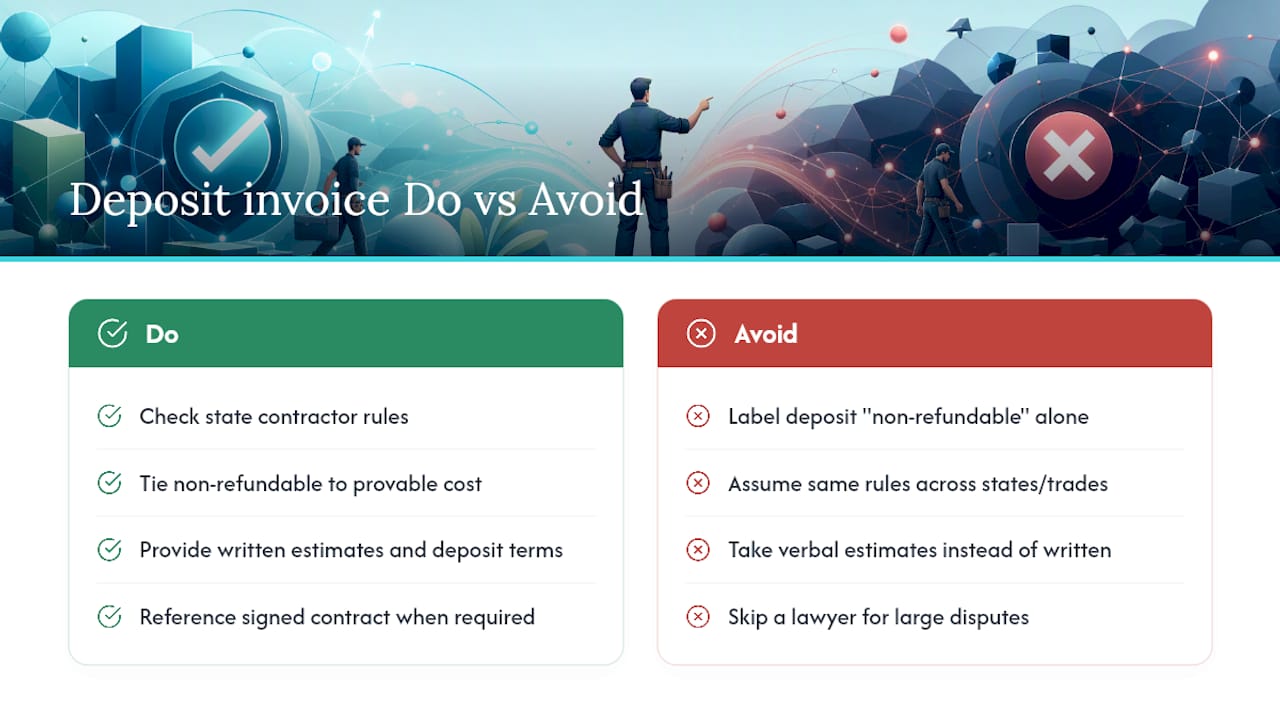
Refund triggers matter more than refund threats. Instead of "deposit is non-refundable," write "non-refundable once materials are ordered on [date]." That's specific, provable, and far less likely to spark an argument three weeks later.
Pro Tip: *Print the math on the invoice itself, not just in an email.
How Do You Calculate the Right Deposit Amount?
Start with your out-of-pocket costs, not a random percentage. If you're buying $800 worth of PVC fittings and a new water heater before you ever swing a wrench, your deposit needs to cover at least that much. Anything less and you're floating the client's material bill on your own credit card.
From there, percentage guidelines help:
- 20% to 50% of the total job cost covers most service and freelance work, and this range shows up across deposit invoice templates built for small contractors.
- 50% is common for smaller jobs, first-time clients, or anything with a tight material budget.
- A flat fee works better for smaller or predictable bookings, like a $100 deposit to hold a Saturday cleaning slot.
A $250 gutter cleaning might just need a flat $50 to hold the date. Match the number to your actual risk, not a habit.
How Do You Record and Track a Deposit for Taxes?
Deposit money isn't yours yet, at least not on paper. Record it as a liability, often called unearned revenue, until you actually complete the work. That keeps your books honest and stops you from accidentally paying tax on income you haven't earned.
A few habits keep this clean:
- Log the deposit under a liability account, not straight into income.
- Reference the deposit invoice number on the final invoice, so nobody wonders "didn't I already pay part of this?"
- Move the money from liability to income only once the job is finished and billed in full.
- If you're unsure whether cash or accrual accounting changes your timing, check IRS Publication 538 for the specifics.
Payment delays are a real threat to small shops. Stripe has reported a 20% rise in companies seeing payment times stretch past 80 days, which is exactly the kind of cash-flow squeeze a well-timed deposit protects you from.
How Should You Communicate and Enforce Deposit Terms?
Bring up the deposit before you send anything in writing. Mention it in the first phone call or on-site visit, so the client isn't blindsided by an invoice. Then confirm it in your written estimate and again on the deposit invoice itself.
Sample clause language that holds up:
- Refundable, until a trigger point: "Deposit refundable in full until materials are ordered."
- Non-refundable, tied to a real cost: "Deposit becomes non-refundable once your installation slot is reserved on [date]."
If you charge late fees on unpaid balances, put the exact rate and terms right on the invoice. Some states cap how much you can charge, so check your local rules before setting a number. Our guide to invoice late fees breaks down wording that's clear without sounding like a threat.
Pro Tip: Say the deposit number out loud before you ever type it. If it feels awkward to say to the client's face, it's probably too high or too vague.
What Do Real Deposit Invoices and Deposit Request Messages Look Like?
Seeing the actual numbers helps more than another paragraph of advice. Here are two quick examples, plus the message that gets a deposit paid fast.
- Small flat-fee job: Gutter cleaning, $250 total. Deposit invoice: "$50 flat fee to hold your Tuesday slot, balance of $200 due on completion."
- Larger percentage job: Bathroom remodel, $6,000 total. Deposit invoice: "Deposit: 40% of $6,000 = $2,400, due before materials are ordered. Balance: $3,600 due on completion."
- Deposit request text or email, sent right after the client approves your quote: "Thanks for the go-ahead on the bathroom remodel! I've sent a deposit invoice for $2,400 (40% of the $6,000 total) so I can order tile and the vanity. Pay link's in the invoice, and I can start the week after it clears."
- What to attach: the scope of work, your proposed start date, the invoice PDF, and a working pay link.
Our post on invoice line items has more copyable examples if you want to see how the math looks across different trades.
How Do You Apply the Deposit on the Final Invoice?
Once the job's done, the final invoice needs to show the deposit as a credit, not a mystery. Keep the layout dead simple:
- Total contract amount: $6,000
- Less: Deposit received (Invoice #1042, paid 3/14): $2,400
- Balance due: $3,600
Issue a receipt when the deposit lands, and mark that original deposit invoice as paid in your records. To close the job file, link the deposit receipt to the final invoice, then move the deposit from your liability account into income now that the work is actually earned.
What Legal Rules Apply to Deposit Invoices?
Deposit invoices sit inside contract law, and a few states add specific consumer protection rules for home improvement work. California, for example, caps how much a licensed contractor can collect as a deposit before starting a job. If you work in construction or home remodeling, check your state's contractor licensing board before setting deposit terms, since these rules vary by state and by trade.
The word "non-refundable" isn't automatically legal. Labeling a deposit non-refundable without tying it to a provable cost is weak if a client disputes it in small claims court. A judge is far more likely to side with you if your invoice says "non-refundable once tile is ordered on 3/10" than if it just says "no refunds." That's the difference between a real trigger and an empty threat. Framing part of the deposit as liquidated damages tied to a specific loss holds up better than a flat "we keep it all" clause.
Consumer protection laws in most states also require that estimates and deposit terms be given in writing before work begins, not verbally promised and invoiced later. If your state requires a written contract for jobs over a certain dollar amount (common in construction), your deposit invoice should reference that signed contract by date and number.
None of this replaces a lawyer if you're dealing with a large project or a client who's already pushing back. But for routine trades work, clear written terms, a specific refund trigger, and a signed estimate cover most of the risk.
What Happens if a Client Disputes or Cancels After Paying a Deposit?
Most deposit disputes come down to one thing: the client feels like they paid for something and got nothing. Your job is to make sure the invoice already answered that question before it ever became an argument.
If a client cancels before you've ordered materials or blocked your schedule, refunding the deposit (or most of it) is usually the fair move, and it protects your reputation. If they cancel after you've already special-ordered a part or turned down other work to hold their slot, point back to the specific trigger language on the invoice. "Non-refundable once cabinets were ordered on 4/2" is a lot easier to defend than a general policy.
Keep a simple process for handling these conversations:
- Pull up the original deposit invoice and reread the exact refund clause together with the client.
- If materials were already ordered, show the receipt or order confirmation as proof.
- Offer a partial refund when it's fair, even if you're not legally required to. It's often cheaper than a bad review or a small claims filing.
- Put any resolution in writing, even a short email, so there's no confusion later.
For jobs where cancellation risk is high, like custom fabrication or events, consider a tiered refund schedule instead of an all-or-nothing rule. Full refund more than two weeks out, partial refund inside two weeks, no refund inside 48 hours. That kind of scale feels more reasonable to clients and reduces the odds they'll push back hard when plans change.
Is a Deposit Invoice the Same as a Down Payment or Advance Payment?
The terms overlap, but they're not identical, and the difference matters for how you word your paperwork. A down payment usually refers to an initial payment on a large purchase, often a percentage tied to financing, more common in real estate or vehicle sales than in trades work. A deposit invoice is the document you send to actually collect that money.
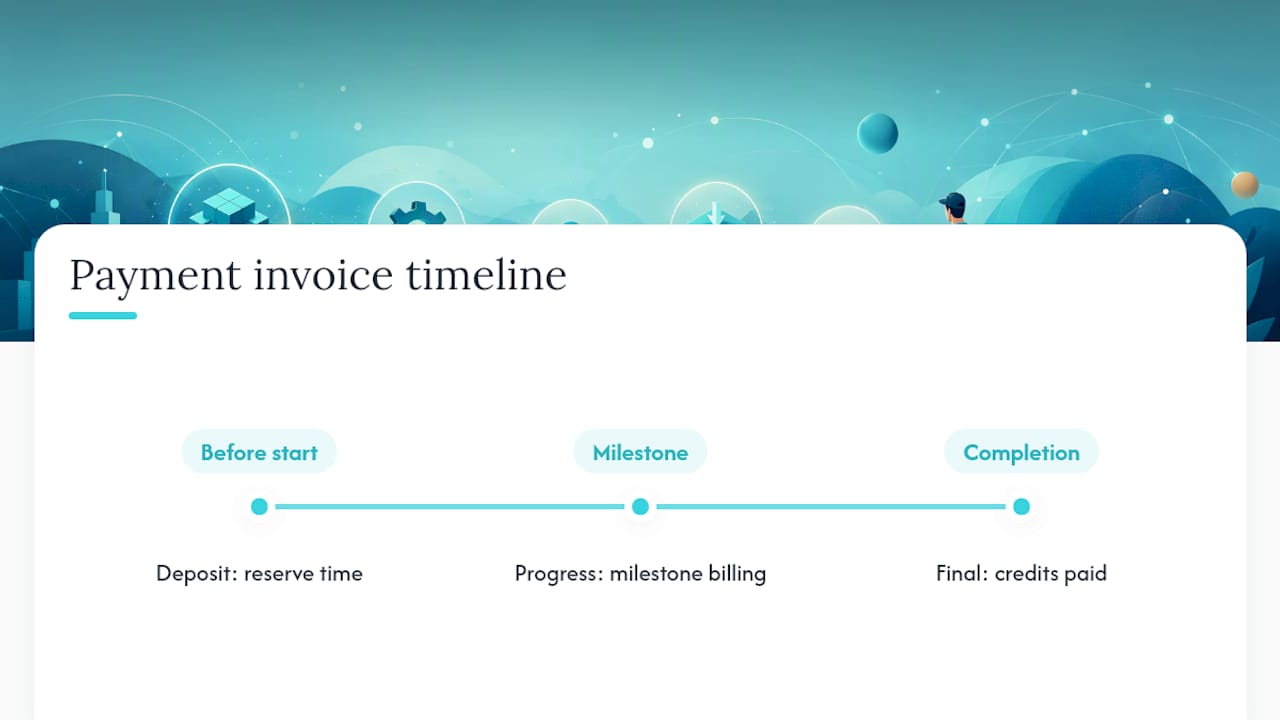
An advance payment is a broader term. It can mean any payment made before work is delivered, including a deposit, a partial progress payment, or a full prepayment for the entire job. Deposits and progress payments differ mainly in timing and purpose: a deposit is collected before work starts to secure materials or your schedule, while progress payments are billed as work is completed, in stages, on a longer project.
For a solo tradesperson, the practical distinction is this: a deposit invoice is what you send early to reserve your time and cover upfront costs. A progress invoice comes later, tied to milestones ("40% due at drywall completion"). A final invoice closes it out and credits everything already paid. Calling all three "deposits" in your own records is where confusion creeps in, especially if a client questions a charge six weeks after the fact.
Keep the labels distinct on paper, even if the client uses the terms loosely in conversation. It protects you if a dispute ever needs to be sorted out with dates, invoice numbers, and receipts instead of memory.
Why Deposits Matter More Than Most Solo Contractors Think
Cash flow problems rarely start with big jobs going wrong. They start with a dozen small jobs where a contractor fronted the material cost and waited weeks to get paid back. A deposit fixes that math before it becomes a problem.
Picture a plumber who quotes a water heater swap. Without a deposit, he's out $600 for the unit before the client has paid a dime. With a $300 deposit collected on quote acceptance, he orders the unit same day and never touches his own credit line. That's the whole argument for deposits in one job.
Get Paid Faster With Fewer Spreadsheets
Quotewren is built for exactly this workflow: turn a finished quote into a deposit invoice, collect payment with a built in pay link, and roll the balance into a final invoice without re-typing a single line. No more digging through email threads to remember which invoice number the deposit was tied to, and no more chasing a client for a receipt three weeks later.

Because Quotewren was built for solo operators, not fleet-sized crews, the pricing stays simple and the setup takes minutes, not a training session. It handles the branded quote, the deposit invoice, the pay link, and the receipt, then automatically sends a review request once the job wraps, so the same client who paid your deposit also helps you land the next one. For a plumber, electrician, or landscaper juggling five active jobs at once, that's less admin time and cleaner records come tax season. Check out how the flow works from quote to invoice, or start a free trial at Quotewren and send your next deposit invoice in minutes.
Where to Learn More About Deposit Invoices
For tax timing questions, IRS Publication 538 covers accounting methods for advance payments. Stripe's deposit invoice guide has practical structuring advice, and event pros can see real-world deposit wording in this wedding planner invoice guide.
Sources
- Deposit invoices 101: What they are and how to use them — Stripe
- IRS Publication 538 — Accounting Periods and Methods
- Recording a Client Deposit or Prepayment — Quicken
- Deposit invoice template — Agiled
FAQ
What Is a Deposit Invoice?
A deposit invoice is a bill requesting partial payment for a project before work begins, usually to cover materials or reserve your schedule. It's a real, payable request, not a preview like a quote.
Can You Issue an Invoice for a Deposit?
Yes. Any contractor can send a deposit invoice once a client has approved the scope of work, and it should show the total project cost, the deposit amount, and refund terms clearly.
What Is the Difference Between an Invoice and a Deposit Invoice?
A regular invoice bills for completed work and expects full payment. A deposit invoice bills for part of the total, upfront, before the job starts, and gets credited against the final invoice later.
How Do You Do a 50% Deposit Invoice?
Tools like Quotewren can calculate and format that split automatically once you enter the total job cost.