
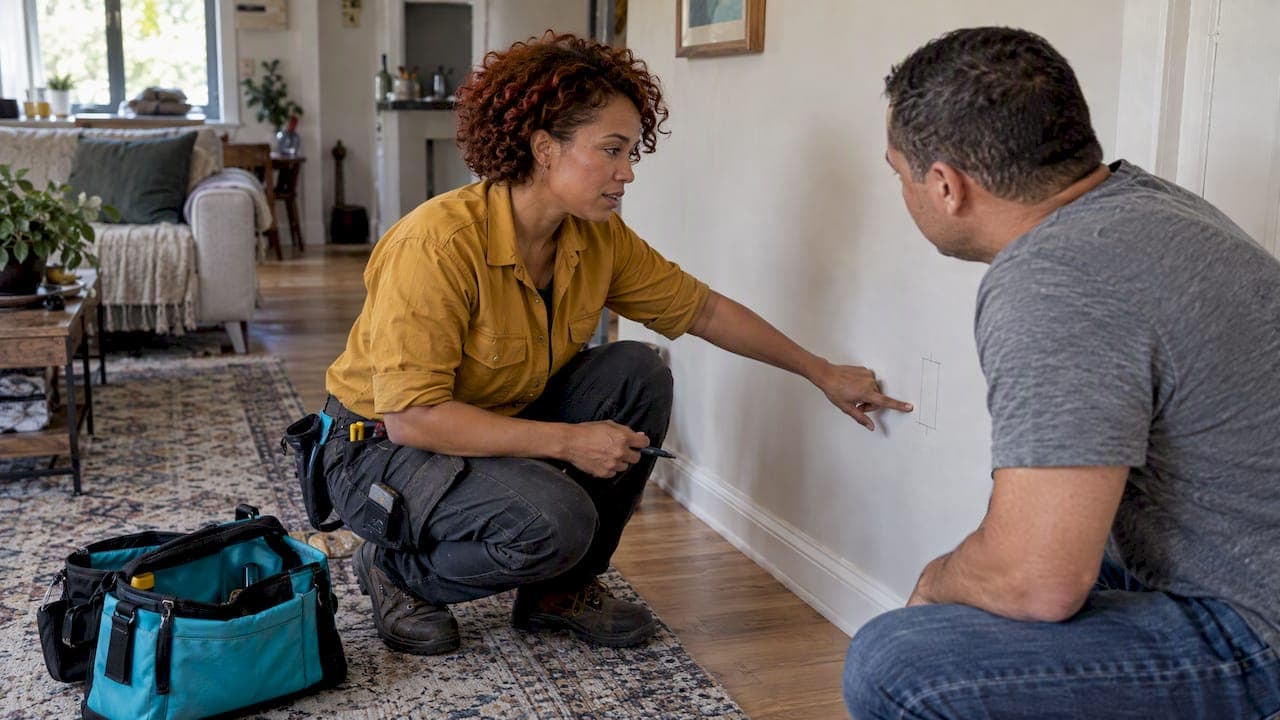
Scope creep is when the job grows past what you quoted and you don't get paid for the growth. The fix is simple to say and hard to do on a busy day: write down exactly what the price covers, and when a customer asks for more, price it and get a yes in writing before you touch it. This guide shows you how, with examples from plumbing, electrical, HVAC, handyman work, landscaping and cleaning.
TL;DR
- Scope creep is extra work done without extra pay. It usually shows up as small favors, not big changes.
- Prevent most of it before day one: a written quote that says what is in, what is out, and what you assume.
- When a customer asks for more, use the same three steps every time: price it, get approval in writing, then do it.
- Keep the original quote as the baseline. Add changes as separate, numbered items and invoice them.
- Check your state's rules on written contracts and change orders. They are not the same everywhere.
Table of Contents
- What scope creep looks like on a real job
- Why it hurts a small business more than you think
- Step 1: Prevent it before the job starts
- Step 2: Respond when the customer asks for more
- Step 3: Get the change in writing before you start
- Step 4: Keep the paperwork clean
- Step 5: Invoice the changes and get paid
- Our perspective
- Make it easy with one tool
- A quick checklist to keep by your truck
- FAQ
- Sources
What scope creep looks like on a real job
Project management sites talk about software teams and big budgets. Your version is smaller and more personal.
One trade publication defines scope creep as deviating from the scope of work without accounting for the deviation in revenue. Its examples come from cleaning and restoration: an extra room, a stain removal, a replacement vanity that leads to more work. It also notes that this tends to show up near the end of a job, when the customer is unhappy and the crew is frustrated.
Here is how that looks in the trades:
- Plumbing: You quote a faucet swap. The customer says, "While you're here, can you look at the slow drain?" The drain turns out to need a snake and an hour.
- Electrical: You quote two outlets. The customer points at a third. "It's the same wall, right?"
- HVAC: You quote a thermostat replacement. The customer wants it moved to a different hallway, which means fishing new wire.
- Handyman: You quote hanging a door. The customer adds trim, then paint touch-up, then a squeaky hinge on the next door.
- Landscaping: You quote mulch for the front beds. The back beds "look the same," so they should be quick.
- Cleaning: You quote a standard clean. The customer asks for the inside of the oven and the fridge, "just this once."
None of these requests is rude. Most customers don't know what the extra work costs you. That is why you have to be the one who brings it up.
Why it hurts a small business more than you think
Each favor looks cheap. Together they add up to hours you didn't charge for.
A construction finance group says unmanaged change orders can cause unplanned losses in productivity and job profitability. It points to hidden changes like schedule shifts, moving work locations and favors. Without a clear view of work, effort and time, your costs get hard to predict.
Another of its articles explains the money side: work done on an unapproved or unpriced change may come with no matching revenue. If you can't recover the cost, you absorb it and your profit shrinks.
Slow approvals hurt too. The Associated General Contractors of America says delayed change-order processing can interrupt cash flow and particularly threaten small businesses, because you still pay for payroll, materials and taxes while you wait.
There is a customer cost as well. When you do free extras and then resent it, the job feels worse for both sides. A clear price up front is kinder than a surprise later.

Step 1: Prevent it before the job starts
Most scope creep begins with a quote that was too vague. A business-software blog lists the usual causes: vague requirements, inconsistent approval paths, many decision-makers, piles of small requests and estimates that ignore past costs. A tighter quote fixes most of those.
Write down what is included
The Federal Trade Commission's home improvement advice says to get a written estimate that describes the work, materials, completion date and price. It adds that the contract should include promises about scope and about labor or material costs.
The California Contractors State License Board gives a longer list for a good written contract: the products and work, materials, amounts, who does what, permits, the completion date, cleanup, debris removal and warranties. It also says to put verbal promises in writing.
For a solo job, that boils down to a short checklist:
- The address and the exact area ("upstairs hall bathroom," not "the bathroom").
- The tasks, in the order you'll do them, with quantities ("replace 3 outlets," "install 1 thermostat").
- Who supplies what. If the customer buys the faucet, say so.
- The condition you leave the space in: cleanup, debris hauled or not.
- The price, the deposit if you take one, and when the balance is due.
- The timeline and what access you need.
A workflow guide from a field-service training site suggests a similar frame: property and areas, tasks and quantities, specifications, customer-supplied items, handover condition, assumptions, exclusions, and access and schedule requirements. You don't need all of that on every job. For a small repair, a few clear lines is enough.
Need a starting point? Our contractor quote template walks through what to fill in. If you do cleaning work, the idea of defining areas and frequency in detail applies to you too. This guide to writing a janitorial scope of work shows how a specific scope keeps both sides on the same page.
Say what is not included
This is the part most people skip. A line like "Does not include drywall repair, painting or permit fees" saves you from arguments later. Our estimate exclusions list shows what to leave out and how to word it.
Add a few assumptions too:
- "Price assumes the existing shutoff valve works."
- "Price assumes the panel has room for new breakers."
- "Price assumes clear access to the unit and attic."
If an assumption turns out wrong, you have a reason to reprice that isn't personal.
Catch estimate mistakes early
A quote that leaves out a trip to the supply house or a disposal fee is scope creep waiting to happen. Run through our 15-minute estimate checklist before you send anything.
Check your state's rules
Rules differ by place. The FTC says contract requirements vary by state, so you should check state or local rules on licensing, insurance, payment limits and cancellation. Two examples: California requires a written contract for home-improvement projects over $500, per the state contractors board. New York requires home-improvement contracts to be written and in plain English, with a specific description of work and materials, price, approximate dates and payment schedule. Look up your own state's contractor board or attorney general page.
Step 2: Respond when the customer asks for more
You don't need a speech. You need the same short routine every time. A business blog describes it as evaluate, price, approve, track, and says a steady process lets you protect profit without turning each request into a confrontation.
The three-step reply
- Say yes to the idea. "Sure, I can do that."
- Give the price and time. "That's an extra $140 and about an hour."
- Ask for approval in writing. "I'll text you a quick change order. Reply yes and I'll start."
Then wait for the yes. Don't start on a nod.
Sample scripts you can use
Plumber, slow drain: "I can clear that drain while I'm here. It's a separate job from the faucet, so I'll add it at $125. Want me to send you the change so you can approve it?"
Electrician, third outlet: "Happy to add it. A third outlet on that wall is $95 with the wire and cover. I'll send the updated quote now."
Cleaner, oven and fridge: "I can add the oven and fridge for $60 today. Want me to put that on the invoice?"
Landscaper, back beds: "The back beds are about twice the size. I'll price them as a second line so you can see the cost."
These prices are only examples. Use your own rates.
When the customer says "it should be included"
Point to the quote, calmly. "The quote covers the front beds only. I can do the back beds for the extra amount, or we can leave them for another visit." The written scope is the baseline for what is included. A field-service training site makes this point: keep the accepted original as your reference and treat later requests as changes against it, rather than overwriting it.
Sometimes you decide to do a tiny extra for free. That is your call, and it can be good business. Just say so: "This one's on me, no charge." Then it is a gift, not a habit.
Step 3: Get the change in writing before you start
A change order is the paper that records a change to the job. The AGC describes it as an official, agreed change to the original scope or terms. It may add or remove work and change the price or terms.
In California, a change order that changes the price or scope must be in writing and signed by both the customer and contractor before the change, and it becomes part of the contract. Your state may differ, but writing it down is smart everywhere. Our change order process guide covers six details to settle before work begins.
What a change order should include
A workflow guide from a service-industry site suggests tracking these items, which scale down well for a solo pro:
- The original quote and the accepted version
- A change number and date
- What is added and what is removed
- The new subtotal, with any taxes or fees
- How the change affects timing
- Who approved it, and proof of the approval
Those come from this small-job workflow. For a one-person shop, you can boil it down to five lines: Change #, date, what changed, new price, customer approval.
Texts count, but set the rules
Quick texts are how most small jobs run. They can also cause trouble. Construction Executive reports that informal texts or verbal directions can create disputes, and suggests contracts define how informal messages can change terms and who can approve changes.
A simple version: put one line in your quote. "Changes to the scope or price must be approved in writing, by text or email, by the person who signed this quote." That covers the situation where one spouse asks for extras and the other disputes the bill.
Step 4: Keep the paperwork clean
Two habits keep your records honest.
Keep the original and add to it. Don't edit the first quote. Add "Change 1," "Change 2." That way you can always see what was agreed first and what grew.
Track accepted, declined and pending separately. The same workflow guide says to keep these outcomes distinct, so pending or declined extras don't leak into accepted work or invoice totals. If the customer says "let me think about it," the extra stays pending, and you don't do it.

Track your own time as well. A construction finance group argues that scope control has to follow labor, time and work effort, not just the price, or profit stays unpredictable even with a change order. A change order that is priced too low still costs you. If you do a few jobs and notice that extras take longer than you charged, raise your change-order rate.
Step 5: Invoice the changes and get paid
A signed change doesn't help if the invoice is slow. The AGC's view is that changes are routine in construction, so the real problem is processing and documenting them quickly enough to keep payment and scheduling aligned. For you, that means sending the updated invoice the day the work is done.
- Show the original job and each change as separate lines.
- Match the line names to the change orders ("Change 1: second outlet, $95").
- Put clear due dates and terms at the bottom. See our guide on invoice terms solo contractors use.
- Ask for payment on completion where you can. Our payment-on-completion checklist has clauses to copy.
If you take deposits or progress payments, keep them tied to the work. New York guidance, for example, says payment schedules must bear a reasonable relationship to work done, materials purchased or other project costs.
If a customer pushes back on an extra charge, stay calm and show them the signed change. Our invoice dispute scripts give you words for it. And if they decline a quote or an extra, our piece on what to ask when customers decline estimates is worth a read.
Our perspective
We built Quotewren for solo pros, so we see this problem a lot. Here is what we believe about scope creep.
It is rarely a customer problem. It is a quote problem and a habit problem. A fuzzy quote invites extras, and a habit of saying "sure, no problem" teaches customers that extras are free.
The fix has to be small enough to use in a driveway. If a change order takes twenty minutes at the kitchen table, you won't do it. If it takes a minute on your phone, you will. That's why we keep quotes, invoices and follow-ups in one simple flow: the quote you send becomes the invoice you send, and the review request goes out after you're paid and the job is done.
We also think pricing the extra is a service, not a squeeze. Customers like knowing the number before you start. Most say yes. The ones who say no just saved both of you an argument.
— jaras
Make it easy with one tool
If you're tired of rebuilding quotes and invoices by hand, Quotewren turns a finished job into a branded quote, then an invoice with a pay link, and then sends review requests by text. There is a Free plan, Quotewren at $19 per month, and Quotewren Crew at $39 per month. You can see the plans and start free, or grab a printable template for your trade first, like the plumbing quote template or the handyman quote template.
A quick checklist to keep by your truck
- Does the quote list the area, tasks and quantities?
- Does it say what is not included?
- Does it list assumptions (access, existing parts, customer-supplied items)?
- Does it say how changes get approved, and by whom?
- When a customer asks for more: did I say the price, send it in writing and wait for yes?
- Is the change numbered, dated and added to the invoice?
FAQ
How do I stop scope creep without upsetting customers?
Say yes to the request and attach a price. "I can do that for $95" feels helpful, not pushy. Most customers just want to know the cost before you begin.
What is the difference between a quote, a change order and an invoice?
A quote is your price for the agreed work. A change order records a change to that work and its price, and gets approved before you do it. An invoice is the bill for the completed work, including any approved changes. For how estimates and proposals differ, see our estimate vs. proposal guide.
Is a text message enough to approve a change?
Often it is the practical choice, but rules differ by state and by contract. Put a line in your quote that says changes can be approved by text or email by the person who signed. Check your state's contractor board for what it requires in writing.
What if I already did the extra work for free?
Don't fight about it after the fact. Tell the customer calmly what it was, and say that next time you'll price extras first. Then use the change-order routine on the rest of the job. If a similar request keeps coming up, add it to your quote or exclusions list.
Sources
- Nothing is Scarier than Scope Creep, Restoration & Remediation Magazine
- Managing the True Cost of Change Orders, CFMA
- The Constant Challenges Faced When Accounting for Change Orders and Claims, CFMA
- Change Orders, Associated General Contractors of America
- Scope creep in project management, QuickBooks Blog
- How To Avoid a Home Improvement Scam, Federal Trade Commission
- Learn About Home Improvement Contracts, California CSLB
- Home Improvement Fact Sheet, New York Attorney General
- Write a scope your crew can check, WorkProof
- Customer changed the scope after approval? ServiceTech Signal
- Keep Text Messages From Changing Contract Terms, Construction Executive