
The overdue invoice process that works is simple: send a pre-due reminder, follow a set schedule of firmer emails and phone calls, then send one final notice with a real deadline before you escalate. Log every touch. If you haven't started, send today's first overdue reminder now, attach a pay link, and write down the date you sent it.
TL;DR:
- Sending a reminder three days before the due date helps catch clients who forgot without appearing bothersome, increasing on-time payments.
- A firm follow-up email and phone call between days 8 and 14 overdue significantly improve collection rates, especially if the call results in a specific payment date.
- Escalate to a demand letter after 30 days overdue or when the invoice amount is significant relative to monthly revenue, and consider small claims if reminders are ignored.
- Automating reminders with stop-on-payment logic and embedded pay links reduces manual follow-up and friction, speeding up collections for solo operators.
- Establishing clear payment terms upfront, taking deposits for large jobs, and segmenting clients enhance pre-emptive cash flow management and prevent overdue invoices.
Table of Contents
- What Is the Overdue Invoice Process, Step by Step?
- Email Templates and a Phone Script You Can Copy Today
- Sorting Real Disputes From Simple Excuses
- When to Send a Demand Letter, File Small Claims, or Write It Off
- Invoice Best Practices That Stop Overdue Bills Before They Start
- Automation That Actually Saves You Time
- When to Chase Harder and When to Let It Go
- A Simpler Way to Run Your Invoice Process
- Sources
- FAQ
What Is the Overdue Invoice Process, Step by Step?
An invoice is overdue the moment it passes its due date, whether that's "net 15" or "due on receipt." The clock doesn't care if the client is busy or the check is "in the mail." What matters is what you do next, and doing it on a schedule instead of whenever you happen to remember beats waiting around every time.
Most solo tradespeople lose money not because clients are dishonest, but because there's no system. You do the job, send the invoice, and hope. Hope isn't a collection strategy. A documented, repeatable sequence is what turns "I should probably follow up" into money in your account. Operational accounts-receivable guides call this a dunning cadence, and it works the same whether you're chasing a $300 handyman job or a $12,000 HVAC install: defined triggers, owned actions, and a paper trail.
Here's a cadence you can copy and adjust to your business:
- 3 days before the due date: Send a friendly heads-up reminder with the invoice attached and a pay link front and center. This isn't nagging. It catches the client who genuinely forgot, and it's standard practice in most past-due invoice checklists.
- Day 0 to 7 overdue: Send a plain, neutral first reminder. No guilt trips. Just the facts: invoice number, amount, due date, and the pay link again.
- Day 8 to 14 overdue: Send a firmer follow-up email and make a phone call. This is where a lot of contractors skip straight to email number three instead of picking up the phone. Don't. A call forces a real answer instead of a read receipt.
- Day 15 to 30 overdue: Loop in the account owner (that's you, if you're solo) for a direct conversation. Ask point-blank when payment is coming. Get a specific date, not "soon."
- Day 30-plus: Send a final notice by email and, ideally, by certified mail for bigger jobs. State a hard deadline and what happens if it's missed.
That last step is where a lot of solo operators freeze up. You don't want to sound like a debt collector to someone whose kitchen you just remodeled. But a final notice with a clear deadline isn't aggressive. It's professional, and it protects your right to escalate later if you need to.
When should you skip ahead faster? Not every invoice deserves the full 30-day runway. Move faster when:
- The invoice is large relative to your monthly revenue (a $6,000 electrical panel job overdue is not the same risk as a $150 faucet repair).
- The client has missed payments before.
- You're picking up signals the client is avoiding you, going quiet on texts, or making excuses that don't check out.
Set one rule and stick to it across every client. For example: "Any invoice over $1,000 that's 10 days late gets a phone call, no exceptions." Consistency is what makes a process instead of a series of one-off decisions you have to make from scratch every time.
Every step needs an owner and a log. If it's just you, that's easy. Note the date, the method (email, call, text), and what was said. If the client claims they never got the invoice, or they promise payment "next Friday," write it down. That log becomes your evidence trail if things escalate to a demand letter or small claims later, and weekly AR reviews keep you from letting invoices slip through the cracks.
Email Templates and a Phone Script You Can Copy Today
You don't need to write these from scratch every time. Keep a version of each saved, and swap in the client's name and invoice details.
- Pre-due reminder subject: "Invoice #1042 due Friday, just a heads-up" — Body: confirm the job was completed to their satisfaction, restate the amount and due date, and include the pay link.
- First overdue email subject: "Invoice #1042 is now past due" — Body: state the invoice number, amount, original due date, and the pay link. Keep it neutral. No blame, just facts.
- Firm follow-up subject: "Following up: Invoice #1042 (10 days overdue)" — Body: reference the earlier email, ask directly when payment will be sent, and note you're happy to answer questions about the invoice.
- Final notice subject: "Final notice: Invoice #1042 due by [date]" — Body: state the exact deadline, the amount owed, and what happens next (a demand letter, a late fee if your terms include one, or referral for collection).
For the phone call, keep it short. Open with, "Hey, this is [name] from [business]. I'm calling about invoice number 1042, which was due on [date]. Can you tell me where that stands?" Then listen. If they say they'll pay, get a specific date and dollar amount, and confirm it back to them out loud. Practitioners who chase invoices for a living often find that a phone call resolves things faster than another email because it forces a real answer instead of silence.
Pro Tip: Always ask "when" instead of "if." "When can you get this paid?" gets you a date. "Can you pay this?" gets you a maybe.
Sorting Real Disputes From Simple Excuses
Not every overdue invoice is the same problem, and treating them the same wastes your time. Some clients forgot. Some are waiting on their own customer to pay them. And some genuinely think you owe them a discount because the drywall patch wasn't perfectly color matched. Each of those needs a different response.
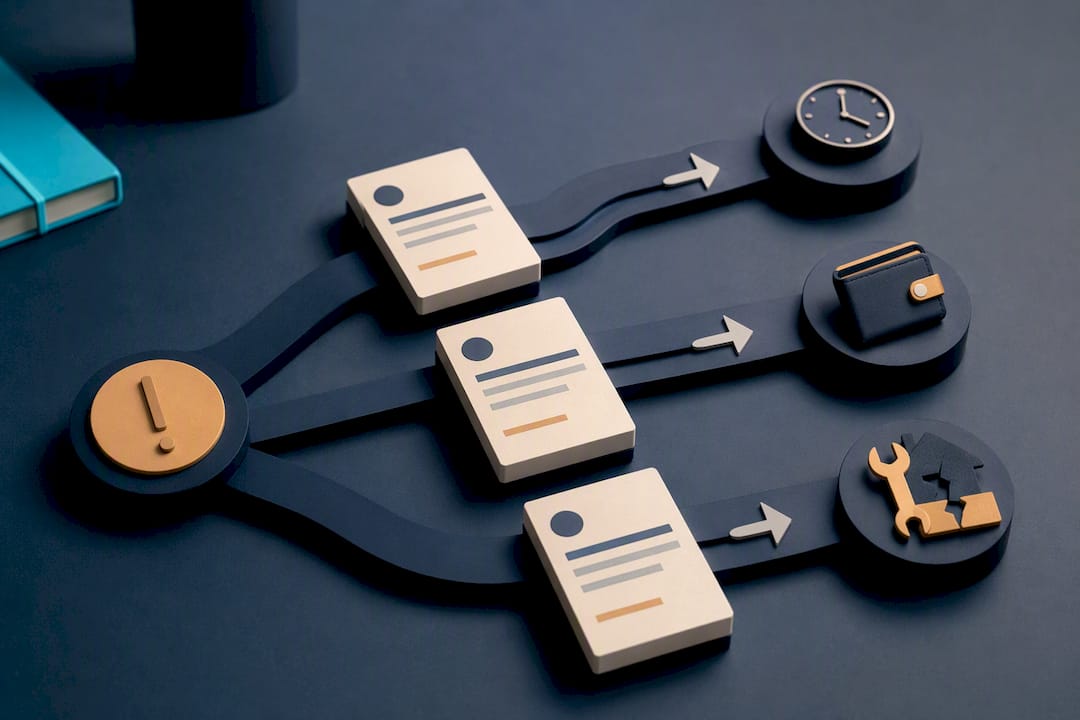
When a client pushes back, don't argue on the phone. Ask them to put the reason in writing, even if it's just a text message. That single step does two things: it slows down anyone who's just stalling, and it gives you a real starting point if the issue is legitimate.
If there's a genuine dispute, say the client claims you never installed the second bathroom fan you billed for, split the invoice. Pause collection only on the disputed portion and keep chasing the undisputed amount right away. Separating disputed from undisputed dollars is one of the simplest ways to recover more money faster instead of freezing the whole invoice over one line item.
Keep a short paper trail for every job, because you'll need it if things escalate:
- The signed quote or estimate
- Photos of completed work with timestamps
- Text or email threads about scope changes
- The original invoice and any revised versions
- Notes on every promise-to-pay conversation, with dates
When to Send a Demand Letter, File Small Claims, or Write It Off
Escalation isn't a punishment. It's just the next step when your regular cadence hasn't worked. A rough rule of thumb: escalate when an invoice is 30-plus days overdue, the amount is significant for your business, or the client has a pattern of stalling.
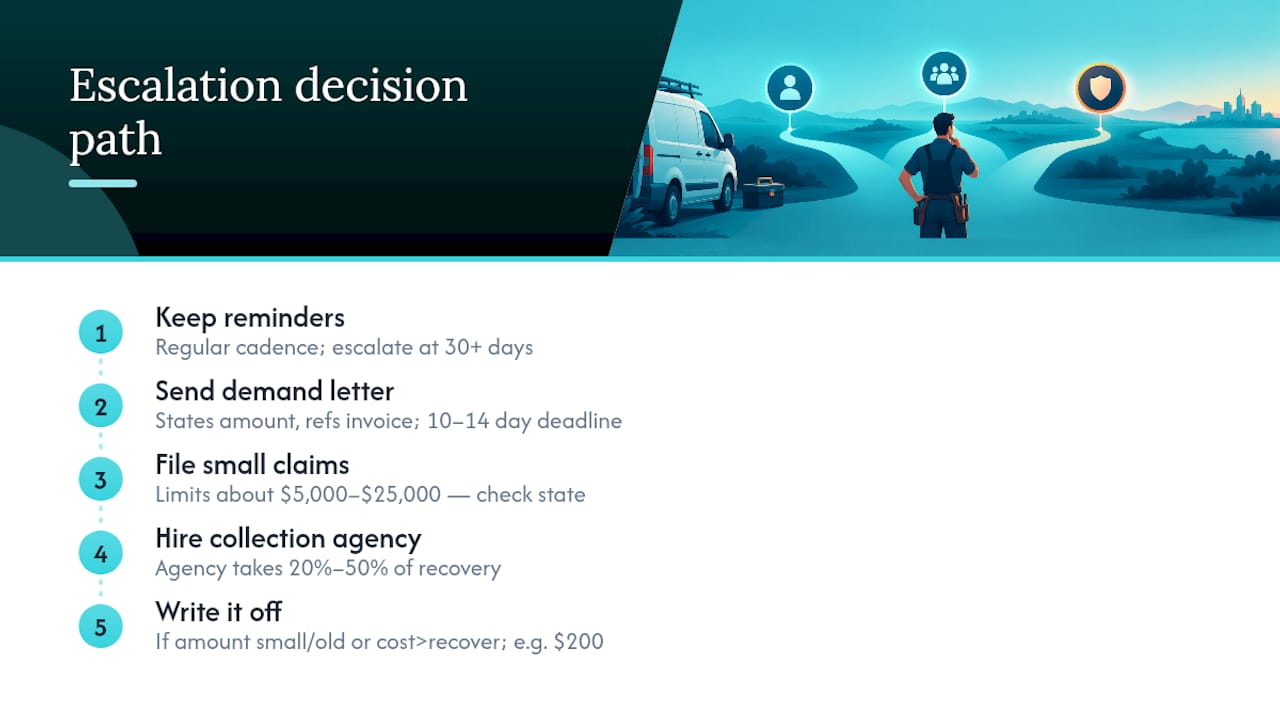
A written demand letter is usually the first real escalation move. It states the amount owed, references the original invoice and job, and sets a firm deadline, often 10 to 14 days. Demand letters aren't just a formality. They create a documented record that you tried to collect in good faith, which matters if you end up in court.
If the demand letter goes nowhere, small claims court is often the most practical next step for solo operators. Small claims limits typically run from about $5,000 to $25,000 depending on the state, so check your state's threshold before filing, since going over it can mean your case gets kicked to a different court entirely.
For invoices too small or too old to justify your own time chasing, a collection agency is an option. Understand that agencies operate under the Fair Debt Collection Practices Act, which limits how and when they can contact a debtor, and most take a cut of anywhere from 20% to 50% of whatever they recover.
When should you write it off instead? If the amount is small, the client has vanished, or the cost of pursuing it (your time, filing fees, legal help) outweighs what you'd recover, cut your losses and move on. Chasing a $200 invoice through small claims for three months isn't a smart use of a solo tradesperson's time.
Invoice Best Practices That Stop Overdue Bills Before They Start
The best overdue invoice process is the one you rarely have to use. A few changes upfront prevent most of the chasing:
- Put payment terms in writing before the job starts, not buried in fine print after. "Net 15" or "due on receipt" should be on the estimate the client signs.
- Take a deposit for bigger jobs. A roofing job or kitchen remodel should get 30% to 50% upfront, with the balance due on completion. Progress invoicing on multi-week jobs keeps cash flowing instead of one big number at the end.
- Add a pay link directly on every invoice so the client can pay with a card or bank transfer in one click, instead of writing a check and mailing it.
- Confirm the right billing contact during onboarding. A surprising number of overdue invoices trace back to the invoice going to the wrong email inbox.
- Segment your clients. A longtime repeat customer might get 15 days and a gentle reminder. A first-time client for a large job might get a stricter deposit requirement and a shorter grace period.
Pro Tip: If a client asks to skip the deposit "just this once," that's usually your clearest early warning sign for a slow payer later.
Automation That Actually Saves You Time
Automation only helps if it removes real manual work, not if it just adds another dashboard to check. The two features that matter most for a solo tradesperson are stop-on-payment logic and embedded pay links.
Stop reminders the moment payment posts. Nothing damages a client relationship faster than a "past due" email landing in their inbox the day after they already paid. Good invoice-to-cash automation checks payment status before sending the next reminder, so you're never chasing money that's already yours.
Put the pay link everywhere. Every reminder email, every text, every printed invoice should have a one-click way to pay by card or ACH. Friction is the enemy: the more steps between "I should pay this" and actually paying, the more invoices sit overdue longer than they need to.
When picking a tool, look for simple, editable templates, SMS reminder support, built-in pay links, and automatic sync with your bookkeeping so you're not manually reconciling who's paid and who hasn't.
When to Chase Harder and When to Let It Go
Plumbers, electricians, and HVAC techs face the same fork in the road constantly: keep servicing a slow-paying client or cut them off. My rule of thumb is simple: if an invoice hits 30 days and the client hasn't given a firm date, no new work until the balance is cleared, no exceptions for anyone. Track outcomes for six months, which clients paid after which step, and you'll see exactly where your process needs tightening.
— jaras
A Simpler Way to Run Your Invoice Process
A tool like Quotewren can automate the reminder steps so you're not manually tracking dates for every client. It lets you turn finished jobs into quotes and invoices with pay links, sends automated reminders, stops reminders once payment posts, and can send review requests to encourage Google reviews while the job is still fresh.

That's the whole point: less time spent on follow-up emails, more time spent doing the work you actually get paid for. Quotewren keeps things simple on purpose. It skips the fleet-management features built for large companies and focuses on what a solo operator needs. Current prices are listed on their pricing page, including options to test the service with a free tier. If you're tired of tracking overdue invoices in your head, start a free trial at Quotewren and set your reminder cadence up once instead of rebuilding it every month.
Sources
The escalation steps in this guide draw on Cornell's legal explainer on small claims court and its companion page on demand letters, both useful if you want to understand your legal footing before filing anything. For the cadence and template structure, the accounts receivable collection process guide and this past-due invoice reminder-to-escalation checklist cover reminder timing and escalation triggers in more depth. If you're setting up automated reminders, this guide on automated payment reminders breaks down setup basics for small businesses.
- Demand letter
- Fair Debt Collection Practices Act (FDCPA) text and guidance
- Accounts receivable collection process guide
- Past due invoice process: reminders to escalation
FAQ
What Happens When an Invoice Is Overdue?
Nothing happens automatically. It's simply unpaid past its due date, and it stays that way until you act on it. That's why a repeatable overdue invoice process matters: it's the difference between money sitting there and money actually landing in your account.
How Long Can an Invoice Stay Overdue Before I Escalate?
Most solo tradespeople should start escalating around the 30-day mark, sooner if the amount is large or the client has a history of late payment. A written demand letter is usually the right move once you hit that point without a firm payment date.
How Do You Handle Overdue Invoices as a Solo Tradesperson?
Follow a set cadence: a pre-due reminder, a neutral first overdue email, a firmer follow-up with a phone call around day 10, direct owner involvement by day 15 to 30, and a final notice with a deadline after that. Tools like Quotewren can automate the reminder steps so you're not manually tracking dates for every client.
What Happens if an Invoice Is 30 Days Past Due?
At 30 days, most contractors should send a final notice with a hard deadline and consider a formal demand letter if payment still hasn't come through. If the amount fits your state's threshold, generally $5,000 to $25,000, small claims court becomes a realistic next step.
What's the Fastest Way to Get Someone to Actually Pay?
A phone call beats another email almost every time, because it forces a real conversation instead of a read receipt. Combine that with an embedded pay link so there's zero friction between "I'll pay you" and the money actually moving.