
Send your first reminder about a week before the due date, another a few days out, one on the due date itself, then follow up at intervals roughly one week, two weeks, and a month after the due date. The one rule that protects you: set your software to stop reminders the moment a payment lands or shows as processing. Adjust the exact days to fit your payment terms and how well you know the client, but that six-touch cadence is the backbone of a reminder system that actually collects money instead of just annoying people.
TL;DR:
- Setting reminders to stop as soon as a payment is received prevents clients from receiving unnecessary follow-ups, ensuring a professional image.
- A typical sequence includes pre-due nudges at 7 and 3 days, a due date notice, then escalating messages at 7, 14, and 30 days overdue, with tone shifting from courteous to firm.
- Automating reminders requires configuring suppression rules for partial payments, processing status, disputes, and long-term clients to avoid miscommunication.
- Using SMS or phone calls at later stages improves the chances of prompt payment for overdue invoices, especially for larger or high-value jobs.
- Testing the system on small jobs and regularly reviewing automation logs helps prevent errors and ensures reminders function correctly.
Table of Contents
- What Is the Best Invoice Reminder Schedule to Copy?
- How Do I Automate Reminders Without Sending a Wrong One?
- What Should Each Reminder Say?
- When Should You Pause or Skip a Reminder?
- Why This Matters More Than Most Tradespeople Think
- Run This Schedule Without Building It Yourself
- Where to Read More on Reminder Setup
- Sources
- FAQ
What Is the Best Invoice Reminder Schedule to Copy?
A full reminder sequence has two jobs: get paid before the due date whenever possible, and escalate calmly if it slips past. Each touch has a purpose, and mixing them up is where most solo operators lose the plot.
The pre-due reminders are courtesy nudges. Nobody's mad yet. The on-due touch is a gentle "hey, today's the day." Everything after that is escalation, and the tone should shift with it.
Here's the default sequence to paste into your invoicing software:
- 7 days before due date — friendly heads-up, includes the invoice link and amount.
- 3 days before due date — second nudge, same tone, slightly more direct.
- Due date — "your payment is due today" with a pay link front and center.
- 7 days overdue — first past-due notice, still polite but clearly flags the late status.
- 14 days overdue — firmer tone, asks for a payment date if there's a holdup.
- 30 days overdue — final notice before you consider a phone call or, for bigger jobs, a late fee.
If you're on Net 7 terms, compress the pre-due steps into a single reminder 2 days out since there's no room for two separate nudges. On Net 14, the standard 7 and 3 day spacing works fine as written. On Net 30, some tradespeople add a fourth pre-due touch around day 20, especially for bigger invoices where a client might just forget it's coming. Practitioner guides back this general shape, pre-due touches roughly 3 to 7 days out, an on-due nudge, then staged follow-ups around 7, 14, and 30 days late, with tone and channel widening as the invoice ages.
None of this needs to be complicated. A $180 drain cleaning invoice and a $4,200 kitchen rewire can run the exact same schedule. What changes is how fast you escalate to a phone call, which we'll get to.
How Do I Automate Reminders Without Sending a Wrong One?
Automation only works if it knows when to shut up. Most invoicing platforms give you three basic controls: when to send (before, on, or after the due date), how many reminders to stack, and whether they go out automatically or wait for your approval first. Stripe's invoicing documentation lays this out clearly, letting you schedule reminders relative to the due date and suppress them automatically once a payment starts processing.
That suppression piece is the whole game. Without it, a client who pays on day 6 still gets your day 7 "you're late" email, and now you look sloppy instead of professional.
Set these rules before you turn anything on:
- Stop all reminders immediately once a payment is received or shows as processing.
- Pause the sequence on partial payments and switch to a "balance remaining" message instead of repeating the full amount.
- Flag disputed or held invoices so they skip automated reminders entirely and route to you for a manual check.
- Build a short list of customer-level exceptions for long-term clients who pay reliably but slowly.
Microsoft's Business Central documents this same logic with reminder levels, grace periods, and filters that keep routine notices from hitting accounts on hold. Whatever software you use, look for that same combination: status awareness plus a review log you can actually check.
Pro Tip: Before turning the whole sequence loose on your client list, run it against one live invoice from a small, low-stakes job. Watch what happens at each stage, confirm the suppression trips when you mark it paid, then roll it out wider.
Once it's running, don't just set it and walk away. Check your job or automation log every couple of weeks for the first month. Business Central's automation tools include a run history for exactly this reason, so you can catch a bad template or a wrong trigger before it goes out fifty more times.
What Should Each Reminder Say?
Tone should climb in three steps: courteous, neutral, firm. Skip straight to firm on day one and you'll damage a relationship you didn't need to. Wait too long to get firm and you'll train clients to ignore you.
Here are three snippets you can adapt today:
- 7 days before (courteous): "Hi [Name], just a friendly reminder that invoice #[number] for $[amount] is due on [date]. Here's the pay link: [link]. Thanks for the work!"
- On due date (neutral): "Hi [Name], invoice #[number] for $[amount] is due today. You can pay here: [link]. Let me know if you have any questions."
- 14 days overdue (firm): "Hi [Name], invoice #[number] for $[amount] is now 14 days past due. Please send payment or let me know a date I can expect it: [link]."
Channel matters as much as wording. Email carries the early touches fine. Once you hit 14 days late, add a text message. Business owners tend to see a text faster than a buried email, and SMS follow-ups tend to move faster than email alone once a message risks getting lost in someone's inbox. By 30 days, or for any job over a few thousand dollars, pick up the phone. A short call often resolves what six automated messages won't. You can find more copy-ready subject lines and message formulas in Quotewren's payment reminder templates if you want a bigger library to pull from.
When Should You Pause or Skip a Reminder?
Automation breaks down fast if it can't recognize the handful of situations where a normal reminder is the wrong move. Build these exceptions in before you flip the switch, not after a client calls you confused about a notice for money they already paid.
- Partial payments — switch to a balance-remaining template instead of repeating the original total.
- Payments processing — ACH transfers and some card payments take a few days to clear, so suppress reminders the moment a payment starts, not just when it finishes.
- Disputed invoices — route these to manual review instead of letting the sequence keep escalating on autopilot.
- Long-term clients — a customer who's paid you on time for three years probably doesn't need the same firm tone as a one-off job.
- High-value jobs — for anything over a few thousand dollars, add a personal check-in before the automated sequence hits its firmer stages.
If you're planning to charge a late fee at the 30-day mark, say so clearly in the reminder rather than surprising the client with it on the next invoice. Quotewren's guide to invoice late fees walks through how to word that without sounding punitive.
Why This Matters More Than Most Tradespeople Think

Late payments aren't usually about bad clients. They're about invoices that quietly slipped to the bottom of someone's inbox, and a reminder schedule is just a system for surfacing them again at the right moment. The tradespeople who struggle with cash flow usually aren't bad at collecting, they're bad at remembering to ask.
The mistake I see most often isn't skipping reminders, it's building a schedule too complicated to trust, then ignoring it because it feels risky. Keep it short. Six touches, clear suppression, done. Test it on one invoice, watch how it behaves for 30 days, then let it run.
— jaras
Run This Schedule Without Building It Yourself
Quotewren turns a finished job straight into a quote, then an invoice, then handles the reminder sequence and review request without you touching a spreadsheet or a separate reminder app. Instead of stitching together a payment reminder schedule by hand across three tools, you get the whole flow, quote to invoice to paid, in one place built specifically for solo operators, not fleet-sized field service companies.
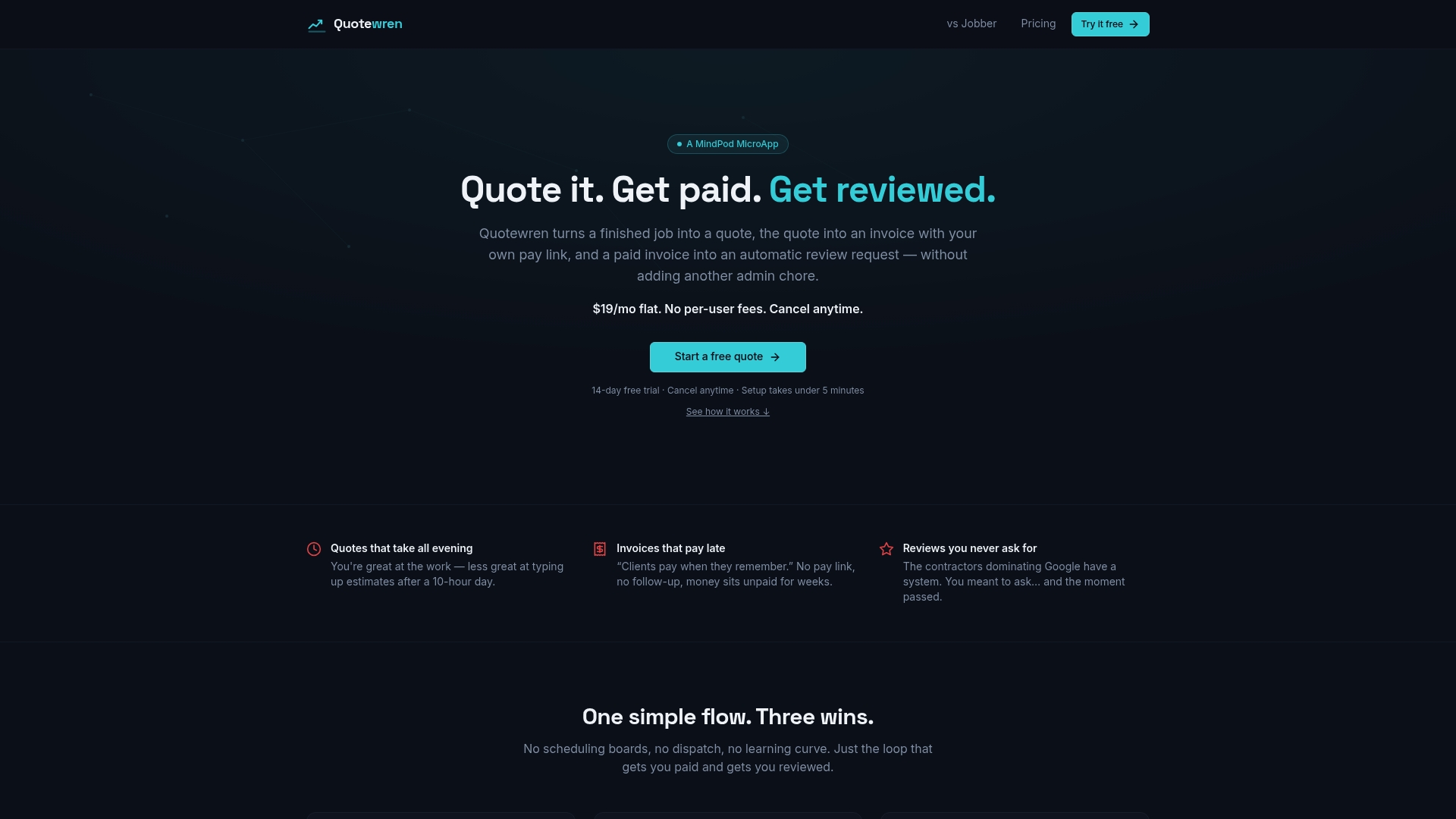
You can start on the Free plan to test the sequence on a single invoice, or move straight to the Quotewren plan at $19 a month if you're ready to run it across your whole client list. The Quotewren Crew plan, at $39 a month, adds room for a growing solo operation without the complexity of the bigger field-service platforms. Send one invoice through the full schedule this week and see how it feels before you commit to anything wider.
Where to Read More on Reminder Setup
- Stripe's automatic collection docs for exact suppression and scheduling controls.
- Business Central's reminder setup guide for reminder levels and exclusion filters.
- Quotewren's reminder setup guide for a tradesperson-first walkthrough.
Sources
- Automatic collection — Stripe invoicing docs
- Set up reminders — Microsoft Dynamics 365 Business Central
- Accountsreceivable
FAQ
When Should You Send an Invoice Reminder?
Send the first reminder 7 days before the due date, a second at 3 days out, one on the due date, then follow-ups at 7, 14, and 30 days late if it's still unpaid. This pre-due, on-due, post-due pattern covers most Net 14 and Net 30 terms without overwhelming the client.
How Do I Set a Scheduled Payment Reminder?
Most invoicing software lets you set reminders relative to the due date, before, on, or after, and choose whether they send automatically or wait for your review. Stripe's invoicing tools document this exact setup, including the option to suppress a reminder once payment starts processing.
Can You Automate Invoice Reminders in QuickBooks?
Yes, QuickBooks and most invoicing platforms support automated reminders tied to due dates, though the exact controls vary by product. If you want a lighter setup built specifically for solo tradespeople, Quotewren handles quoting, invoicing, and the reminder sequence in one flow without the extra complexity.
How Do I Write a Reminder Email for an Invoice Due Date?
Keep it short: name the invoice number, the amount, the due date, and a direct pay link. A due-date reminder should read neutral, not urgent, something like "Invoice #1042 for $350 is due today, here's the link to pay." Save the firmer tone for reminders sent after the due date has passed.