
Use a date-based sequential format like INV-YYYY-NNN (for example, INV-2026-001). That single choice solves most of the headaches solo tradespeople run into with invoicing, and it works whether you're a plumber running three jobs a week or an electrician juggling a dozen.
Whatever format you land on, four rules aren't optional:
- Unique. No two invoices ever share a number, ever.
- No unexplained gaps. If you skip 047, you need to know why.
- Documented. Write your rule down somewhere you'll actually find it again.
- Automated when possible. Let software do the counting so you don't have to.
This format works because it's easy to read, easy to sort, and easy to explain if the IRS or a client ever asks a question about your records.
TL;DR:
- Using a date-based sequential system like INV-YYYY-001 is generally best for solo trades, offering simplicity, clarity, and easy sorting.
- Always avoid reusing or skipping invoice numbers; mark mistakes as void and keep all records to maintain a complete paper trail.
- Separating invoice, credit note, and estimate series prevents record collisions and simplifies organization as your business grows.
- Automating invoice numbering with software prevents human errors, duplicate numbers, and gaps, ensuring consistency and audit-ready records.
- Scaling beyond a few dozen invoices per month may require prefixes for multiple locations or crews, but the core format should remain consistent.
Table of Contents
- What Is an Invoice Numbering System and Why It Matters
- What Are the Best Invoice Numbering Methods?
- How Do You Choose the Right Invoice Numbering Format?
- How to Set Up Your Invoice Numbering System Step by Step
- Why Automate Invoice Numbering Instead of Doing It by Hand?
- How Do You Fix Invoice Numbering Mistakes?
- What Are the Legal Rules for Invoice Numbering in the US?
- How Should Your Numbering System Scale as Your Business Grows?
- Quotewren Makes Invoice Numbering One Less Thing to Manage
- Key Takeaways
- Sources
- FAQ
What Is an Invoice Numbering System and Why It Matters
An invoice number is a unique tag attached to a billing document so you can track it, find it, and prove it's legitimate. It's the same idea as a check number or an order confirmation code. Every invoice needs one so that a specific payment can be matched to a specific job, no guessing involved.
Here's what a solid numbering system actually does for you:
- Matches incoming payments to the right invoice, fast.
- Lets you search old records in seconds instead of digging through email.
- Gives clients a clean reference number for questions or disputes.
- Creates a paper trail if you ever get audited.
There's no single required invoice format under US tax rules, but the IRS does expect identifiable, traceable records. That means the format is up to you, but the numbers need to be unique and consistent. A messy or repeated sequence doesn't break the law by itself, but it makes an audit take longer and looks sloppy to any client's accountant who spots it.
What Are the Best Invoice Numbering Methods?
Most small business owners pick from a handful of proven numbering methods. Here's how each one works, with copy-ready examples.
- Sequential. Just count up: INV-0001, INV-0002, INV-0003. It's the simplest system to run, but it also tells anyone who sees invoice #0004 that you're brand new. Fine for a side hustle, less ideal once you want to look established.
- Year-based. Reset or track by year: 2026-001, then INV-2026-002. This keeps years organized and lets you reset the counter every January, but only if the year stays part of the number. Resetting a counter without the year baked in creates duplicates fast.
- Year-month. For high-volume months: 202605-001, 202605-002. A landscaper billing 40 clients in June benefits from this because it groups invoices tighter than a plain year-based system.
- Client-based. Useful for repeat work: ACME-001, ACME-002. The catch is you end up running parallel sequences for every client, which gets messy if you also need one master list for your books. Keep a separate running total if you go this route.
- Project-based. Similar logic, tied to a job instead of a client: PROJX-001, PROJX-002. Good for contractors billing in phases on one big remodel.
- Hybrid. The most detailed option: 2026-ACME-001. It packs in the year and the client, which is handy for someone juggling dozens of accounts, but the numbers get long. Only use it if you genuinely need that extra context every time you glance at an invoice.
For most freelancers and solo trades, year-based sequential wins because it's short, sortable, and doesn't overshare. Save client-based or hybrid formats for the moment you actually need the extra filing help, not before.
How Do You Choose the Right Invoice Numbering Format?
Run through this short checklist before locking in your system:
- How many invoices do you send in a typical year? Ten a month is a different problem than fifty a month.
- Do you have a handful of repeat clients or mostly one-off jobs?
- Are you one legal entity, or do you operate under more than one business name?
- Do you bill by project phase, or is each job a single invoice?
- Do you want short numbers that are easy for a client to read back to you over the phone?
If you're not sure which method fits, default to date-based sequential. Only add a client or project code if it solves an actual filing problem you're already running into, not because it sounds more organized.
Your starting number matters less than people think. You can start at 001, 1001, or even 5001. Some freelancers start higher than 001 on purpose, so the very first invoice they send doesn't broadcast "this is my first client ever." Either way, the real rule is consistency: pick a starting point and stick with it.
Pro Tip: Never build sensitive client information, like a full name or account number, into the invoice number itself. If that invoice ever gets shared or filed somewhere public, you don't want private details riding along with it.
How to Set Up Your Invoice Numbering System Step by Step
- Pick your format and starting number, then write it down. Decide today: INV-YYYY-NNN, starting at 001. Put that rule in a note you'll actually reopen, not just your head.
- Set your voiding and credit-note policy. Decide now that credit notes get their own series (CN-001, CN-002) and estimates get theirs (EST-001, EST-002), so they never collide with real invoices.
- Set up your tracking, software or spreadsheet. At minimum, track invoice number, date, client, amount, and status (paid, unpaid, void) in one place.
- Lock in your filing rules. Save every invoice PDF with the invoice number in the filename, like INV-2026-045_Plumbing-JobName.pdf, and back the whole folder up somewhere off your laptop.
Four steps, done once, and you never have to think about it again except to follow the rule you already wrote down.
Why Automate Invoice Numbering Instead of Doing It by Hand?
Auto-incrementing numbers is the single best guard against duplicates and accidental gaps in your sequence. Automation catches the human error that creeps in when you're typing invoice numbers from memory at 9pm after a long job.
When you're picking any invoicing tool, insist on these features:
- Auto-increment that blocks duplicate numbers before you can send them.
- An audit log showing when each invoice was created, edited, or voided.
- Custom prefixes and leading zeros (INV-001 instead of INV-1) so your list sorts correctly.
- Separate numbering series for invoices, credit notes, and estimates.
If you're still running a spreadsheet and not ready for software, that's fine, as long as you're disciplined about it. Lock the "next number" cell so it can't get overwritten by accident, and do a quick monthly check to confirm no numbers were skipped or repeated.
How Do You Fix Invoice Numbering Mistakes?
Never delete or reuse an invoice number, even if the invoice was a mistake. Mark it VOID and keep it on file instead of erasing it from your records. A missing number with no explanation is exactly what raises questions in a bookkeeping review.
- Sent the wrong amount to a client? Issue a credit note from your separate CN series, then send a new invoice with the next available number. Keep both documents.
- Made a typo in the client's name? Void the original, note why, and reissue.
- Skipped a number by accident? Log it in a simple "voids and fixes" note so you can explain the gap in five seconds if anyone asks.
Auditors and accountants don't expect perfection. They expect a record that explains itself. A one-line log entry next to every gap does exactly that, and it takes less time to write than this paragraph took to read.
Copyable Templates for Solo Tradespeople
Three templates you can copy right now:
- Date-based: INV-2026-001
- Job code: JOB2026-014
- Client code: ACME-2026-03
Example filename: INV-2026-045_Plumbing-JobName.pdf. Example email subject: "Invoice INV-2026-045 for [Job Name]." Hand a bookkeeper or assistant one sentence: "Use this exact format, in this exact order, no exceptions."
What Are the Legal Rules for Invoice Numbering in the US?
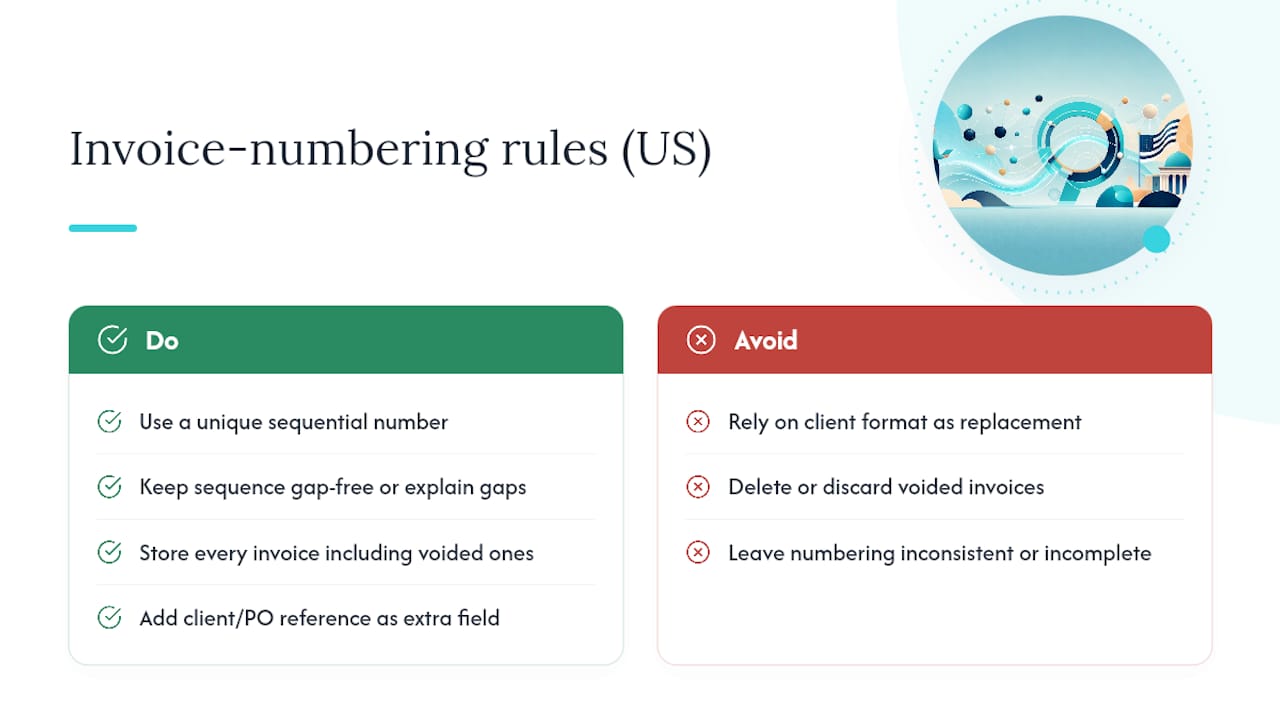
There's no federal law dictating a specific invoice numbering format for US small businesses. What actually matters to the IRS is that your records are complete, consistent, and traceable back to real transactions. A gap-free, well-documented sequence is what gets you through a records request without a headache.
If you sell across state lines, sales tax rules can require you to keep invoices organized enough to prove what was charged, when, and to whom, so a searchable numbering system doubles as tax-season insurance. If you ever work with government contracts or larger commercial clients, some may specify their own invoice or PO reference format for their side of the paperwork. That's a client requirement layered on top of your own system, not a replacement for it. You can still run your own internal numbering; you just add their reference number as an extra field.
The bottom line for a solo plumber, electrician, or landscaper: keep your sequence unique, keep gaps explained, and keep every invoice, including voided ones, on file. That satisfies both the spirit of the recordkeeping standard and any client-side paperwork requirement you'll realistically run into.
How Should Your Numbering System Scale as Your Business Grows?
A system built for ten invoices a year starts to strain at two hundred. Plan for growth before it forces your hand.
If you add a second crew, a second truck, or a second location, decide now whether each one gets its own prefix, like PLUMB1-2026-001 versus PLUMB2-2026-001, so invoices from each team stay traceable without merging into one confusing pile. If you bring on a subcontractor who bills separately, keep their invoices in their own series so your books don't mix your revenue with pass-through costs.
Growing past a spreadsheet is usually the real signal it's time to automate. Once you're sending more than a handful of invoices a week, manual number tracking becomes the exact place mistakes creep in, duplicate numbers, skipped sequences, forgotten voids. Software that auto-increments and logs changes scales with you without adding work.
One thing that doesn't need to change as you grow: your core format. If INV-YYYY-NNN worked at ten invoices a year, it still works at a thousand. Add prefixes for locations or crews if you need them, but don't reinvent your whole system every time business picks up.
Author viewpoint: why simple, documented rules win
The tradespeople who get paid fastest aren't the ones with the fanciest invoice numbers. They're the ones who never make a client stop and ask, "wait, which invoice is this?" A clean, documented sequence removes friction at the exact moment you need the client focused on paying you, not decoding your paperwork. It also makes your own bookkeeping faster, which means fewer evenings lost to reconciling a mess you created six months earlier.
— jaras
Quotewren Makes Invoice Numbering One Less Thing to Manage
Quotewren builds this whole system into the way you already work: finish a job, turn it into a quote, then an invoice, without touching a spreadsheet. Invoice numbers generate automatically in a consistent format, with an audit log behind them, so you never have to remember what number came last or worry about sending a duplicate to two different clients.
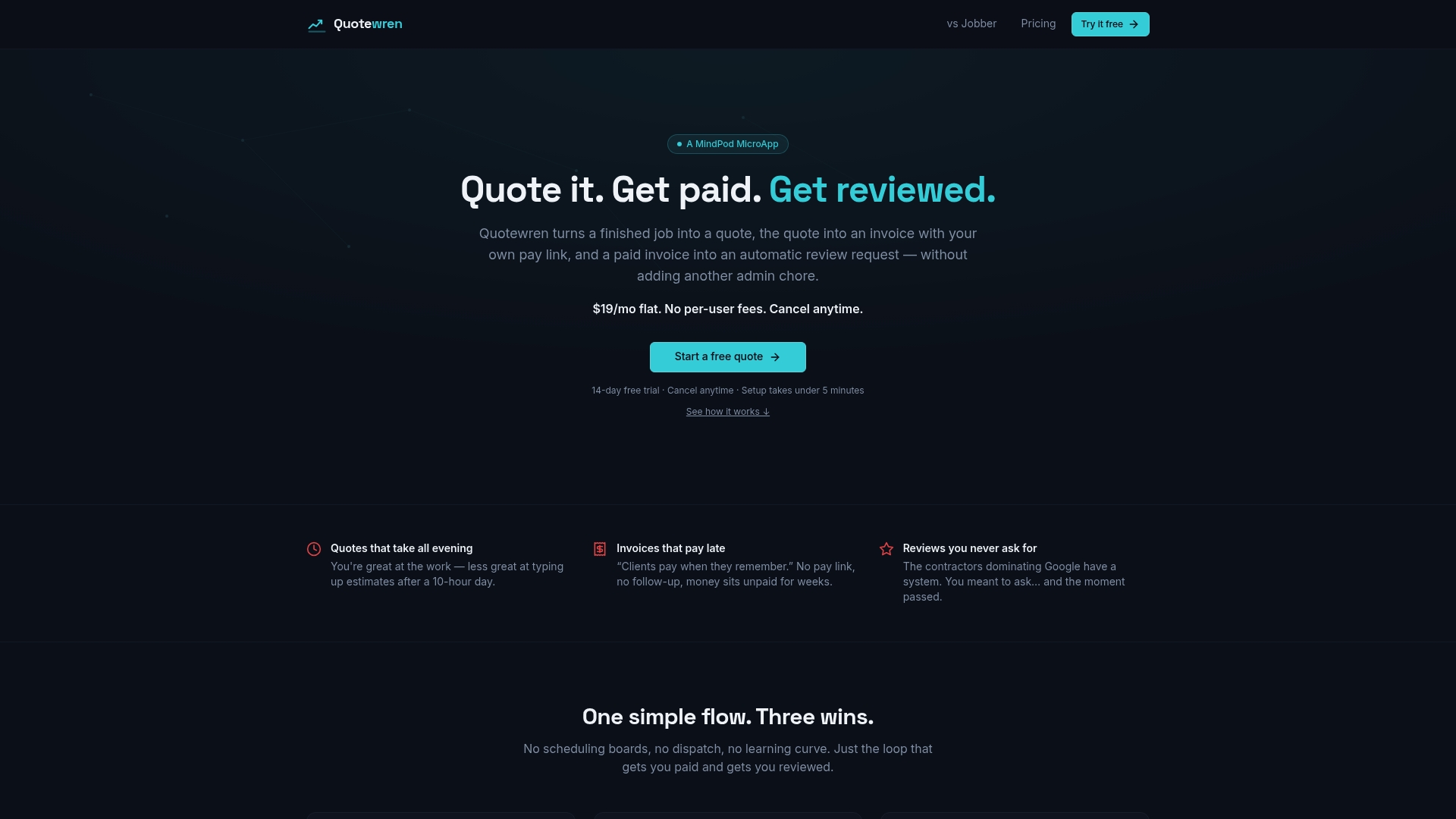
Every invoice Quotewren generates comes with a pay link attached, so clients can pay you straight from the invoice instead of mailing a check or waiting for a callback. And once the job's marked complete, Quotewren automatically sends a three-touch review request by text, so you're capturing Google reviews without chasing anyone down after a long day on the truck. If you're still numbering invoices by hand or losing track of what's been paid, start a free trial at Quotewren and see your next invoice go out numbered, tracked, and ready to get paid.
Key Takeaways
A documented, date-based sequential invoice format with automation behind it is the fastest path to organized books and faster payments.
| Point | Details |
|---|---|
| Default to date-based sequential | Use INV-YYYY-NNN as your starting format unless a client or project need says otherwise. |
| Never skip or reuse numbers | Mark mistakes VOID and keep them on file instead of deleting them. |
| Separate your document series | Give invoices, credit notes, and estimates their own prefixes so records never collide. |
| Automate to prevent errors | Auto-increment and duplicate blocking catch mistakes a manual system misses. |
| Let Quotewren handle the sequence | Quotewren auto-generates invoice numbers, logs changes, attaches pay links, and follows up for reviews after each job. |
Sources
- What is an invoice number, what it is used for and how it is created — Stripe
- Invoice Numbering: Best Practices & Systems That Scale — Invoicemonk
- Invoice Numbering Guide (2026) | MyInvoiceTemplate
- Invoice Numbering Systems for Small Businesses — ToolForte
FAQ
What Is the Best Numbering System for Invoices?
For most freelancers and solo tradespeople, a date-based sequential format like INV-2026-001 is the best balance of clarity, sortability, and audit-readiness. Tools like Quotewren generate this format automatically so you never have to track the next number yourself.
How Should an Invoice Be Numbered?
Every invoice number should be unique, follow a consistent format you've written down, and increase in order with no unexplained gaps. Leading zeros (001 instead of 1) keep your list sorted correctly as the numbers grow.
Do Invoices Have to Be Sequentially Numbered?
US tax rules don't require a specific sequence, but the IRS expects records that are traceable and consistent, which a sequential system delivers automatically. A gap-free sequence with documented voids is the easiest way to prove that consistency if you're ever asked.
What Is the Best Invoice Number Format?
The best format depends on your volume and client mix, but INV-YYYY-NNN works for most solo operators because it's short, sorts correctly, and shows the year at a glance. Add a client or project code only if you have a specific filing need that a plain sequential number doesn't solve.