
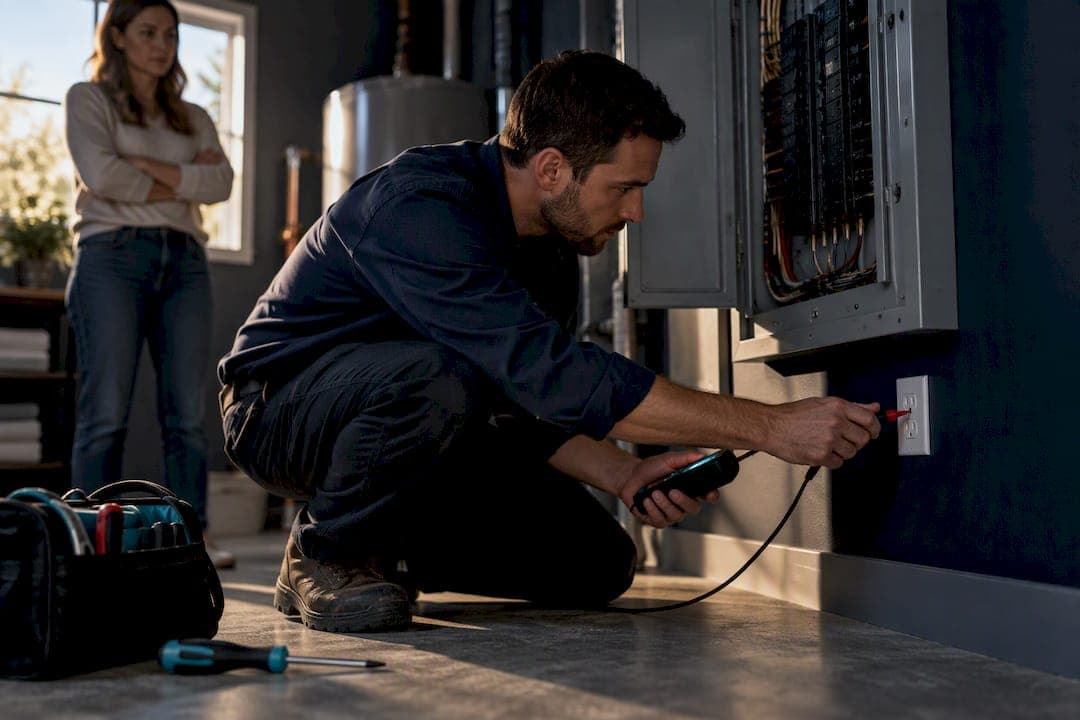
A service call fee is what a technician charges just to show up, look at your problem, and tell you what's wrong. Most homeowners pay somewhere between $100 and $250 for this, depending on the trade and where they live, according to HomeAdvisor's electrician cost data. Before you book anyone, ask if that fee gets credited toward the repair if you move forward with the work.
TL;DR:
- Most service call fees range from $100 to $250, depending on trade, location, and whether the fee includes the first hour of labor.
- The fee covers travel, diagnosis, initial labor, vehicle, and basic supplies, with some companies charging separately for diagnosis or bundling the first hour.
- Emergency, after-hours, or weekend calls often incur higher flat fees or surcharges, and travel distance can add additional costs in rural areas.
- Businesses typically credit the service fee toward repairs if the customer approves the work, but it's essential to ask beforehand about billing structure.
- Clear, written estimates and upfront disclosures help prevent disputes and enable faster, smoother payments.
Table of Contents
- What does a service call fee actually cover?
- How much should you expect to pay by trade?
- Why do businesses charge this, and what should you watch for?
- How do you avoid getting surprised by the bill?
- How do trades actually calculate a service call fee?
- Why clear pricing matters more than most trades realize
- A simpler way to send clear quotes and get paid faster
- Primary sources and further reading
- Sources
- FAQ
What does a service call fee actually cover?
The fee isn't just for "showing up." It's paying for the technician's time and a chunk of running the business behind them. When a plumber, electrician, or HVAC tech charges a service call fee, they're usually covering:
- Travel time and gas to get to your door
- Diagnostic work, meaning the time spent figuring out what's actually broken
- A minimum amount of labor, often the first 30 to 60 minutes on site
- Vehicle and equipment costs, since a fully stocked service van isn't cheap to maintain
- Basic supplies, like fuses, small fittings, or diagnostic tools used during the visit
Not every company structures this the same way. Some charge a flat diagnostic fee that's separate from labor. Others fold the first hour of work into the fee, so you're only billed extra if the job runs longer. A few charge a pure trip fee just for coming out, with diagnosis billed separately on top of that.
Here's how it plays out in real jobs. An electrician who charges a $120 service call fee might spend 20 minutes finding a tripped breaker that's actually a bad outlet, and that fee covers the whole visit even if no further repair happens. An HVAC tech checking a furnace that won't ignite might use that same fee to cover diagnosis, then quote separately for a new igniter. A plumber snaking a slow drain might roll the service call fee directly into the total price if you approve the job on the spot.
Ask which model you're dealing with before the technician arrives. It changes what you should expect on the invoice.
How much should you expect to pay by trade?
Costs vary by trade, but there's enough consistency across the industry to give you a real benchmark. Plumbing service calls typically run $100 to $250, with total project costs landing between $182 and $501 once the actual repair is factored in, according to Angi's plumbing cost data. HVAC technicians charge a similar range, usually $100 to $250 for the initial visit, with labor billed at $100 to $250 per hour after that, per HomeAdvisor's HVAC repair data. Electricians tend to charge $50 to $130 per hour on top of a $100 to $200 service call fee for that first hour, based on HomeAdvisor's electrician pricing.

A common range across plumbing, HVAC, and electrical work is $100 to $250 for the service call itself. That number holds up whether you're calling about a leaking water heater, a dead AC unit, or a flickering circuit, though the total bill depends heavily on what the technician finds once they're inside.
Timing changes the math fast. A few patterns show up again and again:
- After-hours, weekend, or holiday calls often carry a higher flat fee or a surcharge on top of the standard rate
- Distance from the shop can add a travel charge, especially in rural areas
- Emergency requests, like a burst pipe at midnight, sometimes come with a separate emergency flat fee instead of the standard service call rate
- Minimum labor charges mean you're billed for at least one hour even if the fix takes fifteen minutes
If a company quotes you a number that's dramatically outside these ranges, ask what's included. A fee on the low end might not include diagnosis, and a fee on the high end might already include the first hour of labor.
Why do businesses charge this, and what should you watch for?
The fee exists because a technician's time and truck cost money before any wrench gets touched. Wages, fuel, insurance, tool replacement, and the overhead of running a scheduling system all get baked into that number. A solo plumber who drives 25 minutes to your house has already spent real money before diagnosing anything, and the service call fee is how that cost gets recovered instead of getting absorbed into a job that might not even happen.

Many trades credit the service call fee toward the repair if you approve the work on the spot. This is common but not universal, so it's worth asking directly. Some businesses waive the fee entirely for returning customers or for jobs booked during slow periods.
Fee transparency has become a bigger deal industry-wide, and there's now a federal rule addressing it directly.
Businesses may not misrepresent the nature, purpose, or refundability of a fee, and must disclose mandatory fees clearly before collecting payment.
That's the core of the FTC's Trade Regulation Rule on Unfair or Deceptive Fees, which targets bait-and-switch pricing and requires the total mandatory cost to be clear upfront. If a company quotes one number on the phone and adds unexplained charges later, that's exactly the kind of practice regulators are watching for.
How do you avoid getting surprised by the bill?
A five-minute phone call before booking can save you a frustrating conversation later. Ask these questions every time:
- Is this a flat diagnostic fee, or does it include the first hour of labor?
- Does the fee get credited toward the repair if I approve the work?
- What's your cancellation or no-show policy, and is there a charge for it?
- Can you text or email me a written estimate before you start?
- Are parts priced separately, and can you give me a range before you order them?
A company that answers these clearly is one that's used to explaining its pricing, which is usually a good sign. One that dodges the questions or gives vague answers is worth a second look. Getting a written quote or estimate before the technician shows up protects both sides and gives you something to point to if the final bill doesn't match what you expected.
A few more habits help keep costs down. Bundling small tasks into one visit, like fixing a leaky faucet and a running toilet in the same appointment, spreads one service call fee across two jobs instead of two. Booking during regular business hours instead of nights or weekends avoids after-hours surcharges. And confirming parts pricing before work starts means no surprises when the invoice arrives.
Pro Tip: Ask for the estimate in writing, even a text message, before the technician starts any work. A verbal number is easy to forget or dispute later.
How do trades actually calculate a service call fee?
Most solo tradespeople use one of three approaches, and none of them require complicated software or guesswork.
- Flat diagnostic fee: A set price, often $100 to $150, that covers travel and the first look at the problem, regardless of how far the drive was or how long the diagnosis took.
- Minimum-hours model: The tech bills a minimum of one or two hours no matter how quickly the job actually gets done, which protects against underpricing a fast fix.
- Distance plus time plus overhead: A more detailed formula that adds up travel time, labor minutes, and a per-mile vehicle cost, then tacks on 15% to 20% for overhead before rounding to a clean number.
Here's a simple version of that third method. Say a solo electrician expects a 20-minute drive each way, values their labor at $1 per minute, and estimates $10 in vehicle costs for the round trip. That's 40 minutes of drive time at $40, plus the $10 vehicle cost, for a base of $50.
None of these methods are wrong. They're just different ways of answering the same question: how do I get paid fairly for showing up before I even start the job?
Why clear pricing matters more than most trades realize
The biggest misunderstanding I see is treating the service call fee like a hidden cost instead of a normal, explainable one. Customers rarely complain about paying a fee. They complain when nobody told them about it first.
A written quote that spells out the service call fee, what it covers, and whether it's credited toward repairs heads off almost every dispute before it starts. Clear invoicing does the same thing after the job, turning "wait, what's this charge" into "yep, that matches what I was told." Trades that get this right tend to collect payment faster and pick up better reviews, because customers who understood the price going in rarely leave a frustrated one afterward.
Transparent pricing isn't a nice-to-have. It's the difference between a customer who calls you again and one who leaves a review explaining why they won't.
— jaras
A simpler way to send clear quotes and get paid faster
Quotewren turns a finished job into a quote, then an invoice, then an automated review request, without extra steps for a solo operator to manage. That matters directly for service call fees: a clear, written quote that spells out the fee and whether it's credited toward repairs is the single best way to avoid a dispute later.

Quotewren plans include automated review requests, sent by text right after the job wraps up, which helps solo tradespeople build the kind of Google presence that brings in new calls without extra marketing effort. The Quotewren plan runs $19 a month, and Quotewren Crew is $39 a month for growing shops, with a free tier available to try the basics first.
If you're tired of chasing payments or explaining the same fee twice, start with a quote you can send in minutes.
Primary sources and further reading
This article draws on the FTC's rule on unfair or deceptive fees, along with cost data from HomeAdvisor's electrician guide, HomeAdvisor's HVAC repair guide, and Angi's plumbing cost guide. For more on avoiding surprise charges, see this quote versus estimate breakdown.
Sources
- How Much Do Electricians Charge? 2025 Data | HomeAdvisor
- How Much Does Plumbing Repair Cost? 2026 Data | Angi
- Trade Regulation Rule on Unfair or Deceptive Fees (FTC)
FAQ
How much should I charge for a service call?
Most solo tradespeople charge between $100 and $250 depending on the trade, distance, and whether the fee includes the first hour of labor, based on ranges reported by HomeAdvisor and Angi. A simple starting point is calculating travel time, minimum labor, and vehicle costs, then adding some overhead before rounding to a clean number.
What is a service call fee?
A service call fee is the charge for a technician's time and travel to diagnose a problem, separate from the cost of the actual repair. It typically covers driving to the location, initial troubleshooting, and sometimes the first hour of labor.
Why am I getting charged a service fee?
You're covering the real cost of a technician's time, fuel, and equipment before any repair work even starts. Businesses charge this fee because diagnosing a problem takes time and resources regardless of whether you approve the follow-up repair, and FTC guidance requires that fee to be disclosed clearly before you're charged.
What do most plumbers charge for a service call?
Plumbing service call fees typically range from $100 to $250, with total project costs often landing between $182 and $501 once the repair itself is included, according to Angi's plumbing cost data. The exact number depends on your location, the time of day, and whether the visit is an emergency call.