
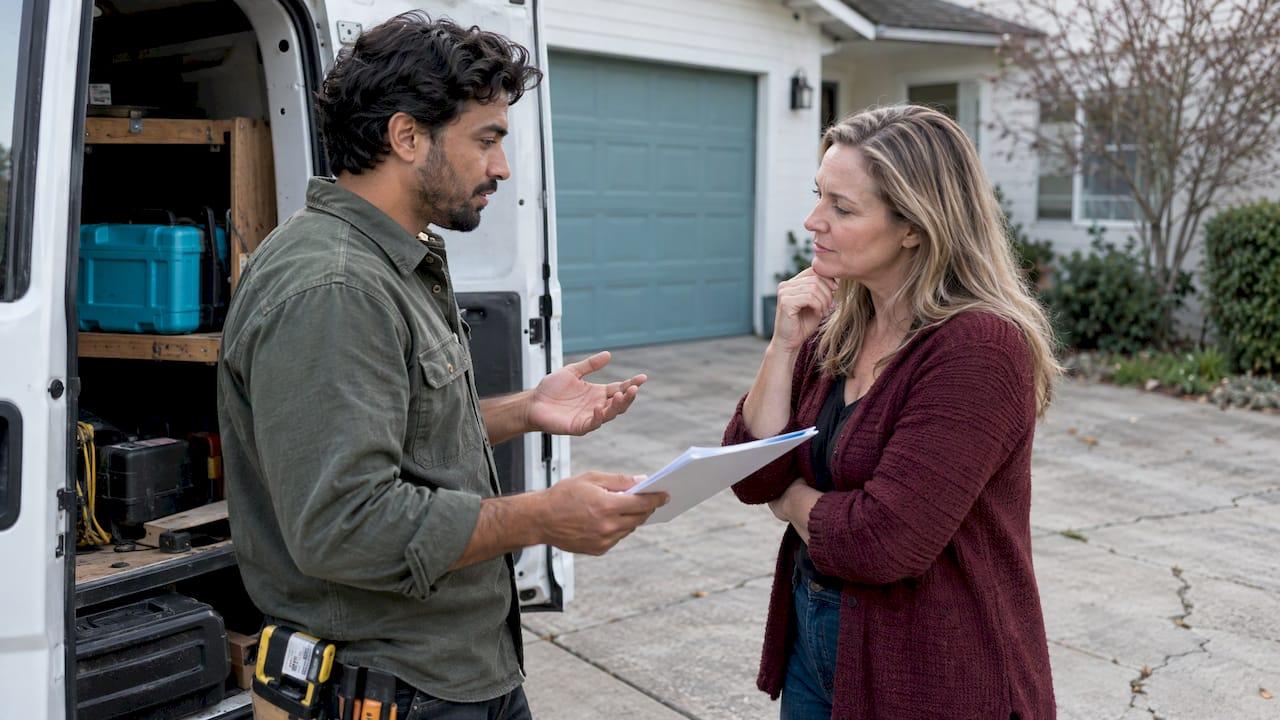
You can charge for estimates, and for some jobs you should. A quick ballpark over the phone can stay free. Once you drive out, measure, check prices and write a real proposal, you are doing paid work. The fix is not to charge everyone. Charge when the work takes real time, say so before you book the visit, and credit the fee back when the customer hires you.
This guide covers when to charge, what fee structures look like, how to say it without losing the job, and how to keep it legal.
TL;DR
- A rough ballpark can be free. A site visit with measuring and pricing is a proposal, and it should not be free.
- Free estimates fit simple, defined jobs. Charge for diagnosis, inspections, design work, and big jobs that take hours to price.
- Tell the customer the fee before you schedule, and credit it toward the job if they hire you.
- Screen by phone and photos first so you only spend drive time on serious customers.
- Some places, like New York City, require you to disclose a fee before you prepare the estimate.
Table of Contents
- Free estimate, paid estimate, diagnostic, inspection: what is the difference?
- Why free estimates became normal, and why that is changing
- When it makes sense to charge
- Screen first: the 10-minute phone check
- How much do contractors charge for estimates?
- Credit the fee back
- What to say to the customer
- Know your local rules
- Keep the paperwork straight
- A simple policy you can use tomorrow
- Our view: the estimate is where the job gets won
- Send the quote, get paid, ask for the review
- FAQ
- Sources
Free estimate, paid estimate, diagnostic, inspection: what is the difference?
Much of the argument about charging comes from mixing up four different things. Sort them out first, and the answer for most jobs gets easy.
- Estimate or quote: a price for a job that is already fairly well defined. You know what the customer wants. You measure, check material costs and write it up. (If you want the difference between an estimate and a proposal, we break it down here.)
- Diagnostic visit: you are finding out what is wrong. This takes time, tools and skill.
- Inspection: you check the condition of something against a list and report on it.
- Service call fee: a charge for sending a person and a truck to the property for a minimum amount of time. We cover this in our service call fee guide.
An electrician at Fox Electric explains it this way: an estimate prices a reasonably defined scope, an inspection documents condition against a checklist, and diagnosis traces the cause of a symptom through testing. A free sales visit to price a new panel is not the same as open-ended troubleshooting of a breaker that keeps tripping.
HVAC shows the split clearly. One Texas HVAC company says a free estimate makes sense when you already know you need a replacement, new install or upgrade, and the visit usually takes 30 to 45 minutes with a written itemized quote. The same company charges a $69 diagnostic fee when a system is not working, because finding the problem takes longer, and it applies that fee toward the repair if the customer goes ahead. That is one company's pricing, not a national rate, but the logic works anywhere.
Quick examples by trade
| Trade | Usually free | Usually worth charging for |
|---|---|---|
| Plumber | Pricing a water heater swap | Tracing a hidden leak, camera inspection |
| Electrician | Quote for a new outlet or EV charger | Finding why circuits trip, a whole-house check |
| HVAC | Quote for a new AC unit | Diagnosing a system that won't cool |
| Handyman | Fixing a door and a faucet | A multi-room remodel plan with several rounds of changes |
| Landscaper | Mowing and cleanup | Full design and planting plan for a yard |
| Cleaner | Flat-rate quote for a standard home | Post-construction or hoarding cleanouts that need a long walkthrough |
Why free estimates became normal, and why that is changing
Free estimates are an old habit in the building trades. Fine Homebuilding describes contractors treating estimating time as overhead, a cost of doing business. That works when most estimates turn into jobs.
For a solo operator it often does not. Every visit that goes nowhere costs you drive time, fuel and an hour you could have billed. One estimating-software company says a visit that does not become a job costs $150 to $200 in mileage and lost time. That is a vendor's figure, so run your own numbers: your hourly rate times the hours, plus the drive. If you lose three jobs in a week, that adds up fast.

There is also a middle ground that many shops use. Fine Homebuilding reports that contractors commonly give free estimates for minor work, like measuring a roof or pricing a front door, but charge for additions and other projects that need a lot of coordination and prep.
When it makes sense to charge
Charge when any of these are true:
- The job needs a long visit. Think more than an hour on site, or a lot of measuring and photos.
- You have to diagnose first. You are selling your knowledge, not just a price.
- You will do design or layout work. Drawings, material choices, several rounds of changes.
- The customer is shopping around. The Contractors Association says an estimate fee can screen out people who are not serious.
- The drive is long. A 45-minute trip each way changes the math.
And keep it free when the job is small, the scope is clear and you can price it from a photo and a short call. A free estimate is also a fair way to meet a new customer for repeat work.
Screen first: the 10-minute phone check
The cheapest way to avoid wasted visits is to qualify the customer before you go. Contractor Matt McCadden, quoted in Construction Dive, says it makes little sense to give a customer with unrealistic schedule or price expectations a couple of free hours when a phone call could have caught it.
Ask these before you book:
- What exactly is the problem or the job?
- Where is the property?
- Do you have a budget in mind?
- Who makes the final call?
- When do you want it done?
If you get solid answers to three or more, book the visit. If not, offer a ballpark by phone or text. Ask for three or four photos. A plumber can often price a toilet replacement from a picture of the shutoff valve and the old toilet. A landscaper can price a cleanup from a quick video walk-around.
If you want a way to price loosely without committing, give a range and say clearly that it is a ballpark. Then send a firm quote after you see the site.
How much do contractors charge for estimates?
There is no standard fee. What you will find is a few common structures:
- Flat fee. A set amount for the visit, like $50 or $100 for a simple site visit.
- Percentage of the project. Sometimes a small share of the estimated job cost, mostly on larger work.
- Hourly rate. Your normal rate for the time you spend.
- Credited deposit. A flat fee that is taken off the final bill.
Some figures from published sources, with dates so you can judge them:
- A 2007 Journal of Light Construction piece reported an on-site consultation fee of $20 to $35, depending partly on travel time, credited to the project when the customer went ahead. Prices have moved a lot since then, but the credit idea has not.
- A 2026 contractor guide suggests a residential example of $150 to $500, credited toward the final contract, with larger commercial or design-build estimates at $1,000 or more.
- For roofing, one Ohio roofer reports that paid inspections average $220 with a range of $75 to $600, and result in a condition report rather than a quote.
Your number should come from your own costs. A simple way to set it: add up your drive time, on-site time and the time you spend writing the quote. Multiply by your hourly rate. Many pros charge about half of that so the fee covers some of the cost without scaring people off. If you are still setting your rate, our guide to time and materials pricing walks through it step by step.
A word on the price of the fee itself: a customer who sees three contractors each charging $200 pays $600 before any work starts. That is the main complaint you will hear on contractor forums. It is why the credit matters so much.

Credit the fee back
Crediting is the easiest way to make a fee feel fair. The Contractors Association says you can credit the cost of the estimate into the cost of the project for prospects who become clients. The customer who hires you pays nothing extra. The one who doesn't has paid for your time.
Here is how it looks on paper:
- Estimate visit fee: $100, paid at booking.
- Job quote: $2,400 to replace a water heater.
- On the invoice: $2,400 minus the $100 estimate credit, so $2,300 due.
Put the credit as its own line on the quote and again on the invoice, so nobody has to remember it. Our contractor quote template shows how to lay that out.
What to say to the customer
Do this before you schedule. JLC's advice boils down to four points: explain the fee up front, say that the visit includes advice, measurements and a written proposal, state the price, and say that the fee is credited if they proceed.
Try a script like this on the phone:
"For a job this size I do a full on-site visit. It takes about an hour. I measure, look at everything, and send you a written quote with materials and labor. The visit is $100, and if you hire me, I take that off the final bill."
For a diagnostic:
"I charge $89 to come out and find what's wrong. If you want me to do the repair, that fee goes toward it."
A few tips that help:
- Say it early. Before the booking, not at the door.
- Say what they get. A written quote, advice, measurements.
- Keep it short. Do not apologize. You are not being rude; you are running a business.
- Offer a free option. "If you just want a rough range, send me photos and I can give you a ballpark by text."
- Send it in writing. A text or email with the fee and the credit terms avoids arguments later.
If a customer says no, that is fine. It is better to find out before you burn a Saturday. Our post on what to ask when a customer declines an estimate can help you learn something from it.
When a customer wants an itemized price, it helps to know what a good itemized quote looks like. This list of questions for an itemized quote is aimed at locksmith work, but the idea carries over: customers who ask what is included are easier to quote, and easier to win.
Know your local rules
The rules differ by city and state, and some are strict. Check with your state licensing board or local consumer agency. Two examples:
- New York City. The Department of Consumer and Worker Protection says licensed home improvement contractors must give a written estimate when asked, and may charge a reasonable fee only if they disclose the cost before preparing it. City rules for repair work also require you to disclose any separate service call charge before the call, and failing to do so is treated as a misleading practice.
- Illinois. The Home Repair and Remodeling Act requires a written contract or work order for work over $1,000, and it must include the total cost and any charge for an estimate.
The common thread is simple: tell the customer first, and put it in writing. That is good practice in every state. If you work somewhere that licenses contractors, ask your board whether estimate fees have special rules for your trade.
Keep the paperwork straight
A fee only works if the paper trail is clean. Keep these separate in your head and on your documents:
- Estimate fee: what you charge for the visit.
- Quote: the price for the job.
- Deposit: money to start the job or order materials. It is not the same as the estimate fee.
- Invoice: the final bill, with credits applied.
Mixing them up is how you get "I already paid you $100" arguments. Before you send a quote, run through our 15-minute checklist of common estimate mistakes. For smaller jobs, the handyman invoicing guide shows how to bill cleanly, and if a customer pays late, see what late payment interest you can charge.
A simple policy you can use tomorrow
Write your rule down once so you do not make it up for each call:
- Under about 30 minutes of work to price, or a clear scope: free, usually by photo or phone.
- Standard site visit for a defined job: free or a small credited fee, your choice by market.
- Diagnostic visit: flat fee, credited to the repair.
- Large or design-heavy job: paid estimate, credited to the contract.
- Always: tell them the fee before booking, and send it in writing.
After 30 days, count how many people booked, how many dropped out, and how many hired you. If drop-off is high and your hire rate is the same, you are filtering out only the time-wasters. If your hire rate falls, lower the fee or make the credit clearer.
Our view: the estimate is where the job gets won
We build Quotewren for solo operators, so we see the same pattern a lot. The trade pro who does great work but sends the quote three days late loses to the one who sends it from the driveway.
Whether you charge for the visit or not, speed and clarity win. A fee with a clear credit, a quote that looks professional, and a payment link on the invoice make you look like a business customers can trust. That trust is what turns a one-time visit into a job and then into a Google review.
We designed Quotewren to keep this simple: a branded quote, an invoice you can make from the approved quote, and automated review requests after the job is done. No big-team features to learn. Just the steps a one-person shop actually uses.
jaras
Send the quote, get paid, ask for the review
Charging for an estimate is one step. What happens after decides whether you get paid and whether you get found. Quotewren is quoting, invoicing and review-request software built for solo trades. You can build a branded quote, turn it into an invoice with a pay link, and send a three-touch text review request after the job.

There is a Free plan at $0, the Quotewren plan at $19 per month, and Quotewren Crew at $39 per month. See the plans and start with Quotewren. If you just want a layout to start with, grab a free quote template or the handyman quote template.
FAQ
Is it rude to charge for an estimate?
No. You are charging for your time and your knowledge. It only feels rude when it comes as a surprise. Tell the customer the fee and what they get before you book, and offer to credit it if they hire you.
Can I charge for an estimate and then apply it to the job?
Yes. This is common, and the Contractors Association describes it as a way to credit the estimate cost for customers who become clients. Show the credit as its own line on the quote and the final invoice.
How much should I charge for an estimate?
There is no set rate. Start with your hourly rate times the drive, visit and writing time, then charge about half of that or a flat fee that matches the job size. Residential flat fees in published guides range from about $150 to $500 on larger work, and small jobs often stay free.
Is a diagnostic fee the same as an estimate fee?
No. A diagnostic fee pays for finding the cause of a problem. An estimate prices a job you already know about. Many shops charge for the first and credit it to the repair, while keeping simple quotes free, as one HVAC company explains.
Do I have to disclose an estimate fee in advance?
In some places, yes. New York City, for example, lets licensed contractors charge a reasonable fee only if they disclose the cost before preparing the estimate. Check your state or city rules, and tell customers up front everywhere.
Sources
- Should your business be charging clients for project estimates? (Construction Dive)
- Should Builders Provide Free Estimates? (Fine Homebuilding)
- Charging for Estimates (Contractors Association)
- Electrical Estimate vs. Inspection vs. Diagnosis (Fox Electric)
- Free AC Estimate vs $69 Diagnostic Fee (KAC Express)
- How to pre-qualify a customer before you quote (JobEstimator)
- Business (Journal of Light Construction)
- Should You Charge for Estimates? 2026 Contractor Guide (N&T Tax & Advisory Group)
- Roofers With Free Estimates Near Columbus (Exterior Alliance)
- Home Improvement Contractor Tips (NYC Department of Consumer and Worker Protection)
- NYC Rules § 2-255 Disclosure Required for Repairs
- 815 ILCS 513/15 (Illinois General Assembly)
- 5 Questions to Get an Itemized After Hours Locksmith Quote