
Sometimes. A customer's spoken "go ahead" can be a real, enforceable contract in the United States. But it is hard to prove, and some states and job types require writing no matter what the customer said. If you are a solo plumber, electrician, HVAC tech, handyman, landscaper or cleaner, the safe habit is simple: treat a verbal yes as a green light to confirm in writing, not as the finish line.
This guide explains when verbal approval holds up, when it does not, and a 60-second way to turn a yes on the driveway into proof you can use. It is general information, not legal advice. For a specific dispute, talk to a lawyer in your state.
TL;DR
- A verbal approval can be a binding contract if it has a clear offer, clear acceptance, something of value exchanged, and both sides meant to be bound.
- "Binding" and "provable" are different. If the customer later says "I never agreed," you need more than your memory.
- Some states require written contracts or signed change orders for home work above a set dollar amount. California's line is $500, and Indiana's is $150 for certain residential improvements.
- A vague "sure, do what you need" is much weaker than "yes, add the second outlet for $185 and finish Thursday."
- Within minutes of any verbal yes, send a short written recap by text or email and ask for a reply.
Table of Contents
- What makes a verbal approval binding
- Binding is not the same as provable
- When the law says it must be in writing
- Verbal approval on the job: what to do in each situation
- The 60-second confirmation text
- Are digital signatures and texted approvals legal?
- What we think
- Make the paper trail part of the job
- A short checklist to keep in the truck
- FAQ
- Sources
What makes a verbal approval binding
The law does not care much about whether words were spoken or typed. Oral contracts are generally enforceable, though statutes limit that in some cases. What matters is whether the conversation added up to a contract.
An express contract needs these pieces:
- A definite offer. You said what you would do, for what price or pricing method.
- Unconditional acceptance. The customer said yes without strings attached.
- Mutual intent to be bound. Both of you understood this was a deal, not a maybe.
- Consideration. Something of value on each side: your work, their payment.
- A legal purpose and parties who can contract.
Notice the word "definite." The yes is only as strong as the terms behind it.
Strong yes versus weak yes
| What the customer said | Why it is weak or strong |
|---|---|
| "Sure, fix whatever you find." | Weak. No scope, no price, no limit. |
| "Go ahead." (after you mentioned a problem) | Weak. Go ahead with what? At what cost? |
| "Yes, swap the water heater valve and the shutoff for $240. Do it today." | Stronger. Scope, price and timing are all there. |
| "Yes" plus a text from you listing the same details and a "Sounds good" reply | Strongest. You now have a record. |
For a tradesperson, "go ahead" is much weaker than agreement on the exact added work, price (or how it will be priced) and timing. That is the gap where most payment fights start.
Binding is not the same as provable
Even a valid oral deal can be a headache. The Florida Bar explains that offer, acceptance, consideration, capacity and legality all matter, and it warns that oral contracts are harder to prove. It also notes that Florida gives you less time to sue on an oral contract than on a written one. That last point is specific to Florida, so check your own state's deadline.
The Bar's practical advice is that writing is better even when an oral deal is legal, because it removes arguments about terms. For a solo contractor the lesson is plain: don't give the customer room to remember the conversation differently.
Here is how that plays out.
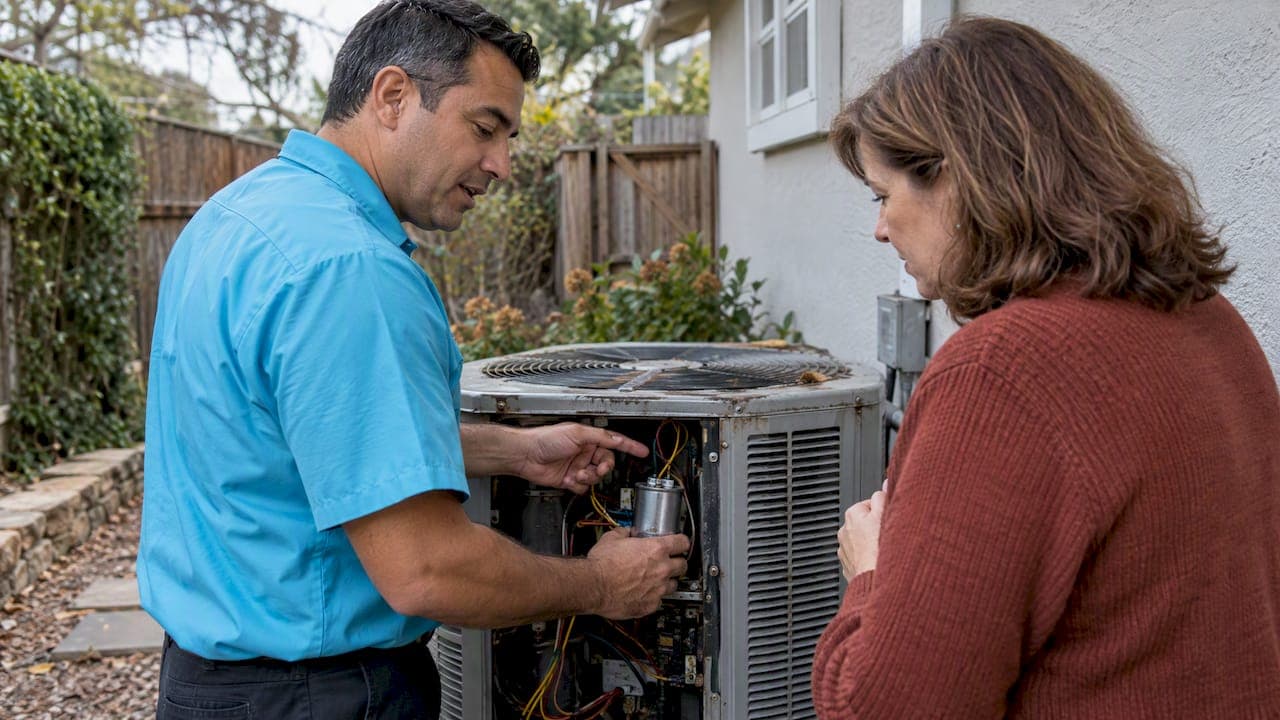
Example: the HVAC add-on. You are replacing a condenser fan motor. While you are in the unit, you find a failing capacitor. You tell the homeowner it is $95 extra. She says "okay." Two weeks later she disputes the invoice: "I only agreed to the motor." With no text, no note and no signature, it is your word against hers. A one-line text sent right after, "Adding capacitor, $95, total now $610," changes that.
When the law says it must be in writing
Many tradespeople assume the answer is the same everywhere. It is not. Three layers can apply to one job.
1. The general writing rules (Statute of Frauds)
Every state has rules that require certain agreements to be in writing. Common categories include land transfers, leases longer than one year, and deals that cannot be performed within a year. For sales of goods, the Uniform Commercial Code generally calls for written evidence at $500 or more, as Cornell's Legal Information Institute outlines. States differ on details and exceptions.
That $500 number trips people up. It is a rule for sales of goods. It is not a universal cutoff for labor or home-service work. If you mostly sell labor, such as cleaning, lawn care or troubleshooting, this rule may not be the one that applies to you. If you sell and install a water heater or a furnace, it might.
2. State home-improvement laws
This layer is the one that bites solo contractors. States often have separate rules for residential work, and they can be stricter than general contract law.
- California. The Contractors State License Board's consumer guidance says home-improvement projects of $500 or more in combined labor and materials need a written contract. Changes to the contract, called change orders, must be in writing and signed by both parties. The guide also says the contract should name the work, materials, price, payment schedule, dates, permits and cancellation rights. It cites a down-payment limit of $1,000 or 10% of the contract price, whichever is less, with stated exceptions.
- Indiana. A 2024 Court of Appeals decision, Balash v. Mader, dealt with Indiana's home improvement statute. Under it, residential improvement work over $150 needs a written, signed contract, and the contractor there could not enforce the oral agreement.
- Florida. Verbal job acceptance can be binding when it meets ordinary contract requirements and is not a type the law requires in writing, according to the Florida Bar. That is Florida's explanation, not a rule for every state.
The point is not to memorize these. The point is that a customer clearly saying yes can still leave you unable to collect, because the law wanted a signed paper. Check your state's contractor licensing board or attorney general site for home-improvement contract rules before you rely on any spoken deal.
3. Your own contract
If your signed agreement says changes must be written, a verbal change may not stick. Under the UCC for goods contracts, a failed oral change might still work as a waiver, but the person who gave the waiver can generally take it back with reasonable notice unless the other side already relied on it. Treat that as a narrow fallback, not a plan.
Verbal approval on the job: what to do in each situation
Situation A: Before the job starts
A customer says "yes, book me in" after your estimate. Whether it is binding depends on your price, scope and state. Don't guess. Send a written quote and get it accepted. Our contractor quote template shows the fields to include, and the free handyman, HVAC and cleaning templates are a fast start.
A quick word on terms, because people mix them up:
- An estimate is your best guess of the price. It may change.
- A quote is a fixed price for a defined scope.
- A deposit is money paid up front toward the job.
- An invoice is the bill after or during the work.
Asking a customer to approve an "estimate" that is really a guess invites a fight later. If you want the price to hold, call it a quote and say how long it is good for.
Situation B: Extra work found mid-job
This is where verbal approvals cause the most trouble. A plumber opens a wall and finds corroded pipe. An electrician finds an old panel that is not up to code. A landscaper hits a buried irrigation line.
Do this:
- Stop and show. Take a photo of the problem.
- State the add-on plainly. What you will do, what it costs, and how much it moves the schedule.
- Get the yes. Spoken is fine in the moment.
- Write it down right away. Text or email the same words back.
- Get a reply or a signature where your state or contract needs one.
We cover the details in our change order process guide.
Situation C: The customer says yes, then goes quiet
A yes with no deposit and no paper is the weakest spot. If you ordered materials, you may be out money. Ask for a deposit when you buy special-order parts, and make the refund terms clear up front. Our deposit refund policy guide has wording you can borrow. Mind your state's cap on deposits where one exists, as California's does.
Situation D: The customer disputes the bill
Stay calm and go to your records: the quote, the texts, the photos, the dates. A clear paper trail often ends the argument before it starts. If it doesn't, see our invoice dispute scripts.
The 60-second confirmation text
You do not need legal language. You need five things in plain words: who, what, how much, when, and a yes from them.
Hi Maria, this is Dan from Dan's Plumbing. Confirming what we talked about: replace the kitchen shutoff valves and add a new supply line for $240, on top of the faucet install. New total is $520. I can finish today. Reply YES to approve.
Why this works:
- It repeats the scope and price in your words.
- It has a timestamp.
- The customer's reply is their own written approval.
- It takes less time than a spoken goodbye.
Save a screenshot of the thread to the job record. Don't rely on your phone alone, since phones get lost and texts get deleted.
Are digital signatures and texted approvals legal?
In general, yes. The federal ESIGN Act says a signature or contract may not be denied legal effect solely because it is electronic, and states have their own electronic signature laws as well. That means a signed quote on a phone can carry the same weight as paper, subject to the same questions about whether the person really agreed.
A few cautions:
- A text reply of "ok" is better than nothing, but a signature on a document with a clear scope and price is stronger.
- Some documents have special rules. If your state requires specific notices, such as cancellation rights, a plain text will not cover them. Use the full written contract.
- If the customer might claim it was not them, a signed document sent to their own phone or email helps show who approved.
For on-site work, many solos use a phone to pull up the quote, hand the phone to the customer, and have them sign or reply right there. However you do it, keep a copy.
What we think
We built Quotewren for people who work alone and have no office manager. Most solo trades don't lose money because the work was bad. They lose it in the gap between "sure, go ahead" and "pay this invoice." A customer who said yes in the driveway feels differently three weeks later when the bill shows up.
Our view is that the legal question, "was it binding?", is the wrong first question. The better question is: "Could I show a stranger what we agreed to in under a minute?" If the answer is yes, most disputes never reach a lawyer, because the customer sees the same record you do.

That is why we keep the paper trail short. A quote that names the scope and price. An invoice that matches it. A change written down the moment it happens. And after the job, a polite nudge for a Google review while the customer is still happy. Nothing fancy, just a habit you can keep when you are tired and wet and your next job starts in an hour.
We also think the cost of this should stay low. A solo operator does not need a system built for a fleet of trucks.
— jaras
Make the paper trail part of the job
If typing quotes and recaps at night is what keeps you from doing this, that is the problem to solve. Quotewren turns finished jobs into branded quotes, then invoices with pay links, and sends a three-touch review request by SMS after the job is done. The Free plan costs $0, the Quotewren plan is $19 per month, and Quotewren Crew is $39 per month. You can see the plans and try it and decide if it fits how you work.
A short checklist to keep in the truck
- Know your state's rule for written home-improvement contracts and the dollar line where it starts.
- Send a written quote for every job, and use the word "quote" only when the price is firm.
- Put scope, materials, price, schedule and payment terms on it.
- Write down every change the moment it happens, with the new total.
- Ask for a signature or a reply, not just a thumbs-up in person.
- Keep photos, texts and signed documents with the job.
- Avoid common slips by running through our 15 minute estimate checklist.
FAQ
Is a verbal agreement binding?
Often yes, if it has a clear offer, acceptance, something of value and intent to be bound. Oral contracts are generally enforceable, but statutes can require writing for certain deals. Proving the terms is the hard part.
Is a verbal job acceptance legally binding?
It can be, if the customer agreed to specific work at a specific price and the job is not one your state requires to be in writing. Many states require written contracts for home improvement above a set dollar amount. A vague "go ahead" is much harder to enforce than a clear yes to defined work.
Can I change a contract with a verbal okay?
It depends on the state and on your contract. California, for example, says change orders must be written and signed by both parties for home-improvement contracts. Even where oral changes are allowed, a written confirmation protects you.
Does a text message count as approval?
Usually it can serve as evidence, and federal law says electronic records are not invalid just because they are electronic. A reply that repeats the scope and price is strong evidence. If your state requires a signed contract or notices, a text alone may not meet the rule.
Sources
- Cornell LII: oral contract
- Cornell LII: express contract
- California Contractors State License Board: What You Should Know Before Hiring a Contractor
- The Florida Bar: Legal and Binding Contracts
- Cornell LII: UCC 2-209, Modification, Rescission and Waiver
- Indiana Court of Appeals: Balash v. Mader
- Wikipedia: Electronic Signatures in Global and National Commerce Act