

Credit card surcharges are legal in most U.S. states, but a handful still ban them outright, including Connecticut, Massachusetts, Maine, and Puerto Rico. Card networks add their own hard limits on top of state law: Visa caps surcharges at 3%, Mastercard caps them at 4% or your actual processing cost, whichever is lower, and neither allows a surcharge on debit or prepaid cards. Before you add a line item to a single invoice, do three things:
- Confirm your state actually permits surcharging
- Notify your card processor, usually 30 days ahead
- Itemize the surcharge separately on every receipt
Quick fact: processing fees typically run 2% to 3% per transaction, which is the number most contractors use as their starting point for pricing a surcharge.
Key Takeaways
Surcharging is legal in most states but capped by card networks at 3% to 4%, banned on debit and prepaid cards, and off-limits entirely in Connecticut, Massachusetts, Maine, and Puerto Rico.
| Point | Details |
|---|---|
| Verify your state first | Check your state attorney general's site and the NFIB chart before adding any surcharge. |
| Respect network caps | Stay at or below Visa's 3% or Mastercard's 4%, and never surcharge debit or prepaid cards. |
| Notify your processor | Give your acquirer roughly 30 days' notice and itemize the surcharge separately on receipts. |
| Consider cash discounts | Offer the same discount to every customer and disclose both prices clearly to skip surcharge rules entirely. |
| Keep invoices clean | Quotewren lets you itemize a surcharge line or build an all-inclusive quote, then auto-follows up for reviews after payment. |
Table of Contents
- Understanding Credit Card Surcharge Rules: Federal, State, and Network Layers
- Which States Ban Surcharges, and How to Check Yours
- What Visa, Mastercard, and Other Networks Actually Allow
- How to Set Up a Legal Surcharge, Step by Step
- Why Many Tradespeople Choose Cash Discounts Instead
- Invoice Examples and Do's and Don'ts for Trades
- What the Rulebook Gets Wrong for Solo Contractors
- Get Your Invoices Surcharge-Ready With Quotewren
- Sources
- FAQ
Understanding Credit Card Surcharge Rules: Federal, State, and Network Layers
Nobody hands you one rulebook for this. You're actually dealing with three separate layers of rules, and they all have to line up before you charge a customer an extra fee.
- Federal law doesn't ban surcharging outright, but it does protect debit and prepaid cardholders. You cannot surcharge those transactions, period.
- State law decides whether surcharging is allowed at all in your area, and some states set their own caps below what the card networks allow.
- Card network rules (Visa, Mastercard, Discover, American Express) layer on top, setting maximum percentages and requiring you to notify your processor and disclose the fee to customers.
If your work takes you across state lines, like an HVAC tech who services three counties that straddle a state border, follow the strictest rule that applies anywhere you operate. On top of all three layers, merchants are on the hook for basic disclosure and for refunding the surcharge whenever the underlying charge is refunded. Skip any one of these and you risk a fine, a chargeback dispute, or a call from your processor asking why you're out of compliance.
Which States Ban Surcharges, and How to Check Yours
Surcharge law is a patchwork, and it shifts more often than most contractors realize. As of now, surcharging is prohibited in Connecticut, Massachusetts, Maine, and Puerto Rico. Other states allow it but impose their own twist, like Colorado's cap of 2% or actual cost, whichever is lower, which is tighter than the network maximums.
Don't take any list at face value, including this one. Verify your state's current status before you touch your pricing:
- Check your state attorney general's consumer protection page for the latest guidance
- Cross-reference the NFIB's state-by-state surcharge chart, which tracks caps, disclosure rules, and recent changes
- Call your payment processor directly and ask them to confirm your state's rule in writing
Pro Tip: If you work multiple states or take jobs near a state line, apply the strictest rule to your whole business. It's a lot easier than tracking two different pricing systems on every invoice.
What Visa, Mastercard, and Other Networks Actually Allow
Even in a state where surcharging is legal, the card networks still control the ceiling. Get this wrong and you're not looking at a state fine, you're looking at your merchant account getting flagged or shut down.
- Visa limits surcharges to 3% of the transaction
- Mastercard sets a 4% maximum surcharge cap, or your actual processing cost if that's lower
- Debit and prepaid cards cannot be surcharged under any network's rules, full stop
- You must notify your acquirer or processor, typically 30 days before you start surcharging
- The surcharge has to appear as its own line item on the receipt, never folded into the price
Mastercard's rules have allowed this kind of surcharging since 2013, but the disclosure and notification requirements haven't gotten any looser since then.
How to Set Up a Legal Surcharge, Step by Step
Once you've confirmed your state allows it, here's the order of operations that keeps you clean:
- Verify legality for your exact location. Check the state, and if you cross state lines, apply the toughest rule among them.
- Set your surcharge amount. Base it on your actual processing cost, usually 2% to 3%, and never exceed your state cap or the network cap, whichever is lower.
- Notify your processor. Most require 30 days' notice before you start.
- Configure your point-of-sale or invoicing software to automatically detect debit and prepaid cards and exclude them, and to show the surcharge as its own line item.
- Post signage at your point of entry and point of sale, and add the same disclosure to your website and any online invoice.
- Train yourself or your crew to explain the fee if a customer asks, and to reverse the surcharge automatically on any refund.
Pro Tip: Refunding a job but forgetting to reverse the surcharge is one of the fastest ways to get a customer complaint escalated to your card network. Build the reversal into your refund process from day one.
Your processor's own merchant agreement can also be stricter than state or network rules, so read that contract before you assume you're clear.
Why Many Tradespeople Choose Cash Discounts Instead
A cash discount is the mirror image of a surcharge: instead of adding a fee for card payments, you set a slightly higher list price and knock a percentage off for cash or check. Card networks treat the two very differently. Surcharges are heavily regulated; cash discounts are generally allowed nationwide as long as you follow a few basic rules.
- The discount must be offered to every customer, not selectively
- It has to be clearly and conspicuously disclosed before payment, per NFIB guidance
- Some states require you to post both prices side by side, the cash price and the card price
A sign that reads "Cash price: $180 / Card price: $185" satisfies most state requirements. Many solo contractors skip the dual pricing altogether and just roll the processing cost into one flat quote. It's one price, no fee conversation on the customer's porch, and no risk of a surcharge violation anywhere you operate.
Invoice Examples and Do's and Don'ts for Trades

Card processing fee: $10.00. Total due: $410.00.** If the customer pays cash, that fee line disappears entirely. If you later refund the job, refund the $10 fee too, not just the $400.
A few do's and don'ts worth pinning above your desk:
- Do put the surcharge on its own line, never buried in the subtotal
- Do post a sign at your shop or job-site entry stating the surcharge percentage
- Don't surcharge a debit card transaction, even by accident
- Don't assume a surcharge that was fine last year is still fine this year, since processing fees averaging 2% to 3% and state laws both shift
For smaller jobs, like a handyman's $120 fence repair or a cleaning service's monthly contract, it's often smarter to skip the visible surcharge entirely and build the cost into your quoted rate. Customers remember the fee line longer than they remember the job quality, and repeat business is worth more than an extra few dollars per invoice. Quotewren's itemized quote and invoice templates make it simple to add a separate surcharge line when you need one, or to build processing costs into a clean, all-inclusive number when you don't.
What the Rulebook Gets Wrong for Solo Contractors
Most surcharge guides are written for retail chains with legal departments, not for a one-truck electrician trying to close out a job before dinner. That's the real gap here: the compliance steps aren't hard, but they're scattered across three different sources (your state, your network, your processor), and nobody hands a solo operator a single checklist.
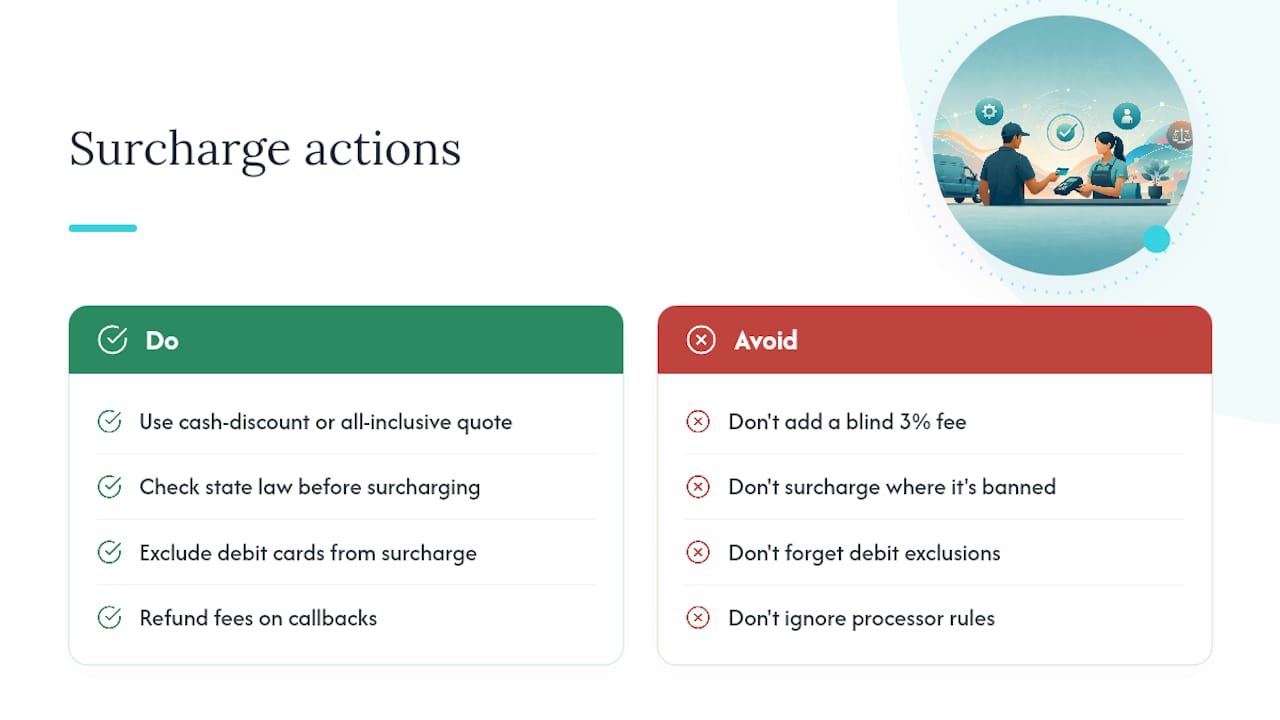
The conventional advice, "just add 3% for card payments," skips the part that actually gets contractors in trouble: forgetting to exclude debit cards, forgetting to refund the fee on a callback, or surcharging in a state that quietly changed its law last year. Those are the mistakes that turn into chargebacks and processor headaches, not the math itself.
If you take one thing from this, prioritize the cash-discount or all-inclusive quote path first. It sidesteps almost every compliance trap discussed here, and for a solo operator without time to babysit state law changes, that simplicity is worth more than the extra percentage a surcharge might recover. Save surcharging for when your margins genuinely need it and you're confident you can maintain the paperwork behind it.
— jaras
Get Your Invoices Surcharge-Ready With Quotewren
Getting the surcharge line right on every invoice, and getting it reversed correctly on every refund, is exactly the kind of detail that's easy to fumble when you're running a business solo. Quotewren builds that structure in from the start: itemized quotes and invoices that keep processing fees on their own line, integrated pay links so customers can pay however they want, and clean, all-inclusive pricing when you'd rather skip the surcharge conversation entirely.

It also handles the part most contractors let slide: asking for a Google review after the job's done. Once an invoice is marked paid, Quotewren's review-request flow follows up automatically, so you're not the one remembering to send that text three days later. If you're tired of chasing payments and chasing reviews separately, start a free trial of Quotewren and send your next quote with the surcharge line built in correctly the first time.
Sources
- NFIB: Credit Card Surcharge and Cash Discount Laws (chart and guide)
- Mastercard merchant surcharge rules
- Average credit card processing fees (WalletHub, 2026)
- Maine government consumer guidance on surcharges
FAQ
Are Credit Card Surcharges Legal in All States?
No. Surcharging is banned in Connecticut, Massachusetts, Maine, and Puerto Rico, while most other states allow it under card network limits.
What Is the Maximum Surcharge I Can Charge?
Visa caps surcharges at 3%, and Mastercard caps them at 4% or your actual processing cost, whichever is lower.
Can I Surcharge a Debit Card Payment?
No. Surcharging debit and prepaid cards is prohibited under every major card network's rules, regardless of your state.
How Is a Cash Discount Different From a Surcharge?
A cash discount lowers the price for cash or check payers instead of raising it for card payers, and it faces far fewer state restrictions than surcharging.
Do I Have to Notify My Processor Before Surcharging?
Yes. Most processors require about 30 days' notice, and you must also itemize the surcharge separately on every receipt.
Can Quotewren Help Me Itemize a Surcharge on Invoices?
Yes. Quotewren lets you add a separate surcharge line item on quotes and invoices, or build processing costs into one flat, all-inclusive price.